Search the blog
Abstract
What must people become capable of, and what must institutions permit them to do, if artificial intelligence is to enlarge human freedom? This monograph examines the Inner Development Goals through that joint question. It treats Being, Thinking, Relating, Collaborating and Acting as a revisable vocabulary for inquiry, while distinguishing the current Guide from earlier versions and from experimental claims about particular interventions. The argument combines comparative ethical interpretation, a critical interdisciplinary literature review, descriptive data and conditional scenarios. Twenty-five university research collections form an explicitly declared search frame; public institutions and scholarship beyond that frame supply necessary counterperspectives. Library access, publication versions and reading limits are documented separately from substantive conclusions.
The central argument distinguishes capacities, opportunities and action, defends unconditional standing, and proposes bounded hypotheses about interactions between cultivation and external conditions. Reflection needs time and access to evidence; care needs provision and accountability; collaboration needs standing and permission to dissent; action needs resources and institutions capable of correction. AI can help people exercise these capacities while also concentrating the means through which they become economically and politically consequential. Evidence about productivity, trust, cooperation and resistance therefore requires distinctions between task performance and learning, association and causation, wage and wealth inequality, and historical frequency and future probability. The monograph rejects a numerical forecast of humanity's future unsupported by an identified probability model. It instead specifies favourable and adverse pathways, their conditions and the observations that would change their assessment. Its contribution is a framework for evaluating the relation between human development and institutional power, together with a research programme that could test parts of that relation without turning a contested vision of a good life into a universal score.
Contents
- Abstract
- 1. Introduction: who can act on a developed judgement?
- 2. Method and the kinds of claims this paper can support
- 3. A situated project, rather than the destination of history
- 4. Being and Thinking: development without an idealised self
- 5. Relating: from sentiment to the organisation of care
- 6. Collaborating: the organisation of shared judgement
- 7. Acting: responsibility beyond resolve
- 8. Cultivation, exclusion and the institutions of human possibility
- 9. AI, human agency and the organisation of work
- 10. Education, knowledge and culture: retaining the means to judge
- 11. Western societies, contested belonging and democratic agency
- 12. Wealth, ownership and the arrival of a reported trillionaire
- 13. The material conditions of a practicable agency
- 14. Law, institutional judgement and the standing to dissent
- 15. Dissent, developed judgement and democratic legitimacy
- 16. Futures for human agency: pathways, conditions and limits of prediction
- 17. A research programme for reciprocal development
1. Introduction: who can act on a developed judgement?
A person can understand a problem and still be unable to change it. A worker may recognise that an automated decision is unfair yet lack permission to question it. A citizen may think carefully about a public service but find that the relevant information is unavailable. A community may care for a landscape while another organisation controls its use. These are illustrative situations rather than observations from a new field study. They expose a difficulty that any account of inner development must address: the cultivation of judgement and the possession of consequential power are different achievements.
The distinction also works in the other direction. A formal right to participate can be difficult to exercise when people cannot understand the issue, distrust one another or have learned that disagreement always ends in humiliation. Institutions can grant a speaking opportunity without creating a useful conversation. A person with economic security can use it thoughtlessly. A technically accessible collection can contain evidence that remains hard to interpret. Neither the individual nor the institution is therefore a sufficient unit of explanation. We need to examine the relations through which a capacity becomes an opportunity, and an opportunity becomes an effective action.
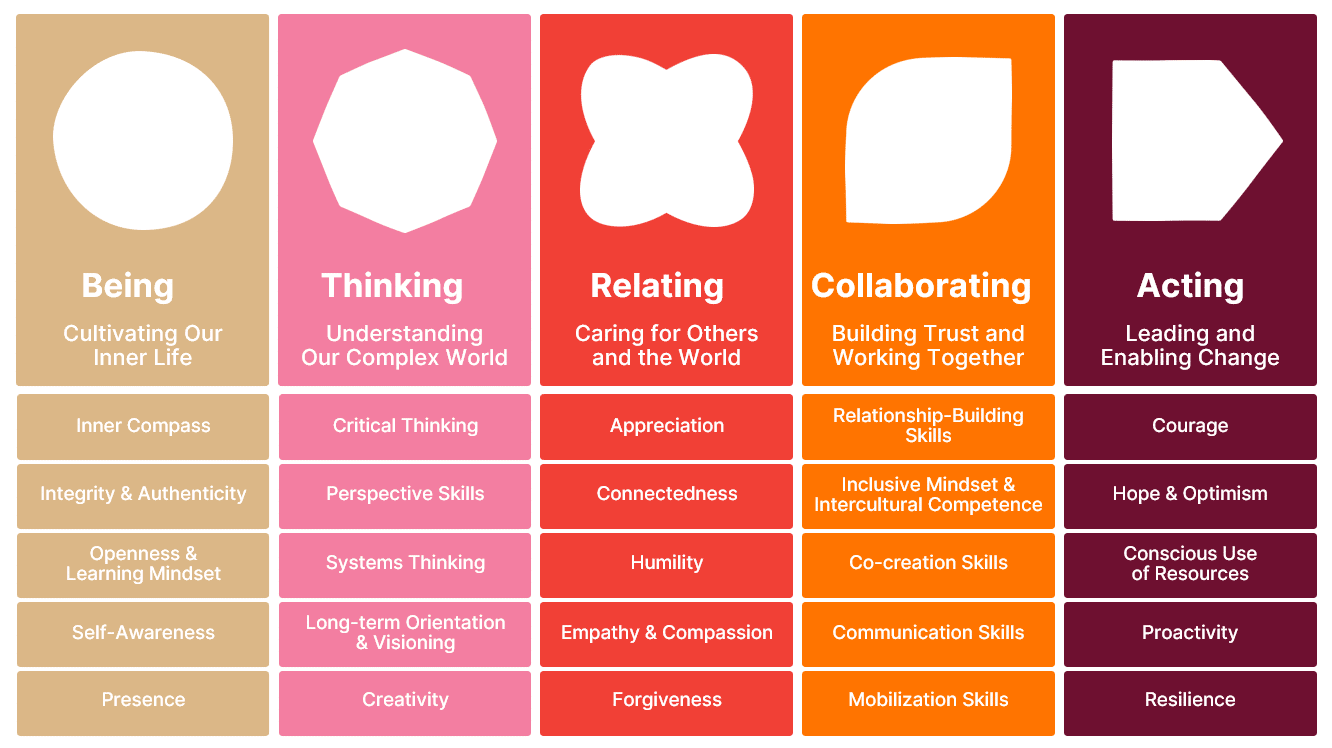
Inner Development Goals provides one contemporary vocabulary for this task. Its current Guide groups capacities within Being, Thinking, Relating, Collaborating and Acting. The documented framework has changed: the 2025 Guide contains twenty-five capacities, whereas earlier materials contained twenty-three. It describes itself as a living resource and understands development in relational and systemic terms. These features make revision and criticism part of a faithful reading of the framework, rather than an attack on its purpose. [IDG001; IDG003; IDG004]
The difficulty is how to interpret the promise. A capacity can be valuable without being precisely measurable. A measurable change can occur without making a society more just. A desirable social outcome can result from a rule or material investment rather than a change in a participant's self-description. Conversely, an immediate outcome measure may fail to recognise the importance of courage, attention or a relationship that enables action years later. An adequate inquiry must preserve these possibilities rather than settle them by definition. If development means whatever produces desirable outcomes, every favourable result confirms it. If desirable outcomes are whatever developed people choose, the theory becomes circular.
This monograph accordingly asks a narrower but demanding question: under what institutional conditions can the capacities named by IDG support human agency and democratic flourishing as AI changes knowledge, work, wealth and dissent? The question contains several objects that cannot be collapsed into one. Human agency concerns people's ability to understand, choose and act for reasons they can examine. Democratic flourishing concerns arrangements through which affected people can participate, contest authority and live with disagreement. Wealth concerns control over economically valuable assets and the security or influence that control may confer. AI concerns a changing collection of systems and their uses, rather than a single actor with one intention. None of these definitions settles every philosophical controversy. They identify the distinctions on which the argument depends.
The original proposition developed here is that inner capacities and external conditions can jointly shape effective agency through identifiable mechanisms. This separates an analytical distinction, a normative commitment to standing and contingent causal hypotheses; it does not assert an interaction in every case. A capacity has an outward history: people learn within languages, practices, relationships and institutions. An institution has an inward dependence: people must interpret its rules, notice its failures and decide whether to sustain or revise it. The proposition is not a claim that everything causes everything. It directs inquiry toward identifiable relationships. Does access to an explanation alter the ability to challenge a decision? Does protected disagreement improve a group's use of evidence? Does income security enable a person to participate in a deliberation that otherwise consumes unaffordable time? Does a training practice affect conduct when the rewards for contrary conduct remain unchanged? Each question permits a more bounded investigation than an assertion that personal transformation will transform society.
AI intensifies the importance of these relationships because it can mediate both a person's capabilities and the surroundings in which they matter. An assistant can help formulate a question, translate a document or expose an alternative interpretation. The same class of system can also present a fluent answer that a user has little opportunity to check. An organisation can use a model to extend a service or to increase the distance between a decision and anyone who accepts responsibility for it. These are possible mechanisms, not claims that every deployment has the same effects. Their evaluation requires evidence about the particular task, people, interface, incentives and decision rights.
The ethical problem therefore extends beyond whether a machine resembles a human. A system may deserve no attribution of consciousness and still alter the conditions of human thought. A user may retain formal choice while relying on an environment that makes some choices difficult to imagine. A worker may become more productive without becoming more independent. A community may receive better information without receiving authority over what happens next. Philosophical debates about machine agency matter, but they cannot replace an examination of these changes in human relations. Nor should current uncertainty about machine consciousness be used to avoid responsibility for present institutional decisions.
The monograph gives particular attention to economic concentration. Its concern is not whether a large fortune is automatically illegitimate or whether technical innovation should be discouraged. The question is which relations of ownership, labour, public investment and governance permit the benefits of innovation to become widely usable. An estimate of aggregate wealth is not a measure of virtue. A rise in task productivity is not a finding that gains reach workers. A trillion-dollar valuation is not a trillion dollars available for spending. Distinguishing these objects makes it possible to discuss reported and prospective trillionaires without treating a compounding illustration as a forecast. Forbes had already reported the first trillionaire crossing in June 2026 and another crossing in October, so a future-only account would be outdated. Those are dated estimates of market-valued assets, rather than audited cash balances or measurements of how much AI caused a fortune. [ECO001; ECO002]
The same precision is necessary for dissent. Civil disobedience, peaceful assembly, nonviolent resistance, political rebellion and violence are not interchangeable categories. Their definitions can be contested without becoming meaningless. A historical dataset of sustained campaigns cannot supply a ratio of all acts of civil disobedience in a society when it neither records all such acts nor defines their denominator. A descriptive participation threshold cannot guarantee future success. The humanities must examine the moral claims and experiences of dissent; empirical research must identify the observations it actually counts; legal inquiry must distinguish protection, liability and justification. The chapters on resistance keep these tasks separate while showing how they bear on one another.
For Western societies, the resulting inquiry is about the capacity to sustain a contested identity. There is no single Western experience that can stand for different histories, institutions and populations. A defensible common aspiration would have to be argued for, not inferred from geographical membership. The position advanced here is that a society committed to public reason and equal standing should preserve the ability to contest its own self-description. Its identity is weakened when criticism can be dismissed as an absence of maturity, care or belonging. It can also be weakened when every shared obligation is treated as domination. The task is to give disagreement an institutional form in which people can oppose a decision without losing their standing as participants.
This argument has opponents worth taking seriously. An individual-centred account may insist that institutions ultimately reflect the capacities of the people who create them; change must therefore begin with personal transformation. A structural account may argue that development language diverts attention from ownership, law and coercion; good intentions cannot alter a distribution of power. A technological account may predict that increasing capability will solve coordination problems more effectively than slow cultural reform. A pluralist critic may reject the attempt to gather divergent traditions within any global developmental vocabulary. Each objection identifies a real danger. None establishes that its preferred unit of explanation can be sufficient in every setting. The chapters test the proposed reciprocal account against these objections rather than merely listing them before returning to the same conclusion.
The historical interpretation is deliberately non-teleological. People did not evolve through a sequence of incomplete moral traditions whose fulfilment is a contemporary framework. Different societies have cultivated judgement, duty, attention and relations for different purposes, often within arrangements that also produced exclusion. The value of comparison lies in exposing alternatives and tensions. It does not lie in collecting attractive phrases from distinct traditions until they seem to endorse a predetermined list. An account of inner development gains intellectual strength when it remains vulnerable to a tradition that questions its model of selfhood or its understanding of progress.
The future is approached with the same discipline. Best and worst cases are conditional descriptions, not bins into which a forecast assigns invented percentages. We ask what would make a pathway more or less plausible, which pressures interact and what observations would warrant changing an assessment. A favourable pathway needs more than benevolent users: it needs broadly accessible capabilities, contestable decisions, material security and institutions that can learn. An adverse pathway need not begin with an openly malicious objective. It can arise from incentives that reward dependency, concentrated ownership, repeated delegation of judgement and restrictions on correction. An intermediate pathway can mix real benefits with losses in autonomy and influence. The boundaries between these pathways remain objects of inquiry.
The paper is a research monograph rather than a report of a new experiment. It draws on primary academic publications, public datasets, historical materials, legal texts and institutional reports, while documenting version differences and retrieval limits. The twenty-five-university search frame is transparent but insufficient by itself: university rank cannot confer truth, and a collection's contents cannot represent all humanities scholarship. The evidence is therefore appraised by its methods and scope. The Library of Congress and public institutions contribute materials with distinct kinds of authority. A law establishes an obligation within its jurisdiction; a philosophical argument offers reasons; an observational study estimates a relation under specified assumptions. Treating all three as identical facts would make the bibliography larger while making the reasoning weaker.
The practical aim is to identify arrangements in which inner development can be examined through outward consequences without being reduced to a score. The proposed evaluation asks whether people gain the means to understand, to refuse, to participate and to seek correction. It also asks whether affected people can challenge the evaluator's account of improvement. These are normative criteria defended in the monograph, not a validated universal index. They provide a basis for a research programme that can fail honestly: some interventions may produce no change, some benefits may depend on context, and some uses of development language may become instruments of exclusion.
The strongest contribution a framework can make may be to keep that examination open. A society whose members are encouraged to become thoughtful, caring and capable of action must also let their thought, care and action alter its institutions. Otherwise development becomes an invitation to adapt oneself to decisions made elsewhere. A shared future requires conditions under which cultivated judgement can become a public reason and, when warranted, a consequential challenge.
2. Method and the kinds of claims this paper can support
The inquiry combines critical humanities interpretation with a structured interdisciplinary review. It asks how accounts of self-cultivation, care, judgement and collective action relate to the institutions through which people can exercise agency. It then examines how AI could change those relations. The work uses no new interviews, participant intervention or original administrative dataset. Its quantitative contribution consists of descriptive comparisons and explicitly specified arithmetic. Its substantive contribution is an argument about the conditions of effective agency, defended against competing interpretations and connected to a programme of further investigation.
A declared search frame, with limits
The university component uses the first twenty-five institutions in the QS World University Rankings 2027, retaining tied ranks. The frame fixes which collections were examined; it does not rank the truth of a claim or the quality of humanities inquiry. The ranking edition is identified because its year differs from the year in which it was released. Official institutional repositories, library access policies and public author or publisher copies were searched for relevant works. Source records identify each institution, the specific works selected, their access route and the parts inspected. [META001]
| QS 2027 rank | Institution in the declared collection frame |
|---|---|
| 1 | Massachusetts Institute of Technology (MIT) |
| =2 | Stanford University |
| =2 | Imperial College London |
| 4 | University of Oxford |
| 5 | Harvard University |
| 6 | University of Cambridge |
| 7 | California Institute of Technology (Caltech) |
| =8 | University College London (UCL) |
| =8 | ETH Zurich |
| 10 | National University of Singapore (NUS) |
| 11 | The University of Hong Kong |
| 12 | Nanyang Technological University, Singapore |
| 13 | Peking University |
| 14 | Tsinghua University |
| 15 | University of Pennsylvania |
| =16 | Yale University |
| =16 | Cornell University |
| 18 | The Chinese University of Hong Kong |
| 19 | University of New South Wales (UNSW Sydney) |
| =20 | Johns Hopkins University |
| =20 | University of California, Berkeley |
| =22 | École polytechnique fédérale de Lausanne (EPFL) |
| =22 | University of Melbourne |
| 24 | University of Chicago |
| 25 | Technical University of Munich |
Ranks identify the collection frame, with ties retained; they do not establish source quality or cultural representation. [META001]
A prestigious-institution frame is vulnerable to selection bias. It can favour English-language scholarship, institutions with substantial resources and subjects that fit their collection infrastructure. It can also reward accessible work over otherwise relevant work behind a restricted service. The study counters these tendencies with public institutions, intergovernmental assessments, non-Western philosophical materials and sources outside the ranked frame. These additions improve the range of perspectives; they do not establish that every intellectual tradition is represented. A source published in an institutional collection need not have been written by an affiliated scholar, and a current faculty page does not establish an author's affiliation when an older work was published.
The review is not a preregistered systematic review or a census of all scholarship. The question is too broad to justify that description without a reproducible database protocol, formal inclusion and exclusion criteria, duplicate screening and a recorded search flow. Instead, targeted searches selected works for relevance, identifiable methods, primary authorship and critical usefulness. The appendices preserve the search and access record so that a reader can see both the evidence used and important limitations. Citations to a record, an abstract or selected sections are labelled according to what was actually available. Downloading a long report does not imply that every page or supplementary analysis was read.
Access does not establish entitlement
Publicly accessible texts were preferred. Institution-published guest access was considered only within its declared terms. An on-site library terminal, an individually issued visitor account, an anonymous repository and a licensed remote service confer different rights. None was treated as interchangeable with the others. The study sought no private or leaked credentials and did not infer remote subscription rights from a public registration form. A blocked download was either replaced by a legitimate public author, repository or publisher version, or recorded as a gap.
This access record matters intellectually. The contents of a repository do not all have the same status: metadata may describe an inaccessible work, an embargoed manuscript or a later publication whose final pagination differs from the available copy. The bibliography accordingly distinguishes the publication being cited from the version inspected. If a manuscript carries provisional numbering, its pages identify that manuscript rather than the final article. An update to a catalogue page is not evidence that a study collected newer data. Where a correction affects a claim, the corrected interpretation takes priority over an earlier headline.
Four forms of reasoning
Historical interpretation examines a document in its setting and asks what its language permits us to understand. A programme, letter or statutory preamble can reveal an argument or aspiration; it cannot by itself establish how every participant thought or why a movement succeeded. The paper uses historical comparison to expose alternative relationships between cultivation and authority. It avoids a sequence in which earlier traditions are portrayed as incomplete stages leading inevitably to IDG.
Philosophical argument examines reasons, distinctions and objections. A claim that forgiveness should be voluntary, or that a person should be able to challenge a decision affecting them, requires a normative defence. A bibliography of empirical studies cannot eliminate that obligation. Conversely, a defended norm does not establish that an intervention reliably produces its intended consequence. The paper separates the standing of an ethical claim from the evidence for a practical means of realising it.
Empirical interpretation follows the study's unit, population, design and outcome. A survey association is kept distinct from an experimental contrast; a randomised task result from a claim about society; a repeated paper from an independent sample. A null or imprecise result is not treated as proof that no effect could exist. A significant effect on a selected measure is not expanded into every attractive consequence. The interpretation also asks whether the outcome has moral and practical relevance: agreement, productivity, trust, learning and political agency are different objects.
Legal interpretation identifies jurisdiction, legal status and time. An adopted statute, an implementing regulation, an official explanation, a judgement and a recommendation supply different kinds of authority. Their entry into force and the application of specific provisions can differ. A historical judgement remains important when legislation later changes, but its significance must be described within that chronology. The paper uses law to examine the institutional conditions of agency, rather than to provide personalised legal advice or a single global compliance rule.
Quantitative boundaries
The distribution charts reproduce identified aggregate estimates with their units and benchmark years. Income is a flow and wealth a stock; net household wealth subtracts liabilities. Income and wealth percentile groups are separately ranked and need not contain the same individuals. The historical chart displays published checkpoints without interpolating unobserved annual values. Middle-group shares calculated as a remainder are identified as calculations. Rounded published shares cannot justify more precise ratios than the underlying evidence permits. [GOV001; GOV002]
Employment exposure measures describe the occupations and tasks a model classifies as potentially affected. They do not report unemployment caused by AI. Energy estimates and future projections are drawn with different visual treatment; data-centre electricity includes uses beyond AI. Reported personal fortunes are attributed to their estimator and date. Changes in those estimates are not automatically changes in cash, realised gains or a measured causal contribution of AI. [GOV005; GOV018; ECO001; ECO002]
The compounding illustration is original arithmetic with declared inputs. It assumes a hypothetical initial fortune and constant nominal growth. Its purpose is to show sensitivity to assumptions. It estimates neither an actual person's future wealth nor a probability of a social outcome. Taxes, withdrawals, ownership dilution, inflation, liabilities and market shocks are omitted by construction and therefore limit its use. A reproducible calculation can be exact while its assumptions remain intentionally unrealistic. Exact arithmetic does not turn those assumptions into empirical findings.
No numerical probability is assigned to a best or worst future for humanity. Such a probability would need a defined event, time horizon, evidence model and defensible treatment of uncertainty. Historical frequencies, selected expert opinions and model scenarios cannot simply be averaged into it. The future chapters instead identify conditions, mechanisms, counterpressures and observations that would change the assessment of a pathway. This approach supplies actionable uncertainty without disguising judgement as a percentage.
Verification and intellectual responsibility
The evidence record retains stable source identifiers, bibliographic metadata, URLs or DOIs, inspected versions, passage locators, claim summaries and limitations. Numerical claims are checked against the identified table or text and, where applicable, independently recalculated. Publication dates and version discrepancies are checked against primary records. Important interpretations are reviewed from another perspective, with findings and responses retained. These procedures reduce avoidable mistakes; they do not establish omniscience or the absence of every error.
The reader should therefore be able to distinguish an observed estimate, an interpretation of a source, an original deduction and a normative proposal. A conclusion that requires an unverified premise is narrowed or left unresolved. The strongest counterargument is preserved even when it complicates the central thesis. The research programme at the end specifies how claims about reciprocal development could be tested or challenged. The paper's credibility rests partly on that possibility of correction: a framework for thoughtful, responsible action should itself remain open to evidence that it has misunderstood the problem.
Interpretive coverage and voices not represented
The philosophical comparisons concern selected texts and arguments: Aristotle in English translation, specified Analects passages in Legge’s translation, the translated SN22:59 discourse, Metz’s contemporary construction of Ubuntu, Tronto’s interview, Zhu Xi’s translated preface and Kant’s English text. They do not represent whole traditions or cultural populations. The colonial case examines Macaulay’s administrative argument without separately verified learner reception; Douglass is consulted through an abridged extract, and Ambedkar through a transcription not fully collated against the official scan. Indigenous-led CARE offers governance principles without supplying a mandate from every people. No affected community was consulted for this monograph. Oral, inaccessible, untranslated and unselected voices remain absent; the institution hosting a source does not establish its cultural representativeness.
3. A situated project, rather than the destination of history
The Inner Development Goals can be understood most usefully as a public vocabulary for discussing the human capacities involved in sustainable change. This description gives the project a substantial purpose while keeping its authority open to examination. A vocabulary can bring neglected questions into view, organise discussion and make educational experiments possible. It cannot, by its existence, demonstrate that its categories are psychologically independent, culturally universal or causally sufficient for ecological transformation. Treating those different achievements as interchangeable would obscure what is distinctive about the project and what remains to be established.
The documentary chronology begins with a gathering on Ekskäret island in April 2019, followed by the public presentation of an initiative during 2020 and surveys in 2021. Thomas Jordan's first-phase report records 861 completed responses to the first survey and 813 valid responses to the second. Respondents were largely Western and professionally connected to leadership or sustainability. Two researchers coded open responses; further deliberation produced the familiar 23 capacities and five dimensions. The report explicitly acknowledges that this phase lacked resources for a thorough literature review, and that communicative usefulness shaped the final arrangement. These numbers are reported sample counts, not representative estimates of global opinion. [IDG001]
An institutional account published in 2023 presents the framework as primarily pedagogical. It also describes an effort to broaden participation beyond the initiative's initial cultural constituency. Its description of Nordic education is part of the initiative's account of its inspiration; it should not be elevated into an established explanation of Nordic democratization. Educational movements coexist with changes in property relations, labour organisation, state capacity and international conditions. A demonstration that education contributed to historical change would require comparative historical investigation, not an inference from a movement's motivating narrative. [IDG002]
The five domains and twenty-five named capacities
The table retains the exact labels in the 2025 Guide. These names describe its repertoire; they do not establish independent psychological constructs or validated outcomes. [IDG004; IDG005]
| Domain | Named capacities |
|---|---|
| Being | Inner Compass; Integrity & Authenticity; Openness & Learning Mindset; Self-Awareness; Presence |
| Thinking | Critical Thinking; Perspective Skills; Systems Thinking; Long-term Orientation & Visioning; Creativity |
| Relating | Appreciation; Connectedness; Humility; Empathy & Compassion; Forgiveness |
| Collaborating | Relationship-Building Skills; Inclusive Mindset & Intercultural Competence; Co-creation Skills; Communication Skills; Mobilization Skills |
| Acting | Courage; Hope & Optimism; Conscious Use of Resources; Proactivity; Resilience |
Version matters. The official organisation now calls its resource the Inner Development Guide and states that it launched the Guide at its 2025 summit. The current resource contains 25 capacities across the continuing dimensions Being, Thinking, Relating, Collaborating and Acting. Its official graphic and downloadable guide independently display the revised arrangement. Creativity sits within Thinking; Forgiveness appears within Relating; Acting includes Conscious Use of Resources, Proactivity and Resilience. These are documentary changes, rather than interchangeable spellings of an unaltered instrument. [IDG003–IDG005]
There is a philosophically significant difference between assembling a helpful repertoire and discovering a natural classification. The dimensions may function as invitations to attend to overlapping situations: one's embodied experience, the quality of judgement, the demands of care, the organisation of cooperation and the initiation of change. On this reading, their permeability is productive. An honest apology belongs simultaneously to self-awareness, perspective-taking, care and action. If the same arrangement is turned into an assessment scale, however, permeability becomes a measurement problem. Researchers must decide whether the dimensions describe different constructs, different expressions of a shared construct, or simply different conversation prompts. Pedagogical elegance cannot settle that decision.
Exploratory empirical work already exists and should be evaluated rather than ignored. Rhodes and colleagues' 2023 article developed an adapted 29-item instrument with an additional organisational-belonging domain. Its measurement pilot involved 39 participants; the coaching comparison involved six MAP participants and ten carbon-literacy participants. The authors report favourable changes in the MAP group's self-assessments, while acknowledging the need for further reliability and validity research. No preregistration was identified in the inspected materials. Each coaching condition contained one whole organisation, with the British MAP group compared against a North-American CLT group. Organisation, country and delivery team were consequently inseparable from intervention; the participant-level contrast cannot isolate a coaching effect. Its small, connected organisational samples, differing interventions and reported rather than independently audited climate outcomes make it evidence for further investigation, rather than a universal effectiveness claim. The canonical Guide and this adapted instrument are different objects. [IDG006]
The subsequent 2025 chapter on measurement and training is recorded by the University of Plymouth as a peer-reviewed publication. Its abstract presents the adapted instrument and MAP model positively. The chapter's full text was not accessed in the source review, so its abstract cannot be used to establish that the limitations of the earlier pilot have been resolved. In particular, a later publication date alone supplies no new sample, replication or cross-cultural validation. [IDG016]
The appropriate research sequence is therefore plural. A construct study should establish what an assessment actually measures. An intervention study should establish whether a specified practice changes specified capacities under specified conditions. An outcome study should establish whether those changes alter decisions, resource use or institutional arrangements. A democratic study should examine who can participate, who interprets the results and who may contest the goals. None of these studies can substitute for the others. A workshop might improve collective attention without reducing emissions; an emissions rule might work without changing a self-report; a caring organisation might be assessed poorly by a scale that rewards confident self-description.
The humanities' contribution begins precisely where these differences matter. Historians can examine the selection of traditions and the political conditions under which development vocabularies become credible. Philosophers can scrutinize the meanings of growth, maturity and the common good. Literary and cultural inquiry can explore the narratives through which people become recognizable as developed or deficient. These inquiries neither terminate in IDG nor become obsolete once its categories are adopted. Their continuing independence protects the Guide from becoming a self-confirming language in which every favourable outcome verifies the framework and every unfavourable outcome proves that participants need more development.
The interpretive proposal of this monograph is to treat IDG as a revisable meeting ground. It can connect traditions without annexing them, encourage research without preempting its findings and support action without requiring everyone to affirm the same theory of personhood. Its usefulness will depend partly on what it helps communities do, and partly on whether those communities retain the authority to change the map.
4. Being and Thinking: development without an idealised self
Being and Thinking invite a demanding question: what kind of person is imagined when a development framework asks us to improve? A narrow answer pictures an autonomous individual who gains awareness, regulates emotion and thinks more accurately. A richer answer examines how these activities depend on bodies, relationships, institutions and the language through which experience becomes intelligible. The official Guide explicitly understands inner development as relational and systemic, while describing itself as a living resource rather than a definitive truth. That institutional clarification creates room for the richer interpretation; it does not make that interpretation inevitable in every application. [IDG003]
One philosophical point of comparison is Aristotle's account of habituation in Book II of the Nicomachean Ethics. Character is cultivated through repeated action, while excellent conduct involves choice and attention to particulars. The appropriate response is not obtained by mechanically averaging two extremes. This is a historical philosophical argument, not experimental evidence that any contemporary curriculum will produce virtuous conduct. [IDG009]
The comparison is useful because it makes development practical without reducing it to task performance. A person may rehearse respectful listening and become more capable of it. Yet successful listening requires judgement about when silence enables another person to speak and when silence allows deception to prevail. Similarly, integrity involves more than fidelity to an existing self-image. A person who discovers that a cherished commitment harms others may need to revise it. Authenticity then becomes a responsibility to bring one's conduct into a more truthful relationship with experience, rather than a permission to preserve every preference as an expression of one's identity.
No chronology running from Aristotle through modern psychology to IDG follows from this comparison. The ancient argument belongs to a political and social world with hierarchies that cannot simply be accepted as contemporary norms. Its value here is selective and contestable: it distinguishes cultivated disposition from the possession of information, and particular judgement from obedience to a rule. A comparative humanities method asks what this distinction illuminates and what it conceals. It does not recruit an entire historical tradition as a precursor of a present-day brand.
The selected Confucian and early Buddhist texts make the idea of cultivation more interesting by refusing the assumption that a single model of selfhood underlies it. In the Analects, learning, reflection and conduct are placed in relation to one another. Passages on continuing self-examination and on the dangers of thought without learning situate cultivation in relationships and practices. This account also contains hierarchical prescriptions. Comparison requires examining those prescriptions, not extracting agreeable sayings while discarding every difficulty. The nineteenth-century English translation consulted here is itself an interpretive mediation. [IDG010]
Early Buddhist discourse offers a different challenge. In SN 22:59, form, feeling, perception, fabrications and consciousness are examined through their instability and resistance to complete control. Identification with them is questioned in a discourse oriented toward liberation. This does not establish that Buddhist traditions share a single psychological model or that the discourse endorses a contemporary sustainability framework. [IDG011]
The resulting philosophical tension is fruitful. Some development languages aim to make the self more stable, coherent and confident. Others question the forms of attachment through which a self becomes defended. An honest framework must make room for both possibilities. A robust sense of agency may enable a person to resist domination; loosening a rigid identity may enable that person to listen or apologize. The ethical issue is what these changes permit and whom they serve. Neither confidence nor detachment is inherently a mark of superior development. Each can become evasive when removed from its circumstances.
Presence, on this interpretation, is a capacity to remain available to what a situation reveals. It may include noticing fear before the fear is turned into hostility. It may also include recognising that fear is responding to a real danger. A worker facing retaliation does not demonstrate poor development by being unable to achieve tranquility. An organisation that demands serenity while preserving the conditions that produce insecurity has mistaken an institutional obligation for an individual's emotional assignment. The same caution applies to authenticity: inviting vulnerable disclosure in a workplace is ethically different from granting someone secure conditions in which disclosure remains optional.
Empirical caution is especially necessary when contemplative practices are proposed as a direct route from Being to Relating. Kreplin, Farias and Brazil's systematic review and meta-analysis of randomised studies of healthy adults found that reported prosocial effects of meditation depended on the outcome and the studies' methods. Compassion findings were qualified by control-group and instructor conditions, and favourable results did not extend uniformly to aggression, prejudice or connectedness. The review concerns the interventions and evidence it examined, rather than a verdict on religious traditions or every possible contemplative practice. [IDG007]
The original inference is modest: attention training should not carry a moral guarantee. Someone can become calmer while continuing to pursue exploitative ends. Conversely, compassion may be cultivated through practical solidarity, caregiving or collective struggle as well as through explicitly contemplative exercises. Practice should therefore be evaluated through multiple forms of evidence: participants' experiences, observed interaction, institutional consequences and the testimony of those affected. A self-report of increased kindness is a possible datum; it is not a sufficient answer to someone who continues to be harmed.
Thinking introduces a complementary obligation. Reflective judgement must examine the evidence supporting one's convictions, but also the boundaries of the problem being examined. A technically sound answer to a badly framed question may reproduce an avoidable harm. For example, calculating the fastest way to automate a service does not establish that speed is the right objective, that affected workers have been heard or that the service should be automated. Systems thinking becomes ethically important when it makes such suppressed relations visible. It becomes merely decorative when complexity is invoked to avoid responsibility for identifiable decisions.
Donella Meadows' account of leverage points places information, rules, institutional goals and paradigms within a differentiated account of intervention. She also emphasises that the list is a provisional invitation to inquiry, not a recipe for locating the correct intervention in every system. Its relevance to IDG is philosophical and practical; its ordering is not an experimentally established schedule of returns on leadership training. [IDG014]
This distinction matters for claims about deep change. A shift in worldview may transform a community's understanding of what is possible. A rule change may protect people immediately and create conditions in which another worldview can become practicable. Their relationship need not be a competition over which intervention is more fundamental. Housing, time, income and freedom from retaliation can enable reflection; reflection can help people organise to secure those conditions. The explanatory task is to trace the connection in an actual setting. Calling values a deep leverage point does not relieve anyone of tracing the intermediate decisions, conflicts and material consequences.
A major review of inner–outer sustainability research by Wamsler and colleagues describes fragmentation, overly simple directional accounts and insufficient attention to processes over time. It proposes an integrated research agenda rather than reporting a trial of IDG. This supports investigation of reciprocal relationships while limiting attempts to use the review as direct causal verification of a particular Guide or training program. [IDG008]
For future-facing inquiry, Being and Thinking can consequently be joined through an ethic of revisability. The person must be able to notice investment in a belief; the group must be able to examine that belief without requiring humiliation; the institution must be able to change course when its evidence changes. Such an ethic is demanding because it combines emotional endurance with public accountability. It asks for more than tolerance of uncertainty. It asks that uncertainty be used to design learning, specify thresholds for action and preserve ways of correcting mistakes. Where evidence establishes harm, openness cannot mean indefinitely withholding judgement.
The educational implication is to cultivate settings, not simply traits. Seminars, assemblies and workplaces can distribute speaking time, make disagreement legible, document reasons and permit decisions to be reopened. These are outer arrangements through which inner capacities become possible and visible. They also provide a test of the framework itself: if the language of development makes a disagreement easier to understand and address, it has helped. If it turns a critic into an allegedly immature person whose argument can be dismissed, it has become an obstacle to Thinking.
5. Relating: from sentiment to the organisation of care
Relating begins with an attractive promise: people can learn to care beyond their immediate interests. Its contemporary challenge is that care is already distributed very unevenly. Some people perform care continually, while others possess the resources to purchase it or to avoid confronting their dependence on it. A framework that calls universally for more care must therefore ask who is already caring, who receives recognition and who controls the terms under which caring work is done. Otherwise, a good ethical intention can become another demand placed on people carrying the greatest burden.
Care theory offers a substantial philosophical correction. In a published interview, Joan Tronto connects care to democratic decisions about responsibilities and needs, disputes the reduction of care to a feminine disposition and draws attention to privilege's capacity to evade caring obligations. She also recognises the difficulty of extending care beyond familiar groups. These are normative arguments and political interpretations; they should not be cited as statistical estimates of care work or as causal evidence that an IDG program redistributes it. [IDG013]
The argument developed here is that care must become a question of provision and power. Kindness during a conversation matters, but so do the availability of accessible services, the conditions of caregivers and the ability of recipients to challenge what is done in their name. Someone can be treated warmly while being denied a voice. Someone can receive a benefit while remaining subject to humiliating rules. Genuine attention should enable the person affected to describe the situation differently from the person offering assistance. Relating becomes democratically serious when this difference can alter a decision.
Empathy is therefore a beginning rather than a final warrant. Imagining another person's distress can motivate attention, but imagination also imports the observer's categories. A person may empathize with a familiar story and miss a less recognizable injury. Compassion must be accompanied by testimony, careful inquiry and rights that do not depend upon the intensity of an observer's feelings. The stranger who does not awaken my sympathy still has a claim upon just treatment. The community whose ceremonial relationships I do not understand still has a claim to participate in decisions affecting its place.
Ubuntu supplies another comparative resource, provided that it is treated as a field of thought rather than a universal African slogan. Thaddeus Metz constructs a moral theory from Southern African materials in which communal identification and solidarity ground an account of dignity and human rights. He explicitly addresses objections concerning vagueness, collectivism and contemporary applicability. The account is one philosopher's defended formulation, not a survey demonstrating uniform belief across African societies. [IDG012]
Metz’s grounding also creates a serious limit for the argument here: section 3.3 makes dignity depend on a threshold capacity for community, excluding some humans from dignity on that account while recognising other forms of moral status. The monograph rejects a capacity threshold for equal human standing. Cognitive disability, dependence and the inability to communicate a reason cannot remove a person’s claim to protection and representation. A relational account remains useful without importing this particular exclusion. [IDG012]
The comparative relevance is that relationship need not erase the person. The capacity for relationship can support the standing of an individual, including an individual whose community is acting unjustly. The ensuing proposal for IDG is to distinguish connectedness from conformity. Belonging is ethically valuable when it sustains agency and mutual responsibility. It becomes dangerous when a dominant group treats disagreement as betrayal. A community can be close and coercive. A person can refuse its prevailing norms because a deeper commitment to its members requires opposition. Relating should make this form of resistance intelligible rather than diagnose it as a failure of empathy.
The revised Guide's inclusion of Forgiveness makes the distinction particularly urgent. The documentary fact is the addition of a named capacity; the ethical interpretation offered here is that forgiveness must remain voluntary and should coexist with accountability. [IDG004–IDG005] This is a claim against institutional coercion, rather than a settlement of every dispute about personal moral duties to forgive. Forgiveness is also distinct from restoring trust, reconciliation or waiving a remedy. Institutions have no entitlement to require it from people they have harmed. Repair may involve restitution, changes in authority, public acknowledgment and protection against recurrence. Forgiveness can sometimes renew a relationship, but its absence does not disprove a victim's development. The person responsible must undertake repair without making another person's emotional transformation a condition of responsibility.
Humility is similarly double-edged. For a person accustomed to being heard, it may mean relinquishing the assumption that their judgement is final. For a person routinely dismissed, ethical growth may require more confident expression. The same institutional injunction cannot be assessed independently of these positions. In a discussion of ecological policy, a professional expert may need to recognise local knowledge; a local participant may need resources and secure standing to articulate it. Humility should change the distribution of authority rather than leave it intact while improving the tone of discussion.
Ecological care extends this analysis to the living world. The IPBES values assessment recognises multiple ways of understanding nature, distinguishes instrumental, intrinsic and relational values, and links the exclusion of values to decision-making and power. It warns against treating market valuation as an exhaustive account of what nature means. This intergovernmental assessment establishes a relevant body of scientific and policy synthesis; it does not imply that every community shares a single environmental ethic. [IDG015]
The philosophical implication is that connection cannot be reduced to the private sensation of feeling close to nature. A forest may be understood as habitat, livelihood, ancestral place or a participant in a network of obligations. These understandings may overlap, but they cannot always be translated into one metric without losing something decisive. Respect sometimes requires allowing a difference to remain explicit. A deliberative process should identify whose valuation prevails, why it prevails and which claims cannot fairly be traded away. The emotional enrichment of powerful participants cannot substitute for this work.
The resource-conscious capacity added to Acting also creates a bridge from Relating to material practice. Its significance becomes clearer when set beside the first-phase report's deliberate exclusion of frugality from its initial conception of transformational capacities. The later Guide places the conscious use of resources in the visible repertoire. [IDG001; IDG004] This evolution invites a question rather than proving an achievement: will care alter consumption, procurement, land use and investment, or remain a favourable self-description? An ecological ethic acquires force when it can interrupt a profitable decision because the decision violates responsibilities that a community has reason to recognise.
Relating thus reaches toward institutions that make care durable. Such institutions would grant standing to affected people, maintain channels for dissent, compensate caring work and track whether commitments are honored. These proposals are the monograph's normative conclusions, not measured effects of existing IDG adoption. Their importance is that they supply an outward test of inward claims. A community should not need to infer the presence of compassion from a training certificate when it can examine how people are treated and how responsibilities are shared. IDG's strongest contribution may be to initiate that examination, provided that the examination remains able to criticize IDG itself.
6. Collaborating: the organisation of shared judgement
Collaboration becomes consequential when people can change what a group understands and what it does. Invitations to speak may help, but they do not establish that a contribution can alter the agenda, the available options or the decision. The central question of this chapter is therefore how collaborative capacities acquire institutional force. It asks when dialogue helps people learn from one another, when agreement conceals exclusion, and how AI changes the conditions under which a shared judgement is formed. The argument concerns the organisation of participation as well as the qualities participants bring to it.
The revised 2025 Guide names five capacities in this dimension: Relationship-Building Skills; Inclusive Mindset & Intercultural Competence; Co-creation Skills; Communication Skills; and Mobilization Skills. These are the current labels, within a Guide containing twenty-five capacities. [IDG004] The interpretations developed here are proposals for their use, rather than official definitions or findings that the Guide produces particular outcomes. The evidence inspected here contains no direct test of the complete IDG framework. Their different tasks, populations and measures permit bounded comparisons; they do not supply a universal collaboration score.
The chapter defends a distinction between learning together and deciding together. People can learn from testimony without agreeing on a policy. They can agree on a policy without understanding one another particularly well. A temporary coalition can act responsibly while preserving substantial differences. These possibilities matter because an assessment centred on consensus may mistake convergence for improvement. The relevant question is what changed, through whose contribution, and whether the change remains answerable to those who bear its consequences. This account makes room for cooperation without requiring a shared theory of the good life.
Collective intelligence and the value of influence
Collective intelligence needs a specified task. Estimating an observable quantity, interpreting a patient's account and choosing a public priority involve different standards of success. An accurate numerical aggregate does not establish that everyone received fair consideration. Conversely, a process that hears participants respectfully can produce an inaccurate estimate. Both achievements may matter, but one cannot stand as evidence of the other. A group should identify the relationship between its epistemic task and its authority before choosing how to combine contributions.
Lorenz and colleagues' experiment involved 144 ETH students making factual estimates across repeated rounds. Feedback reduced diversity and increased confidence without improving collective accuracy under the reported measures. The design did not include deliberative discussion or representative political decision-making. [U09S05] Jayles and colleagues provide a counterweight: estimation experiments in France and Japan found benefits from social information, with stronger results when reliable information was supplied. Their hidden virtual experts controlled information quality; the main article distinguishes the accuracy of individuals from the location of the group's central estimate. [COL001]
The opposition between these findings is useful because it prevents two attractive simplifications. Independence can protect a group from common error, but refusing all influence would also prevent learning from someone who knows more. Agreement can reflect evidence entering a discussion, but it can also reflect participants repeating the same weak premise. A practical response would preserve the history of judgement. Participants could record an initial view, identify the information that changed it and assess the revised view against a task-appropriate standard. This arrangement would make convergence inspectable. It is a research proposal, not a procedure validated by either experiment.
Expertise also needs an account of relevance. An engineer may understand a system's performance while knowing little about its effect on an unfamiliar working practice. A practitioner may identify an important failure without knowing its technical cause. Neither contribution becomes dispensable because the other exists. Consider a hypothetical hospital selecting an administrative assistant: a technical evaluation can establish whether it performs a task, while staff testimony can reveal whether the task description omits essential work. Giving both contributions standing does not mean weighting every assertion equally. It means that disagreement about the task itself must remain open before performance is aggregated.
Relationship-building should help maintain this openness. A useful working relationship permits participants to ask for reasons without turning every correction into a dispute about personal worth. It also permits them to distinguish an unresolved empirical question from an incompatible priority. Their relationship need not become intimate. In some settings, reliable professional boundaries offer a better basis for cooperation than demands for disclosure or emotional closeness. The capacity is valuable when it keeps inquiry possible across differences, including differences that participants have sound reasons to retain.
Dialogue, warmth and democratic commitment
Dialogue can create conditions for reconsideration that ordinary encounters lack. Fishkin and colleagues studied a structured 2019 deliberative event involving 526 registered US voters and a comparison group of 844. Many initially polarised policy differences narrowed, alongside reduced affective polarisation. Balanced information, moderated discussion and an extended common task formed a bundled intervention; its effects do not isolate one conversational skill or demonstrate national institutional change. [U02S03]
A more recent result complicates the assumption that mutual warmth secures democracy. Voelkel and colleagues randomly compared twenty-five treatments in an online megastudy of 32,059 US partisans. Many treatments reduced animosity, but support for undemocratic practices and partisan violence responded differently. Some treatments backfired, and effects substantially decayed at a two-week follow-up. The quota-matched opt-in sample and short interventions limit wider generalisation. [U02S04]
Collaboration therefore requires several evaluative questions. Do people understand an opponent's position better? Do they accept fair procedures when those procedures disadvantage their side? Can an affected minority challenge what the group proposes? These questions concern different relations. A participant might learn to like someone while continuing to support a rule that silences them. Another might dislike an opponent while honouring that person's equal standing. Treating interpersonal ease as the defining outcome would obscure both cases.
This distinction does not diminish civility. Humiliation and threats can make inquiry difficult, and an orderly exchange can permit people to examine reasons they would otherwise reject. The ethical difficulty lies in determining what civility demands from differently placed participants. A rule against personal intimidation can protect discussion. A rule requiring every objection to sound reassuring can protect the comfort of those controlling the agenda. A defensible standard would favour conduct that enables others to contribute, while allowing the description of an injustice to remain disturbing. Composure should help a reason become intelligible, without becoming a prerequisite for treating its substance seriously.
Communication Skills can be understood through the responsibility to preserve another person's claim during reformulation. A summary should distinguish what someone asserted, the reasons they offered and what remains disputed. Participants should be able to correct the summary before it becomes the group's record. This matters when an objection concerns the decision's legitimacy rather than one adjustable feature. Describing opposition to compulsory surveillance as a preference for greater reassurance would change the objection. A collaborative process should make that alteration visible instead of treating a smoother account as a successful resolution.
Inclusion, authority and intercultural standing
An inclusive process must consider who can shape its categories. Inviting diverse participants after the problem and its acceptable answers have been fixed offers one form of access, but may leave the decisive authority elsewhere. Inclusion can therefore be evaluated at successive points: the formation of the question, the interpretation of contributions and the determination of action. A person can participate substantially at one point while being excluded at another. The analysis here follows the movement of authority rather than treating attendance as a sufficient measure.
Burchill and colleagues' Australian health-research survey offers a bounded illustration. Among 247 completed responses, reported use of ethics guidelines was substantial, while meaningful Indigenous participation varied across research activities and governance was stronger in community-controlled organisations. The co-designed survey used targeted and network recruitment; self-report, uncertain representativeness and a 17% targeted response rate restrict national inference. It does not measure the effects of an IDG intervention. [U23S06]
Recognition needs procedural consequences if it is to affect what happens next. A community should be able to question whether a project should proceed, rather than merely improve the researcher's description of it. This does not imply that every participant possesses a veto over every shared decision. It requires a justified account of which decisions need whose authorisation, which commitments can be negotiated and what refusal means. In a hypothetical collaboration involving community-held knowledge, permission to attend a workshop would not settle permission to publish the knowledge. The distinction should be agreed before contributions are solicited.
Intercultural competence should include the ability to recognise limits to one's authority to translate. Translation can make a claim accessible and allow collaboration across languages. It can also replace a relationship or obligation with a familiar individual preference. A responsible process would let contributors inspect the proposed translation and retain a qualification that does not fit the group's vocabulary. The cost of a less concise document can be justified when concision would erase what is contested. Participants should also be able to decline having their contribution treated as representative of an entire culture.
A serious objection is that such protections can make collective action cumbersome. Resources are finite, decisions have deadlines and not every disagreement can be resolved. The objection defeats a requirement of endless consultation, but it does not establish that speed should determine standing. The group needs an explicit decision rule, a reason for its scope and a way of recording objections that survive the decision. Where delay causes harm, the reasons for proceeding should be stated alongside the remaining disagreement. Where a proposal is reversible, a limited trial with agreed review conditions may be defensible. Neither urgency nor inclusiveness should function as an unquestionable slogan.
Mulligan and colleagues' fairness analytic offers a conceptual resource for this task. It exposes differences in meanings, assumptions and boundaries across disciplines, with productive contestation as its purpose. The analytic is an incomplete heuristic, not experimental proof that a workshop produces just outcomes. [U21S03] This attention should extend to the group's own evaluation vocabulary: who decides what counts as cooperative behaviour, and can participants contest that judgement without losing their place?
Co-creation and AI mediation
AI mediation creates a plausible opportunity to reduce some burdens of participation. A system could help a contributor organise an argument, compare versions of a proposal or review a long exchange. These are possible uses whose quality requires testing in the intended setting. Assistance becomes ethically significant when it enables a contribution that would otherwise struggle to enter the conversation. It becomes problematic when the system's polished formulation becomes more authoritative than the participant's subsequent correction.
Tessler and colleagues' 2024 study supplies positive evidence worth taking seriously. Its accessible abstract reports 5,734 participants across the research, preference for AI-generated group statements over human-written statements, and a replication in a virtual UK citizens' assembly. Statements were iteratively generated using opinions and critiques. Only official metadata and the abstract were accessed here; the full article required publisher registration and was not read. This supports a limited statement about reported endorsement, not a judgement that AI mediation secures democratic legitimacy. [COL002]
The distinction between endorsement and legitimacy is substantive. An endorsed statement may identify a compromise people had difficulty expressing. It may also leave a group's authority, membership or distribution of burdens unexamined. These are possibilities to investigate, not findings attributed to the study. A mediation system should permit participants to inspect which claims were incorporated, which were omitted and why the output is being offered as common ground. An objection could remain attached to the shared statement rather than being absorbed into an agreeable formulation. The resulting document might be less seamless and more accountable.
There is also evidence that assistance can improve individual work while narrowing the range of outputs. Doshi and Hauser's preregistered online experiment analysed 293 writers and 600 evaluators. Access to GPT-4 story ideas improved external assessments of short fiction, particularly for lower-scoring writers, while assisted stories became more similar to one another. The task involved eight-sentence stories and fixed prompts, not political deliberation; similarity was assessed through embeddings. Transfer to civic dialogue is a hypothesis requiring separate testing. [COL003]
For co-creation, one safeguard would retain independently formed contributions before displaying a shared machine draft. Participants could then compare the draft with those contributions and identify alternatives it fails to preserve. This would not guarantee independence or accuracy. It would create evidence about what the assistance changes. A system that reliably improves expression but makes distinct concerns less visible would demand a different response from one that improves expression while preserving disagreement. Evaluators should examine both the usefulness of each output and the variation across the collection.
Trust should likewise remain a question of warranted reliance. Cheung and Ho's 2025 study analysed perceived explainability and trust using a cross-sectional Singapore drone survey of 1,002 respondents. It did not experimentally manipulate explanation, and it reused the cohort examined in their earlier 2024 paper. Reported associations cannot establish that explanations cause justified trust or actual adoption. [U12S08] A pleasing explanation should consequently be evaluated against what the participant can check and challenge. Increased willingness to accept a recommendation may be beneficial, harmful or irrelevant to the purpose of the collaboration.
A hypothetical council using AI to summarise public submissions illustrates the decision that follows. It should specify whether the system merely assists staff, proposes themes or influences which options reach deliberation. Contributors need a route to correct a material omission. Staff should retain responsibility for the record and explain how corrections affect subsequent consideration. Purchasing a useful summariser would not authorise delegation of political judgement. The contractual objective should include the treatment of disagreement, rather than optimise only for a document that readers find clear.
Mobilisation, refusal and institutional correction
Mobilisation connects shared judgement to the capacity to organise action. Its value cannot be inferred from the number of people persuaded or the speed of recruitment. Effective coordination can serve a defensible public purpose or an unjust one. The ethical question concerns the reasons for the action, the obligations it places on participants and the authority of those who direct it. Someone who agrees with a campaign's objective may still have good reasons to dispute its tactics or decline a particular risk.
Lee, Chan and Chen's study of Hong Kong university students surveyed 908 respondents in March 2019. Political social-media communication correlated with persistence, but the political-use measures did not significantly predict radicalism. The study was cross-sectional, with student sampling and plausible reverse causality; it cannot establish that communication caused mobilisation or generalise to all protest participation. [U18S05]
Commitment, communication and authority should remain distinct. A coalition can sustain shared work while permitting members to revise their participation. Leaders should make responsibilities and foreseeable burdens intelligible; they should also distinguish a disagreement about tactics from disloyalty to participants. A campaign that requires everyone to display the same emotional commitment risks obscuring differences in exposure to consequences. Collaborative capacity includes making these differences discussable, without assuming that the people least able to participate care least about the objective.
Refusal deserves protection, but dissent does not acquire merit simply because it opposes a majority. A participant can repeatedly demand reconsideration to delay an urgent benefit, or invoke a minority position to avoid answering evidence. The answer should concern the objection's substance and procedural role. A group could require that renewed challenges identify new information, an unanswered material reason or a failure to follow the agreed process. It should not require the dissenter to endorse the decision before they can remain a participant. Proceeding after a justified hearing differs from pretending that everyone agreed.
Institutional permission to challenge thus needs more than an encouraging tone. This chapter proposes a named route for correction, records that preserve reasons and a person or body responsible for responding. Protection against retaliation should accompany an invitation to expose failures. A developmental assessment should not become the means of withdrawing that protection by classifying a persistent critic as deficient in collaboration. The evaluator's account of improvement must itself remain contestable. Otherwise the framework rewards accommodation to the institution while describing that accommodation as growth.
These proposals lead to an empirical programme with distinct outcomes. A study could examine whether a specified practice improves comprehension, whether objections change decisions and whether those changes redistribute burdens. Participants' accounts should include those who leave, refuse or remain dissatisfied. Comparisons would need to consider resources, selection and the effects of the decision rule itself. An attractive meeting or an endorsed machine summary is insufficient evidence for the full argument. The account of collaboration defended here would be weakened if its procedures preserved dissent symbolically while leaving justified contributions unable to influence action. That possibility is a condition for honest inquiry, rather than a reason to declare collaboration successful in advance.
7. Acting: responsibility beyond resolve
The 2025 Guide places Courage, Hope & Optimism, Conscious Use of Resources, Proactivity and Resilience within Acting. These are its current labels, verified against the official graphic; the following interpretation is the monograph’s argument, rather than a reproduction of the Guide’s definitions. [IDG004] Acting concerns what people do with cultivated attention, understanding and relationships. It also raises the possibility that development makes a harmful project more effective. A determined person can persevere in exploitation; an imaginative institution can find new ways to evade criticism. Capacities acquire ethical significance through their purposes and through the relations they establish with those affected.
An account of responsible action must therefore allow a person to act decisively and still be wrong. Good intentions cannot make consequences irrelevant, while an unfavourable outcome does not by itself prove negligence. Someone may act carefully under uncertainty and encounter a danger that reasonable inquiry could not disclose. Another person may receive a favourable result after imposing an unjustified risk on others. Assessment needs to examine available knowledge, control, foreseeable burdens and the opportunities for correction. Calling either person courageous or resilient leaves that assessment unfinished.
The reciprocal agency thesis developed in the introduction provides a starting point: capacities become effective through external conditions, and institutions depend on people who interpret and sustain them. Acting tests whether this proposition can explain more than an attractive relationship between personal and social development. A protected appeal requires someone willing to use it; willingness may disappear when the appeal produces retaliation. Yet action can also begin before protection exists. If the thesis implies that people must wait for enabling institutions, it cannot explain the attempt to create them. The chapter accordingly treats agency as something exercised under unequal conditions, including efforts to contest those conditions, rather than as a reward available only after institutions become adequate.
Courage with restraint
Courage is often recognised through an agent’s willingness to bear danger. That criterion identifies an important feature without establishing whether the act deserves support. A person may expose themselves to risk for a destructive cause. A leader may announce personal resolve while distributing the gravest burdens to workers or bystanders. The relevant question includes who incurs the danger and whether they have a meaningful part in deciding that it should be incurred. Courage cannot be inferred from the volume or confidence with which a commitment is declared.
For an institution, this means distinguishing difficult decisions from displays of decisiveness. Admitting that a deployment should stop can threaten an executive’s reputation; continuing it may threaten people with less power. The decision’s moral character depends partly on that difference. An internal critic who asks for independent review may exercise courage through delay. Someone who refuses to release a sensational accusation before checking it may exercise courage against their own supporters. Restraint can demand resolve when the surrounding incentives reward spectacle.
Bryan defends a defeasible duty of reasonable inquiry in civil disobedience, qualified by urgency, oppression, exclusion and unequal epistemic resources. [U06S02] This supplies a useful constraint on the chapter’s argument without prescribing agreement with authorities. Investigation should be proportionate to what an actor can know and to the foreseeable consequences of error. A public body controlling relevant records has obligations that an isolated complainant cannot reasonably discharge. Those records may also be the object of the dispute. Requiring complete proof before permitting challenge would make official control of information a defence against accountability.
The opposite danger is moral licence. A conviction that existing institutions are unjust can become a reason to discount every contrary account, including the accounts of people burdened by the resistance. Neither courage nor political exclusion removes their standing. A defensible practice makes its claim and reasons sufficiently clear to be challenged, acknowledges foreseeable costs and identifies conditions under which it would change course. Such disclosure cannot always be complete: exposing a vulnerable participant or a protective strategy may itself cause harm. Answerability demands responsible justification, not unlimited visibility.
There is nevertheless an objection to this interpretation. A rights-based critic may argue that the obligation to oppose a grave wrong does not depend on a public process recognising that wrong. The chapter accepts this. Public approval is not the source of every moral duty, and consultation cannot authorise violations of basic rights. The proposed constraint concerns the justification of means and the treatment of other people, rather than an institutional veto over the cause. Courage can require refusing a prevailing decision while remaining responsible for what that refusal does.
Hope without a promised outcome
Hope and optimism should not be treated as interchangeable demands for a positive outlook. For this analysis, optimism concerns an expectation that an outcome will be favourable; hope concerns maintaining a practical commitment to a possibility one has reason to value. This distinction is proposed here for inquiry. It does not claim that every tradition uses the words in this way. It allows a person to continue working without asserting that success is probable, inevitable or assured by good character.
That separation matters where evidence is uncertain or losses are irreversible. People may have reason to protect a threatened place even when they cannot promise its preservation. They may continue to seek redress while recognising that complete restitution is impossible. Insisting that participants express optimism can silence an accurate account of their situation. An institution should not make recognition of grief, exhaustion or danger into evidence of deficient development. People can contribute responsibly while disagreeing about what the future is likely to bring.
Hope can also become a way to postpone responsibility. A promise that innovation will eventually repair a present injury may be offered without specifying who will do the work, finance it or bear the risk if it fails. The problem lies in the promise’s use as a substitute for an available obligation. A responsible future commitment should identify an agent, a revisable plan and a way to recognise failure. Long horizons expand the field of concern; they do not automatically outweigh claims made by people being harmed now.
A strict consequentialist might object that this defence gives too much weight to a valued possibility and too little to expected results. Persisting in a hopeless undertaking can consume resources that would do more good elsewhere. The objection is substantial. Hope should sustain inquiry and commitment without immunising a project against comparison. Where evidence supports a better route to the same defensible objective, changing route can preserve hope more faithfully than repeating a failing tactic. Where evidence remains indeterminate, the choice requires explicit reasoning about costs and alternatives rather than an invented numerical probability.
Chenoweth’s caution against treating a historical participation association as a guaranteed strategy illustrates that distinction. [U05S01] Its detailed empirical analysis belongs in the resistance chapter. Here the lesson is methodological: a motivating narrative must remain answerable to the evidence on which its promise depends.
Resources and the distribution of discretion
Conscious Use of Resources raises a problem that cannot be resolved through personal attentiveness alone. Resources include the means through which action becomes possible: materials, energy, money, time, information and organisational capacity. Their moral assessment also concerns control. Two people may make apparently similar choices while facing different constraints; one may determine a procurement policy while another can only accept what is provided. An injunction addressed equally to both can conceal the unequal discretion behind their conduct.
A hypothetical employee may use less paper while an organisation repeatedly purchases equipment that cannot be repaired. Individual conservation could have value, but measuring it as the main evidence of responsible action would misidentify the decision with the greatest scope. The appropriate enquiry traces what each actor controls and what they can influence collectively. It also asks whether savings reduce a harmful demand, enable useful provision or simply finance further expansion. The chapter does not infer any particular environmental effect from the intention to use resources consciously.
Nussbaum’s capability argument evaluates substantive opportunities rather than resources alone; her later legal essay distinguishes internal capacities from capacities supported by social conditions. [U24S01; U24S02] The extension proposed here is that resource assessment should investigate usable discretion. Having access to a tool is different from having time to learn it, permission to question its use or the means to survive refusing it. Training participants to manage scarcity may help them now while leaving the production of that scarcity unquestioned.
Wealth consequently enters Acting through the ability to choose and to impose choices. A large asset holding may provide room for experimentation, but the relevant responsibilities depend on actual ownership rights, liquidity and institutional control. No trillionaire date or contemporary fortune is asserted here. The limiting case asks whether extraordinary private discretion is accompanied by obligations to explain consequential decisions and by effective means of challenge. Philanthropic generosity does not settle these questions, just as substantial wealth does not by itself answer them adversely.
There are limits to a participation-centred account of resources. Future people cannot attend a procurement meeting, and ecological systems cannot present reasons in the form that a human assembly expects. Present participants may agree on an action whose burdens fall elsewhere. Reciprocal agency must therefore be supplemented by substantive constraints and forms of representation that can be criticised for their adequacy. A decision cannot become responsible merely because everyone admitted to the room finds it acceptable. The selection of who or what enters that room is already an exercise of power.
Proactivity and permission to interrupt
Proactivity concerns initiating an appropriate response before being compelled by events. Its value depends on what counts as appropriate and on whether acting early forecloses choices that others should retain. Installing a system quickly can appear proactive while creating dependencies that make later reconsideration expensive. Waiting can be equally consequential when preventable harm continues. There is no morally neutral position outside the timing of action.
The proposed criterion is to examine the relationship between urgency and reversibility. Under uncertain conditions, an early action that preserves alternatives can be preferable to an extensive commitment that is hard to undo. This is a defeasible principle: a limited pilot can still harm people, and prolonged experimentation can become an excuse for withholding a needed service. The actor must explain what the intervention can reveal, who bears its burdens and when the resulting evidence will receive a decision. Reversibility means little if the institution has no practical capacity to reverse.
The same approach applies to interruption. Someone must possess authority to suspend a process when a concern meets a defensible threshold. Giving every participant an unlimited veto could make coordinated provision impossible; giving only the sponsor that authority could make scrutiny dependent on the interests being scrutinised. A workable arrangement differentiates temporary suspension, independent assessment and final decision. These powers should follow the seriousness and time sensitivity of the concern rather than the critic’s institutional rank.
The moral-advice paper argues for assistance that supports reflection instead of dependence on an artificial adviser’s authority. [U04S03] For action, the further question is who can authorise a consequential step. A fluent recommendation may help someone formulate options without acquiring the right to choose for them. Delegation can be reasonable when a task is bounded and its failures can be detected. It becomes harder to defend when the person nominally responsible cannot understand the relevant limits or secure correction.
Proactivity can also be unfairly moralised. A subordinate may have been told repeatedly that initiating change exceeds their role. Later, the same institution may describe their caution as a lack of leadership. The interpretation must attend to that history rather than read an observed disposition as a stable trait. An organisation seeking initiative should examine whether previous initiatives received reasoned responses and whether people were penalised for identifying inconvenient problems.
Resilience as repair rather than endurance
Resilience is ethically ambiguous because survival can preserve both valuable relations and harmful arrangements. An employee who learns to endure abusive treatment may gain a capacity needed to protect themselves. That gain should not become evidence that the organisation’s conduct is acceptable. Adaptation can be necessary under unjust conditions without making those conditions desirable. The ethical judgement of an intervention must distinguish relief available now from the obligations that remain with those controlling the environment.
For this chapter, resilient action includes the capacity to recover judgement and to revise a damaged practice. Recovery need not mean a return to the previous routine. Where that routine produced the injury, restoration would reproduce the problem. Repair can instead require changes in authority, access, compensation or the distribution of work. Personal endurance is one possible contribution; it is not a substitute for institutional correction.
Tigard distinguishes ethical endorsement, having obligations and being appropriately answerable; Willem and colleagues document difficulties locating downstream responsibility across changing actors, settings and times. [U25S07; U25S10] These sources motivate a distinction between announcing responsibility and organising its exercise. The chapter’s proposal is to assign a reachable person or body the authority and resources to investigate a harm, coordinate a remedy and report unresolved limits. Shared involvement should not make every participant equally liable, but neither should it leave the injured person responsible for discovering which participant will listen.
Repair also needs a history. If an error was foreseeable, the explanation should identify why existing checks failed. If it was genuinely difficult to foresee, the account should identify what has been learned and what now requires change. Confidentiality may limit public disclosure of personal details without justifying silence about the structure of the failure. An apology can recognise a wrong while leaving material losses untouched; compensation can address a loss while preserving a practice likely to repeat it. Adequate response depends on the injury rather than on completing a standard ceremonial sequence.
The obligation to repair cannot depend on forgiveness. Those harmed may decline reconciliation while accepting restitution, or remain uncertain about whether a relationship can resume. Requiring emotional closure would transfer part of the repair burden to them. Responsible resilience belongs as much to the institution that must bear criticism and change as to the person who must live after injury. Its evidence would include the treatment of continuing objections, rather than the speed with which an organisation declares the matter closed.
Dissent inside and beyond institutions
Institutionalised dissent can reduce the personal risk of challenging a decision. Its strength depends on whether the channel can reach the disputed purpose, rather than only correct implementation errors. A complaint procedure may investigate whether a model followed its rules while excluding questions about whether those rules should govern the service. That limit can be reasonable for a particular office, but some accessible body must be able to examine the larger concern. Otherwise procedure organises dissatisfaction without making its object contestable.
Markovits distinguishes reopening a politically neglected question from imposing a preferred answer on the renewed democratic process. [U16S05] This offers a useful test of institutional and extra-institutional action. Does the intervention widen the possibility of reconsideration, or does it establish the actor’s certainty as final authority? The test cannot settle every case: a democratic reconsideration may itself leave a grave injustice intact. It does, however, expose the claim that opposition automatically authorises the opponent to govern.
The demand for constructive engagement can also protect an institution from uncomfortable criticism. Breuer and colleagues question stakeholder practices oriented principally towards acceptance rather than mutual learning. [U25S08] A refusal to participate in such a process may be a reasoned response to its limits. Institutions should not classify every refusal as hostility, nor should critics assume that every imperfect invitation is merely manipulation. The relevant evidence includes what can change, who controls the agenda and whether earlier objections produced consequential responses.
When internal routes fail, external criticism can preserve a possibility of correction. This is a normative position, not an assertion of legal immunity for any tactic. Moral justification, practical effects and applicable law remain distinct enquiries. Restraint requires attending to foreseeable burdens; accountability requires allowing the justification to be challenged. Neither requirement entitles an institution to define maturity as compliance.
What would challenge the argument?
The chapter’s account risks making reciprocal agency too expansive to explain failure. If every benefit demonstrates an interaction between people and institutions, while every loss reveals a missing condition, the thesis cannot be tested. A research design should specify the relevant capacities and institutional conditions before observing results. It should also identify cases in which one matters little: a rule may protect people without improving their dispositions, and a person may act effectively despite hostile institutions.
The framework may privilege people able to give recognised reasons. Requiring polished justification could silence exhausted participants or those whose testimony does not fit professional conventions. Support for translation, evidence gathering and representation could improve access, but those supports introduce intermediaries with their own authority. Researchers should examine whose claims change in translation, not assume that a formally inclusive process distributes standing adequately.
A bounded study could compare capacity development, institutional protection, their combination and an appropriate comparison condition within a specified decision setting. Outcome selection would need affected participants’ involvement and safeguards against retaliation. Measures might examine whether concerns receive reasons, whether warranted corrections occur and where burdens of participation fall. Follow-up would assess whether improvements survive staff changes or an adverse event. Such a design could find that training adds little to institutional reform, that reform remains unusable without support, or that the combination creates new barriers. These possibilities must remain admissible results.
Specific hypotheses make that comparison more demanding. Protected interruption should improve warranted correction when people already recognise errors but fear consequences; capacity support should matter more when a usable channel exists but participants struggle to articulate a concern. Their combination should outperform either alone only where those obstacles coexist. These are conditional predictions to specify before recruitment, not findings. Researchers would need to check that protections are actually usable and that the support changes the intended practice. Existing safety rights must not be withheld to manufacture a comparison. Where allocation cannot be random, differences in authority, resources and prior conduct need explicit attention. A result contrary to the specified prediction should narrow the thesis, rather than prompt an unmeasured diagnosis that participants needed deeper development.
The test also needs to preserve the difference between ethical defence and effectiveness. A practice could improve measured outcomes while denying someone a right; a fair procedure could encounter outcomes nobody wanted. Acting becomes responsible through judgement that remains exposed to these tensions. The proposed contribution is a conception of resolve that includes permission to interrupt, obligations of repair and the capacity to accept justified correction. It leaves the five capacities open to criticism whenever their exercise makes other people less able to question, refuse or shape what is done to them.
8. Cultivation, exclusion and the institutions of human possibility
This chapter offers a selective comparative history and a critical argument, rather than a continuous history of humanity or a causal evaluation of IDG. Its primary documents are read in translated, edited or digitised forms whose limits are recorded in the source record.
Historical comparison without a developmental ladder
What people should become, and who may decide, are inseparable historical questions. A curriculum can encourage judgement while reserving authority for those who teach it. A political right can protect people whose conduct its defenders dislike. A technology can extend an activity while relocating control over its purposes. These possibilities complicate the monograph's proposition that cultivated capacities and institutions co-determine effective agency. The proposition is useful if it directs attention to specific relations. It becomes uninformative if every outcome can be explained retrospectively by some unspecified mixture of person and environment.
The historical task is therefore to examine how development becomes an authoritative description. Here, cultivation means deliberate practices intended to change understanding, disposition or conduct; it does not presume that every change improves a person. Effective agency means the ability to act consequentially for reasons one can examine. These are analytical definitions, open to criticism. They do not describe a common historical essence hidden beneath different traditions. The humanities matter because a society's preferred qualities can also legitimise its preferred hierarchies. The question is not only whether people acquired capacities, but whether the designation of some people as developed allowed them to govern others.
Three distinctions guide the comparison. An author's programme is evidence of what that author advocated, not proof that society followed it. Access to a practice is different from authority over its interpretation. Finally, similarity of vocabulary does not establish continuity of purpose. Courage before a reading public, discipline within a ranked educational order and solidarity through collective bargaining can all involve capacities valued today, while placing those capacities in incompatible relations to authority. History makes those incompatibilities available for thought; a genealogy assembled only from agreeable phrases would conceal them.
Learning and the authority to define maturity
Zhu Xi's preface to his Great Learning commentary, dated 1189, links education, cultivated character and government. It presents antiquity as exemplary and distinguishes elementary instruction from higher learning for specified male groups. It condemns rival teachings and describes editorial reconstruction as recovery of an interrupted transmission. The consulted text is a modern English translation, not direct study of the Chinese manuscript tradition. [HIS001]
This programme resists an opposition between an interior self and an external social order. Instruction in ordinary conduct belongs within an account of political and familial life. Yet recognition of this connection does not vindicate every arrangement it contains. The distinction among educational groups raises the question of who receives preparation for governing and who receives preparation for occupying an assigned place. An institution can cultivate capacities intensively while narrowing the people authorised to exercise them. The presence of organised cultivation consequently cannot serve as a proxy for democratic inclusion.
A stronger interpretation would emphasise that a demanding educational ideal can criticise rulers as well as instruct subjects. That possibility should remain visible. The preface cannot be reduced to a cynical instrument whose moral language merely disguises power. Its claims about deficient learning invite assessment of whether teaching serves its stated purposes. Nevertheless, the author also claims authority to distinguish authentic cultivation from dangerous alternatives. Criticism occurs within a contested account of legitimate knowledge. The difficulty is not that every tradition has boundaries, but that the capacity to draw those boundaries is itself unequally distributed.
This case also challenges a progressive chronology. Zhu Xi's appeal to an exemplary past supplies no empirical account of universal ancient schooling. An imagined restoration can organise a reforming argument as effectively as a promise of novelty. Contemporary developmental language should therefore be examined for the historical authority it invokes: whether it promises recovery, advancement or convergence, it must explain who may challenge the resulting ideal. Translation into a present framework can illuminate a question without enrolling the author as an early supporter of that framework.
Kant's 1784 essay places courage alongside conditions for public reasoning. It distinguishes a scholar's address to readers from restricted reasoning within an official role and combines criticism with obedience. Its gendered description of dependence also undermines any reading that treats its universal language as unqualified inclusion. These are features of the consulted English text, not findings about the behaviour of eighteenth-century populations. [HIS002]
The tension is more instructive than a simple celebration of independent thought. Reason can have a public outlet while a person remains obliged to execute orders elsewhere. The boundary between critical authorship and operational obedience preserves an institutional division of labour, but it can also separate recognition of a wrong from the authority to prevent it. The worker who understands an objection and cannot interrupt a process presents a contemporary analogy. Whether that division is justified depends on the office, the harm and the available remedies; the historical essay cannot decide present cases by itself.
Nor does outsourcing an intellectual task necessarily surrender agency. People can choose teachers, advisers and tools because cooperation extends what they can understand. The relevant distinction is between assistance they can assess and dependence whose terms they cannot contest. Otherwise an account of maturity risks making self-sufficiency its ideal and excluding the legitimate dependencies of ordinary life. The autonomy framework examined in the cited autonomy analysis makes room for willingly endorsed dependence while requiring attention to multiple spheres of experience. Its conceptual argument supplies a present comparison, not a historical connection to Kant. [U03S01]
Colonial improvement and the politics of the curriculum
Macaulay's education minute of 2 February 1835 proposes allocating a limited fund to English education and forming a mediating class between British rulers and India's population. He claims literary and intellectual superiority while acknowledging no knowledge of Sanskrit or Arabic. This case examines an administrator’s justification; actual learner reception remains unresolved in the consulted evidence. The source used here is an edited primary-text selection; the hosting URL's reference to 1833 must not displace the minute's date. [HIS005]
The colonial argument demonstrates that knowledge and domination need not be opposites. An administration can support education while making its own standards the conditions of recognition. The learner's acquisition of a capacity may be real; the hierarchy that makes that capacity valuable may remain coercive. It would therefore be insufficient to ask whether an educational intervention improved performance. We must also ask what purposes performance served and which other abilities became harder to recognise. The humanities offer resources for examining both judgements without reducing the learner to a passive product of official intentions.
The strongest opposing interpretation deserves consideration. Teaching a language with extensive scientific and literary resources can create opportunities, and learners may use those opportunities for purposes an administration did not intend. The minute alone cannot establish the subsequent conduct of educated Indians, still less measure all consequences of colonial schooling. But possible appropriation does not make the initial terms legitimate. A capacity can be usable in resistance and cultivated through an unjust arrangement. That combination refutes both the claim that benefit justifies domination and the claim that domination makes every acquired competence worthless.
A parallel concern arises when contemporary frameworks gather traditions into a universal repertoire. The problem is not borrowing as such: comparison depends on translation and exchange. The problem is an asymmetry in which one institution extracts concepts while retaining final authority over their meaning and value. Bowrey and colleagues' public Indigenous-knowledge submission contests state-centred recognition and stresses practical community governance and support. It is a policy intervention, not an outcome evaluation. [U19S07] My inference is that respectful development must allow a community to refuse a proposed translation or circulation of its knowledge. Refusal is a possible exercise of agency, even when an outsider regards wider circulation as beneficial.
Public culture, argument and the ordinary materials of dissent
The official programme for the Washington suffrage procession of 3 March 1913 demands constitutional enfranchisement and describes the march as protest against political exclusion. Its arguments and advertisements occupy the same publication. One argument contrasts an educated woman's exclusion with an uneducated male foreigner's participation. These selected passages reveal a campaign's rhetoric, not every participant's view. The date is confirmed visually on a public institutional reproduction of the original cover. [HIS003]
The juxtaposition of civic claims and commercial material matters. Public culture is assembled through printable documents, organisation, services and expenditure as well as eloquence. A programme makes a cause legible and a gathering practicable; its advertisements also show that circulation occurs within an economic world. They do not establish who paid every cost or how representative the marchers were. The narrower inference is enough: courage reaches a public through material arrangements, and those arrangements can influence whose courage becomes visible. Personal conviction and communicative infrastructure should be examined together without treating either as the other's simple cause.
The programme also exposes a disagreement within the idea of qualification. Its demand for inclusion does not require a completed proof that every woman has become an exemplary citizen. Yet one supporting argument seeks standing through comparison with a supposedly less qualified male outsider. A movement can challenge one hierarchy while borrowing another. The historian should preserve that contradiction rather than assign a whole movement a single moral character. For a developmental account, the practical implication is that recognition cannot rest exclusively on a competition over who appears most educated, respectable or mature.
This supplies a limit to the monograph's central thesis. Political standing should not be conditional on successful cultivation. Otherwise authorities could delay a right by diagnosing those excluded as unready, or withdraw it when their judgement becomes inconvenient. Capacities may affect how a right is exercised; they do not necessarily establish whether its holder deserves it. The proposition about co-determination must therefore operate inside a prior normative commitment to standing, rather than licensing institutions to distribute standing by developmental assessment. This is a defended distinction, not a conclusion established by the programme's eventual political effects.
In the Library of Congress OCR derivative, the repeated heading gives 13 March, while the internal cover transcription and procession schedule give 3 March. The original cover settles the discrepancy. [HIS003]
The lesson reaches beyond a corrected date. A searchable record can transmit an error fluently enough to become evidence in a second account. AI-assisted reading needs recoverable links between a claim, its derivative representation and the underlying document. Ease of retrieval does not establish fidelity.
Archives also create a conflict between keeping evidence available and keeping participants secure. Fife, Flinn and Nyhan's scoping review examines activist digital projects and the importance of privacy, precarity and deliberate ephemerality, with explicit selection limitations. [U08S06] My inference is that preservation should not automatically outrank a contributor's reasons for restricted visibility. A public sphere needs memory; a person should not have to accept indefinite exposure as the price of being remembered. Institutional judgement must address that conflict rather than classify openness as maturity and withdrawal as fear.
Labour conflict and capacities that cannot bargain alone
The Wagner Act, signed on 5 July 1935, creates an institutional response to labour conflict. Its original first page identifies unequal bargaining power and connects protection of organising and collective bargaining with commerce and industrial stability. These are legislative claims and purposes, not independent causal estimates of the law's results. The National Archives page also displays a later amended transcript, which must not be mistaken for the original act. [HIS004]
The original protection was bounded. Section 2(3) excluded agricultural labourers, domestic service in a family's home, and people employed by a parent or spouse from its definition of employee. The boundary is visible in the 1935 statute; exclusions added in later legislation must not be attributed to this original text. Recognition of collective agency can therefore enlarge some workers' opportunities while leaving others outside its protections. The document alone does not establish every motive behind that boundary. [HIS004]
The document changes the unit of analysis. An individual can be capable, determined and articulate while lacking bargaining power against an organisation. A collective can pool capacities, but whether it can persist depends partly on enforceable permissions and protection against interference. The relevant institutional response is not simply to encourage both sides to listen better. Listening may improve negotiation, yet an injunction to cooperate can favour the party already able to set terms. An account of collaboration must consequently distinguish the quality of discussion from the distribution of power behind it.
There is a serious objection: conflict can destroy trust, impose costs on third parties and obstruct adjustment. The statute itself frames organisation within an interest in managing industrial strife, so collective agency is not presented as unlimited. A developmental vocabulary need not romanticise antagonism to recognise that disagreement can be organised productively. The question is which conflicts a procedure permits and whose interests its definition of stability protects. Order achieved by suppressing a grievance differs from order achieved through a settlement participants can contest. Neither description can be inferred merely from a calm workplace.
Labour history also makes causal discipline necessary. It is possible for a rule to alter bargaining opportunities without a measurable transformation in anyone's inward disposition. Routine compliance or changed incentives may suffice for some outcomes. That possibility weakens any strong claim that institutional improvement always requires personal transformation. A more defensible version says that cultivated judgement can matter at specified points, such as recognising an objection or deciding to organise, while law and resources may operate through other mechanisms. Research must identify those points rather than award inner development retrospective credit for every improvement.
Technology, public purpose and contested scale
UNESCO's Constitution, adopted on 16 November 1945, connects durable peace with intellectual and moral solidarity, education and exchange. Its purposes include communication, access to publications and conservation of cultural materials. The consulted 2026 edition records later amendments; it is not an untouched 1945 document. The Constitution articulates institutional commitments, not evidence that those commitments prevented war. [HIS006]
The comparison reveals a change of ambition without establishing a completed historical transition. The document joins mental formation to international organisation and knowledge infrastructure. Yet agreement on mutual understanding leaves questions about selection, translation and authority unresolved. A shared communicative space can enlarge participation while favouring those best equipped to circulate within it. The promise of universality therefore creates work rather than closing it: affected people need means to dispute the description of their culture and the terms on which it becomes publicly available.
Morefield's 2019 dissertation supplies a historical test of benevolent technological language. Her selected introduction and conclusion trace changing meanings of appropriate technology and scalable global-health innovation. They acknowledge affordable technologies' contributions to access and liberation, alongside institutional and donor constraints; interview dependence limits what criticism becomes recordable. This is archival and interpretive history, not a trial of AI. [U20S06]
The implication is that an apparently humane technology cannot be assessed through its stated intention alone. Scale can extend a useful device, but decisions about what scales may favour what donors can count, organisations can reproduce and markets can supply. This is a mechanism proposed for investigation, not a numerical finding attributed to Morefield. Conversely, local control does not guarantee adequacy or fairness. Some communities may reasonably seek reliable large systems; others may need autonomy over a smaller provision. Historical criticism should ask how purposes are negotiated rather than treating either scale or locality as intrinsically virtuous.
Technological determinism fails here as an explanatory shortcut. A device's capabilities constrain possible uses, but they do not specify ownership, access or remedy. Stilgoe's qualitative study of self-driving-car governance distinguishes machine learning from social learning and examines proprietary constraints. [U08S05] Its case cannot settle contemporary AI safety, yet it supports a question relevant to historical comparison: who acquires knowledge from a failure, and who can require a change? Faster learning inside a company is not automatically learning available to the society exposed to its decisions.
Walsh's 2017 conceptual critique similarly separates superhuman performance from assumptions about recursive self-improvement. It is neither a current capability assessment nor a probability model. [U19S05] The broader point is methodological: technical novelty cannot supply its own chronology of social progress. What follows from an invention remains a question about mechanisms, conflict and institutional choices. A future may contain exceptional capabilities together with restricted opportunities to challenge their use; another may distribute modest tools effectively. Neither arrangement can be ranked by technical power alone.
A historical constraint on the present framework
This comparison does not culminate in IDG. The current Guide offers a revisable vocabulary; its documented revision does not convert the preceding histories into stages of its emergence. [IDG003] Those histories instead impose constraints on its use. Cultivation must remain contestable; political standing must survive a judgement of immaturity; material organisation must enter explanations of public action; technology must be assessed through purposes and control as well as performance. These are conclusions argued here, not capacities validated across the selected societies.
The monograph's reciprocal thesis survives only in a more precise form. Institutions do not simply enable capacities already defined elsewhere: they participate in defining which capacities count. People can then contest that definition, sometimes through cultivated reflection and sometimes through an existing grievance or enforceable right. An inquiry should identify the proposed mechanism, compare cases where it operates and fails, and ask whether altered authority explains an outcome without altered disposition. The humanities' role is to keep the purposes of this inquiry open to challenge. Effective agency includes the ability to dispute what an institution calls development.
9. AI, human agency and the organisation of work
AI assistance should be judged partly by what people become able to do after receiving it. A completed task can be useful even when its user learns little. A stronger worker can remain powerless over the organisation deploying the tool. A responsible decision can require consultation and restraint that an output benchmark never records. The concern of this chapter is how these differences should govern claims about human development. Its central proposal is that assistance enlarges effective agency when people retain meaningful opportunities to understand the work, revise its purposes and act upon a justified disagreement.
This proposal does not require everyone to perform every task unaided. Human capacities already depend on tools, colleagues and inherited knowledge. Delegation can release attention for more valuable activity and make previously inaccessible work possible. The ethical question concerns the dependence created: whether it is intelligible, contestable and compatible with learning. IDG's vocabulary can help formulate that question, but cannot answer it by naming desirable capacities. The argument requires evidence about the particular system and the conditions under which those capacities can matter.
What counts as a better human–AI system?
Augmentation and synergy answer different questions. Augmentation compares assisted people with people working alone. Synergy asks whether the combination exceeds the better solo performer, human or AI. Vaccaro, Almaatouq and Malone's meta-analysis, covering 106 experiments and 370 effect sizes from January 2020–June 2023, estimates augmentation at Hedges' g = 0.64, but synergy at g = −0.23, with a 95% confidence interval of [−0.39, −0.07]. The source reviewed here is the October 2024 author manuscript, checked against final publication metadata. [U01S05]
The distinction changes the interpretation of success. A system that raises a novice's performance may be valuable without demonstrating that the combination is technically superior to automation. Equally, a solo model's stronger score does not establish that removing people is desirable. A benchmark may omit error severity, explanation to affected parties, accessibility or the legitimacy of the decision being made. These considerations should enter the evaluation openly. They should not be smuggled into the definition of performance so that the preferred arrangement wins automatically.
The meta-analysis does not establish a universal disadvantage of collaboration. Its creation-task confidence interval crosses zero; superiority to decision tasks is a different comparison. Inclusion rules and heterogeneous studies limit application to later systems and tasks lacking solo baselines. [U01S05] The practical inference is to test how work is allocated: reconsidering complete machine decisions differs from assigning each partner a subtask it performs well.
A convincing positive case exists in customer support. Brynjolfsson, Li and Raymond's inspected author manuscript studies a staggered deployment among 5,172 agents in one software firm's support operation. Issues resolved per hour rose about 15% on average, with larger gains among less experienced workers. The difference-in-differences design requires identifying assumptions; it is not the main comparison of an intact randomised trial. The study does not measure wages or aggregate labour demand. [U02S02]
Such assistance could expand access to competent service and reduce the penalties of inexperience. An agency-centred assessment should nevertheless ask what happens to discretion. Does improved performance give the worker more options, or simply raise the required pace? Can the worker explain an exception to the suggested response? Is newly acquired competence recognised when tasks or promotions are allocated? These are questions for further research, not adverse outcomes established by the support study. They distinguish a benefit received through a tool from authority acquired within an organisation.
There is a strong objection to this broader evaluation: adding ethical requirements can obscure substantial gains and create an endlessly movable standard. That objection is justified when criteria are introduced only after an inconvenient result. The remedy is to specify outcomes beforehand, including costs and the value of reliability. Some settings may reasonably prioritise rapid completion; others require a record of reasons and opportunities for appeal. Agency is an evaluative commitment defended here, not a claim that it must outweigh every other consideration in every task.
Learning cannot be inferred from assisted output
The classroom evidence makes the distinction concrete. Bastani and colleagues' randomised mathematics study in one Turkish high school found improved assisted practice alongside a 17% reduction in subsequent unaided exam grades in its GPT Base arm, which lacked the study's learning safeguards. The GPT Tutor arm, with teacher-designed safeguards, avoided the detected exam deficit but did not demonstrate an exam improvement over control. These short-term school outcomes cannot be transferred directly to adult employment. The published correction concerns affiliation, not a change to results. [U15S07; U15S10]
The relevant question for work is which learning opportunities a deployment preserves. An apprentice may need to encounter routine cases because recognising unusual cases depends on understanding the ordinary ones. Alternatively, assistance may supply feedback that an overstretched supervisor cannot provide. These are opposing mechanisms to test. An organisation cannot decide between them by counting outputs alone. It would need to examine delayed performance, transfer to unfamiliar problems and the ability to recognise when the tool's usual procedure is inappropriate.
Training arrangements should also distinguish learning from proving worthiness. Requiring independent work can protect competence, but can become exclusionary when everyone is expected to demonstrate the same unassisted performance regardless of accessibility needs. A fair evaluation could allow an established assistive environment while testing judgement under altered conditions. The aim would be to identify whether the person can recognise failure, seek help and explain consequential choices. Complete technological independence is an implausible standard for many contemporary occupations and an unnecessary standard for human dignity.
Acemoglu, Kong and Ozdaglar's May 2026 working paper models another possible tension: personalised agentic advice can discourage learning that contributes to shared knowledge. Collapse depends on stipulated relationships between knowledge, effort and incentives; the paper estimates no collapse probability or date. Better aggregation can improve resilience; imperfect synthetic information can leave a positive knowledge floor without removing the learning-disincentive mechanism. It is a theoretical, unreviewed working paper, not observed evidence of society losing knowledge. [U01S06]
The model motivates an institutional question without settling it. When verification, documentation and teaching benefit many people, who funds the effort? A workplace might preserve public explanations, maintain resources others can challenge and acknowledge contributions beyond immediate production targets. Those proposals would impose costs. Their justification depends on whether the resulting knowledge remains useful and whether contributions are fairly distributed. More documentation is not necessarily better learning: an archive that nobody can search or question may merely shift work onto its maintainers.
An efficiency objection remains important. If tools perform a routine reliably, preserving that routine for educational purposes may waste scarce time. The response should be selective rather than nostalgic. Organisations can identify which experiences are needed for subsequent judgement and which can be replaced by simulations, feedback or supervised practice. This is a researchable distinction. Retaining human learning means designing routes to competence; it does not require preserving every inherited workflow. A credible policy would be revised if it consumed resources without improving the capacities it was meant to sustain.
Reliance, persuasion and the conditions of judgement
Overreliance should mean reliance exceeding what the evidence warrants in a particular situation. Frequent use alone cannot establish it. A person may appropriately trust a well-tested system, while a sceptical user may ignore reliable advice. The normative issue is whether the user has reasons proportionate to the consequences of accepting or rejecting the recommendation. An explanation can assist that judgement, but only if it supplies relevant evidence and can be checked. Fluent justification is not a substitute for that process.
Institutional incentives matter. Hung and Plott's small sequential-choice experiments found that different reward rules changed participants' use of private information. Conformity could obscure information, yet following predecessors could also improve accuracy over private signals alone. The experiments involve selective student participation and artificial tasks; they are not AI workplace trials. [U07S02] Their limited relevance is to challenge the assumption that every repeated answer reveals independent agreement. Evaluation needs to distinguish independently supported judgements from agreement rewarded by the setting.
In a hypothetical workplace, staff might learn that accepting model advice is fast and institutionally safe, while rejecting it demands a lengthy explanation. Such an arrangement could generate apparent consensus without establishing that workers endorse the advice. This is a proposed mechanism. It could be tested by changing review incentives, protecting reasoned disagreement and examining whether evidence use changes. The result might favour the existing procedure: workers' objections can also be poorly informed. Protected dissent should enable evaluation of disagreement, rather than make disagreement correct by definition.
Persuasion introduces a related boundary. Salvi and colleagues' structured debate experiment found stronger immediate agreement effects for personalised GPT-4 relative to its human baseline. It measures self-reported position change, not truth or democratic consent. The September 2026 correction gives P = .0678 for personalised versus non-personalised GPT-4: that incremental comparison is not statistically significant. The human-baseline finding and the personalisation comparison must remain separate. [U22S05; U22S09]
A persuasive assistant therefore raises questions different from those raised by an accurate classifier. Users should be able to understand whether the system is helping investigate an issue or advancing an interested party's position. Disclosure alone may be insufficient if alternatives cannot be examined or the system controls the evidence encountered. An agency-centred design could provide access to sources, distinguish factual uncertainty from contested values and allow the user to change the question. These are proposed safeguards whose effectiveness requires assessment; the debate experiment does not establish that they would work.
The strongest counterargument is that all communication frames attention. Teachers, colleagues and newspapers also select evidence and persuade. AI should not be subjected to an impossible neutrality standard while human influence escapes scrutiny. The appropriate requirement is accordingly reciprocal accountability. Human and machine-mediated recommendations should be assessed for disclosed interests, opportunities for correction and responsiveness to challenges. A trustworthy relation need not be influence-free. It needs to leave the recipient able to examine the influence and, where warranted, refuse it without losing essential access.
Decision authority and responsibility
Responsibility cannot be inferred from a person clicking approval. Meaningful review requires access to relevant information, competence to interpret it, sufficient time and authority to change the result. These are normative conditions proposed here. They explain why formal human involvement can coexist with practical powerlessness. If a reviewer is assigned responsibility while being denied the resources to detect or remedy errors, the institution has distributed liability without distributing control. That possibility must be examined in actual deployments rather than presumed from interface design.
The allocation of responsibility should reflect the allocation of consequential choices. Model developers influence system behaviour, purchasing organisations select purposes and constraints, managers organise review, and users make situated decisions. These relationships do not imply that everyone bears identical responsibility for every failure. An investigation should identify which actor could foresee, prevent or correct the relevant harm. It should also recognise responsibility for omissions: deciding against a useful technology may impose costs, just as deploying an unsuitable one may do. Assessment requires plausible alternatives, not an imaginary risk-free baseline.
The Berkeley Off-Switch Game offers a conditional technical insight: uncertainty about human preferences can make intervention informative and create incentives to preserve an off switch. Its one-shot cooperative model relies on assumptions about the human and available information; it is not a guarantee for deployed autonomous systems. [U21S02] The philosophical extension is that responsiveness to correction should be examined as a designed relationship. A nominal override does little if exercising it attracts penalties or the organisation cannot continue operating afterwards.
Fairness requires an equally explicit account. Mulligan and colleagues propose a heuristic for exposing different meanings, boundaries and mechanisms of fairness. Their interdisciplinary analysis does not identify one universally correct metric or experimentally validate improved justice. [U21S03] In workplace assessment, the relevant disputes could concern equal opportunity, reasonable adjustment, accurate recognition or access to appeal. Selecting a metric cannot settle which claim deserves priority. That selection itself requires reasons, participation and attention to consequences for people whose circumstances the metric simplifies.
Technical mitigation can nevertheless matter. Kiyasseh and colleagues report reductions in several measured disparities using human visual explanations in retrospective surgical-skill assessment. This does not establish prospective credentialing fairness, patient benefits or effects across demographic categories excluded for sample-size constraints. [U07S05] The lesson is to examine a specific mitigation's reach. An intervention can improve the tested system while leaving important ethical questions unresolved. Conversely, unresolved questions do not erase a demonstrated improvement within its stated scope.
Work changes at several levels
Tasks, jobs and labour markets require different observations. The ILO's 2025 occupational index combines human task assessments, expert review and model-assisted scoring to estimate potential exposure. It is a snapshot of existing occupations at the start of 2025, with equally weighted tasks where importance and frequency information is unavailable. Exposure does not establish adoption, job loss or eventual demand, and the index excludes future new occupations. [GOV005]
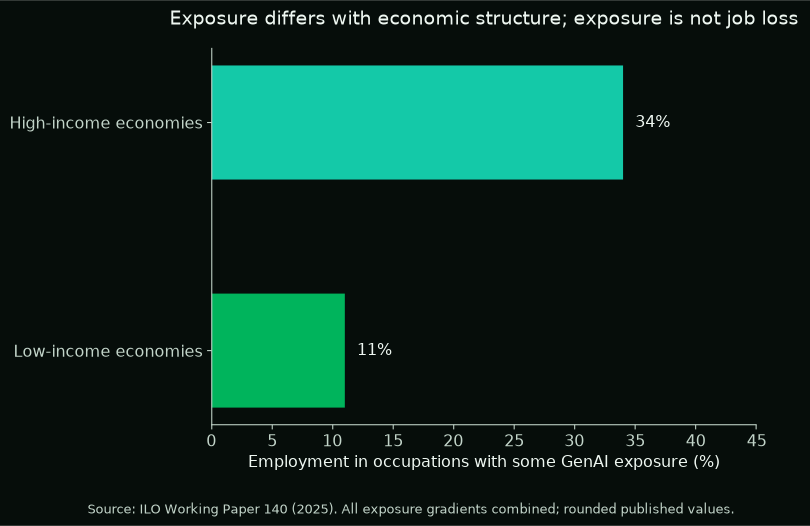
A task inventory should therefore initiate inquiry rather than determine a redundancy decision. The same technical possibility could support shorter hours, increased output, expansion of a service or reduced staffing. Which outcome occurs depends on choices and constraints requiring separate evidence. An occupation's unautomated tasks may also become harder to perform when supporting roles disappear. These are hypotheses about organisational change. Evaluating them requires tracking how tasks interact, rather than assuming that the economic value of a job equals the sum of independently removable components.
Acemoglu and Restrepo distinguish displacement, productivity effects and the creation of new labour-intensive tasks. Their historical U.S. industry analysis is a framework for investigating labour demand, not a forecast of current generative AI. [U01S03] Its usefulness here is to make innovation's direction discussable. An organisation can ask what valuable work it creates and what routes into that work it offers. Learning then becomes connected to available roles. Encouraging adaptability while eliminating entry routes would leave the institutional part of development unexplained.
Recent counterevidence constrains claims of an immediate labour-market revolution. Humlum and Vestergaard's March 2026 Danish working paper links adoption surveys with administrative outcomes through December 2024. Its pooled difference-in-differences contrasts rule out average earnings and recorded-hours effects larger than 2%, alongside task reorganisation; the dynamic earnings interval is wider. The bounds concern its studied contrasts, occupations and horizon; observational identification and possible spillovers constrain interpretation. They do not establish that later systems have no effects. [U24S03]
The support-operation gains and Danish findings are not contradictory estimates of one common object. They concern different settings, outcomes and comparisons. Their coexistence makes it necessary to trace how a productivity change reaches remuneration, employment or time outside work. That transmission cannot be supplied by the word “benefit”. A worker may value easier tasks even without higher pay; a society may value expanded access even without reduced hours. Those possibilities should be investigated alongside bargaining and ownership, without presuming either exploitation or shared prosperity from task improvement alone.
Bernhardt, Kresge and Suleiman's 2021 policy report proposes worker technology rights, including disclosure, contestation, bargaining and enforcement. It is a normative framework informed by interviews and research, not a representative prevalence study or a statement of current law. [U21S04] The proposal developed here is to make workers participants in defining useful change. Participation would have to affect decisions and remain compatible with confidential information and operational constraints. Its success should be evaluated through outcomes and accessible remedies, rather than attendance at consultation meetings.
Epistemic diversity and an evaluable account of agency
Diversity concerns more than the number of generated answers. Terwiesch and colleagues compare a historical student idea pool with GPT-4 product ideas, finding differences in purchase-intent ratings, novelty and pool diversity across the compared idea pools. These differences should not be read as a demonstrated negative within-idea correlation between quality and novelty. Later models and structured generation partly mitigate diversity loss. The study does not test realised sales or human–AI collaboration, and semantic diversity is not democratic representation. [U15S08] Its relevance is to distinguish a promising individual proposal from a collection's range of alternatives.
An organisation could produce many polished proposals while repeatedly exploring the same assumptions. That possibility is not established by counting stylistic variations. Evaluation should examine problem selection, underlying reasons and alternatives discarded before the final comparison. Relevant diversity might include disagreement about what should be optimised, whose costs should count and which outcomes cannot fairly be traded away. These are normative proposals. A model generating several personas cannot stand in for affected people with independent interests and the authority to contest the process.
Nor should diversity be maximised indiscriminately. Repetition can reflect reliable shared knowledge, while novelty can introduce error. Some perspectives deny other people's standing and should not receive authority merely because they are unusual. The challenge is to defend exclusions and distinguish them from convenient suppression. A reasoned process would explain why an objection is irrelevant, unsupported or harmful, and preserve ways to challenge that classification. Epistemic diversity is valuable where it improves inquiry and exposes neglected claims; it is not a requirement to treat every assertion as equally warranted.
The chapter's institutional conditions can be tested. A deployment evaluation could compare output quality with delayed competence, examine whether protected disagreement changes error detection, and trace who receives the saved time or increased income. Such measures should be defined with affected participants, with comparison conditions appropriate to the intervention and explicit limits on causal inference. Some rights require normative justification independently of measured productivity. Some training programmes will fail. A framework claiming to support agency should permit both findings and revise its practices accordingly.
IDG becomes useful in this account when reflection, humility, care and courage help people exercise consequential judgement under those conditions. It becomes misleading when their absence is invoked to excuse an institution's denial of information or discretion. Human agency does not require constant superiority to a machine. It requires opportunities to understand a dependence, contest its terms and participate in deciding what the work is for. The evidence reviewed here supplies bounded grounds for investigating those opportunities; their protection remains a responsibility to be argued for and implemented.
10. Education, knowledge and culture: retaining the means to judge
An educational institution must decide what a learner should be able to do when assistance is available and what they should retain when it is withdrawn. These purposes can diverge. Producing a convincing answer with a tool may be a worthwhile accomplishment, especially where access makes a previously inaccessible task possible. Yet education also concerns the judgement with which someone decides whether an answer deserves acceptance. The distinction becomes politically consequential when qualifications authorise their holders to teach, diagnose, administer or govern. The question is whose competence a completed performance demonstrates and which responsibilities its recognition permits them to assume.
This chapter argues that an education adequate to AI must preserve people's opportunities to interpret evidence and dispute the ends to which knowledge is put. The argument develops the monograph's account of inner capabilities and outer conditions. Reflective judgement requires practice, but practice requires time, intelligible materials and some authority to question the standard of success. The current Inner Development Guide provides a vocabulary for such inquiry, including Creativity within Thinking; its educational usefulness remains a question distinct from causal validation. [IDG003; IDG004] The criteria defended below are normative proposals informed by heterogeneous research, rather than a universal account of learning derived from one framework.
Assisted performance and retained learning
Bastani and colleagues' preregistered classroom trial involved nearly 1,000 students in one Turkish high school. Compared with control, GPT Base improved assisted practice grades by 48% but reduced subsequent unaided exam grades by 17%. GPT Tutor improved practice by 127%, while its unaided exam result was statistically indistinguishable from control. The intervention covered four sessions; it does not establish long-term outcomes or effects in adult work and humanities education. Teacher-designed safeguards mitigated the deficit without demonstrating an exam benefit. An August 2025 production correction repaired Osbert Bastani's affiliation, rather than these results. [U15S07; U15S10]
The distinction warrants inquiry beyond mathematics without supplying the answers. A humanities seminar could compare an interpretation developed with assistance against a later defence of a different passage without that assistance. The relevant outcome would include whether the learner recognises ambiguity and can answer an objection, rather than whether they reproduce the earlier formulation. A second assessment should permit tools and examine whether their use is appropriate. Otherwise, a test designed to detect retained understanding might mistakenly establish that independence from every tool is the purpose of education.
Independence should mean enough competence to govern reliance. A historian need not memorise every archive, and a reader who uses translation need not become proficient in every language before making an inquiry. Someone may responsibly rely on expertise they could not reproduce, provided that they understand the scope of the reliance and know how disagreement can be investigated. Teaching should therefore examine what must be retained for a particular responsibility. Where a person will judge evidence, knowing how to recognise its limitations matters. Where a task merely requires a usable preliminary transcription, less understanding may suffice, subject to subsequent review.
Evidence about work adds a necessary counterweight. Brynjolfsson, Li and Raymond's study followed 5,172 support agents through a staggered AI rollout, using difference-in-differences rather than an intact randomised main comparison. Larger task gains among novices were compatible with useful assistance; the setting and observational assumptions limit generalisation. [U02S02] The educational issue is consequently how organisations turn useful assistance into an opportunity to acquire judgement. Reducing every aided achievement to dependency would overlook real access benefits. Calling every performance gain learning would obscure whether the worker can diagnose a failure or challenge a recommendation later.
Qualifications, assessment and the right not to delegate
A qualification is a public claim about competence under stated conditions. It can attest to tool use, unaided understanding, collaboration or a mixture, but should distinguish those achievements. The ethical problem is not that assistance makes an accomplishment unreal. It is that an institution may certify a competence its assessment did not examine. Equally, refusing to recognise assisted work can exclude learners whose access depends on accommodations. Fair assessment requires a defensible account of the contribution being tested and a proportionate way to observe it. It also requires a route to question an accusation of improper assistance.
Coghlan, Miller and Paterson's philosophical analysis of online proctoring examines privacy, autonomy and contestability while recognising the legitimate importance of academic integrity and the limitations of ordinary invigilation. It offers reasons for evaluating supervision, rather than an empirical audit of contemporary products. [U23S05] The proposal here is that institutions should redesign evidence of understanding before expanding observation of a learner's private environment. Discussion of a draft, explanation of a revision and work on an unfamiliar problem may establish something a finished document cannot. These approaches need evaluation; they do not make every accusation fair or every oral examination accessible.
Examination practices can reproduce the confusion they are meant to resolve. A confident speaker may defend an interpretation well while excluding a less fluent peer from recognition. A timed test may confound knowledge with a particular mode of access. Evaluators should ask whether the chosen demonstration is necessary for the competence in question and offer equivalent routes where it is not. This does not imply eliminating standards. It places the burden on an institution to explain why its standard measures the responsibility it certifies. Credential prestige cannot supply that explanation, nor can the absence of a credential disprove knowledge that other evidence establishes.
Nussbaum's entitlement argument distinguishes substantive opportunities from resources and satisfaction, and includes practical reason and imagination within a defended, revisable account of capabilities. It is a normative argument, not an educational intervention. [U24S01] A qualification should accordingly matter through the opportunities it makes usable. A learner may become knowledgeable while remaining unable to enter a profession; another may acquire recognised standing without acquiring the competence that standing presumes. Neither condition can be diagnosed solely through a personal development score. Educational justice concerns the relationship between what people can do and what institutions allow others to recognise.
I propose a qualified right not to delegate consequential judgement to AI. This is an ethical criterion, not a claim that existing law already guarantees it. Learners should have a practicable route to develop and demonstrate understanding without being compelled to accept a model's interpretation. Staff charged with assessment should retain the authority to investigate an automated recommendation. The right would require resources: maintained alternatives, review time and explanations of consequences. It would not prohibit voluntary reliance, justify excluding necessary accommodations or give every individual an unlimited veto over shared provision. Its purpose is to preserve a meaningful choice about how responsibility is exercised. The claims should be separated: an opportunity to acquire understanding, a route to challenge a consequential decision, and a demand for an entirely manual service need not have the same scope. Maintaining a costly parallel service could reduce other people’s access. A defensible limit would establish necessity, the lack of a less restrictive alternative, disproportionate shared burden and an accessible human review of consequential errors. Preserving judgement therefore need not preserve every earlier delivery method. Institutions should explain and periodically review such limits rather than treat efficiency as a permanent exemption.
Evidence access and interpretive authority
Access to information does not confer authority over its interpretation. A school can make a report available yet exclude pupils from deciding which questions the report should answer. A repository can permit reading while leaving an affected community unable to correct its descriptions. These are analytical possibilities, not findings about all schools or repositories. They distinguish the opportunity to receive knowledge from the power to shape the purposes and standards governing its use. Education should develop capacities for both, while resisting the assumption that improved comprehension resolves a disagreement over who may decide.
A useful explanation begins with the question it answers. Miller's review connects explanation with contrasts, selected causes and interaction, while distinguishing explanatory satisfaction from truth and warranted trust; its application to AI is a research programme rather than a deployment trial. [U23S04] The chapter's proposed educational exercise would ask a learner to formulate the alternative against which a claim is being explained. Why this classification rather than another? Why this passage as evidence rather than a neglected document? Asking these questions can expose the limits of an explanation without requiring everyone to reconstruct the computation that produced it.
Source provenance should be taught as a history of a claim. A learner needs to distinguish a primary account from an interpretation and a current corrected finding from an earlier version. The EPFL persuasion record makes this obligation concrete. A preregistered experiment with 900 US participants measured immediate agreement in structured debates. Its personalised GPT-4 condition outperformed a human baseline. The 3 September 2026 correction changed the personalised-versus-unpersonalised GPT-4 comparison to P=.0678; that incremental advantage is not conclusively established. Persuasion was measured, not accurate learning or democratic consent. [U22S05; U22S09] Responsible interpretation depends on which comparison survives correction, rather than the confidence of the headline.
The duty to investigate cannot rest entirely on the reader. Institutions should maintain corrections beside the claims they qualify, connect accessible summaries to inspectable sources and distinguish reading recommendations from endorsements. They should support the labour of checking. Chen's philosophical account of AI trust leaves room for justified distrust and responsibility at the ecosystem level; its engineering proposal is unvalidated. [U12S09] My inference is that critical judgement needs an identifiable respondent. Teaching people to challenge an answer achieves little if the organisation receiving the challenge can redirect responsibility indefinitely between a supplier, a system and the user.
Creativity beyond the most attractive answer
Terwiesch and colleagues compare 200 ideas sampled from a pool generated by 50 MBA students with 200 GPT-4 ideas for inexpensive student products. Higher purchase-intent ratings coexist with lower novelty and collective diversity; later model and prompting interventions partly mitigate diversity loss. A historical comparator, text-only ideas and a survey outcome restrict inference about realised innovation or human–AI collaboration. [U15S08] The result does not settle creativity in poetry, public reasoning or cultural practice. It does help resist the assumption that one attractive output establishes the quality of an entire field of possibilities.
A humanities conception of creativity should ask how a problem becomes worth posing. An innovation exercise can produce many answers while leaving the underlying demand intact. A cultural work may instead question the demand, change whose experience is recognisable or resist the requirement to be immediately useful. These claims require reasons within the relevant practice, not an assertion that commercial evaluation is inherently shallow. Purchase intent is pertinent to some purposes. Its limits appear when it becomes the sole warrant for decisions whose consequences concern people outside the market being surveyed.
Nor should diversity become an unquestioned numerical good. Differences can be trivial, and a varied set of proposals can still omit the people affected. Some tasks require consistency; others require exploration. Educational evaluation should name the relevant kind of difference and explain why it matters. Semantic distance between texts cannot by itself establish the presence of cultural plurality, a change in interpretation or fairness in representation. A critique of homogenisation must therefore examine the selection process as well as the outputs: who proposes alternatives, who judges them and which forms of experience are difficult to express in the accepted format.
A defensible creative pedagogy would preserve opportunities to formulate a problem before consulting generated suggestions. Learners could identify what an initial interpretation excludes, compare assisted alternatives and explain why a discarded possibility deserves renewed attention. Such arrangements are proposals for testing, not evidence of a uniquely human creative essence. They should allow AI assistance to be useful without deciding in advance that it enlarges imagination. An adverse result would be that participants produce impressive work but lose the ability to explain their choices or recognise an alternative. Independent judgement must remain an outcome the pedagogy can fail to secure.
Cultural plurality and control of knowledge
Digitising cultural material requires decisions about what distinctions will survive. EPFL's historical-map segmentation study finds that coarse categorisation works better than finer classification and that performance varies by corpus. Its pixel scores concern segmentation, not historical truth or political neutrality. [U22S07] These distinctions matter when a simplified category becomes part of a public account of a place. Improved technical performance could accompany the removal of a distinction relevant to a historian or community. The evaluative question is what the system makes easier to see and what it makes harder to say.
Kaplan and di Lenardo's conceptual account treats historical data as selected and repeatedly reconstructed, with alternative coherent reconstructions remaining possible. Coherence does not guarantee truth; the paper does not establish democratic archive governance. [U22S08] A cultural institution should therefore preserve the relationship between an interpretation and its materials, including uncertainty about missing evidence. It should make disagreement visible where rival accounts cannot yet be resolved. This does not mean every account merits equal acceptance. It means the grounds for rejecting one should remain available for criticism, especially where the archive itself reflects an unequal history of preservation.
Indigenous governance presents a stronger demand than inviting additional perspectives into an already settled system. Burchill and colleagues' co-designed Australian survey obtained 247 completed responses: reported ethics-guideline use was substantial, while meaningful participation and governance varied. Its self-selected, cross-sectional reports limit national and causal inference. [U23S06] Respectful procedure and control over analysis are different objects of assessment. The chapter's argument is that a project should ask who can frame the inquiry and govern subsequent use, alongside whether researchers describe themselves as respectful. A favourable answer to one question cannot be presumed to answer the other.
Carroll and colleagues' CARE Principles place Collective Benefit, Authority to Control, Responsibility and Ethics alongside FAIR data principles. Developed through Indigenous-led deliberation, the practice paper provides a governance framework and calls for further implementation research; it is neither an intervention trial nor a mandate representing every Indigenous people. [EDU001] The implication developed here is that knowledge access sometimes requires negotiated limits. Making cultural material technically obtainable does not by itself justify every reuse. Educational institutions should distinguish permission to consult a collection from permission to transfer its contents into a new commercial or computational setting.
This position faces a serious objection: collective control can conflict with criticism or with the interests of members who challenge their recognised representatives. Protecting a community must not render those members unintelligible. A responsible arrangement should distinguish external extraction from internal disagreement and ask how different claims to representation are heard. One proposed safeguard is to document the locally authorised decision-maker and any contested mandate, protect dissenting testimony under appropriate consent and privacy terms, and negotiate review through the relevant Indigenous governance arrangement. This does not presume an outside appeal can override sovereignty. No general framework resolves every conflict between individual inquiry and collective responsibility. IDG practice should leave that conflict open to reasoned consideration, rather than counting the willingness to share as maturity or interpreting withholding as a deficit in collaboration. Institutions owe communities more than opportunities to enrich someone else's developmental vocabulary.
Language, access and the boundaries of a common framework
Joshi and colleagues' 2020 analysis relates digital language resources to representation in NLP research, using selected catalogues, Wikipedia and publication metadata. Its resource classification reveals disparity but does not measure contemporary model quality or cultural worth. [EDU002] For this chapter, the significance is the choice of what counts as available knowledge. Resource counts can identify an engineering constraint without implying that a language lacks a rich intellectual life. An institution should not confuse material absent from its accessible corpus with material absent from a community's knowledge.
Language access consequently involves more than supplying a translated interface. A translation can preserve the approximate conclusion while changing what a concept asks its users to notice. Educational practice should leave space to examine such changes, retain original wording where appropriate and consult speakers and knowledge holders about the relevant usage. Wang Zhongjiang's philosophical argument presents plural Confucian accounts of relationships and cultivation; the consulted text is an institutional reprint, not an independently collated final journal PDF. [U13S06] Its presence challenges any presumption that ethical development begins from one uncontested account of selfhood. It does not make a tradition uniformly supportive of IDG.
Material access also requires context. Yang and colleagues' historical Chinese school surveys distinguish household from school ICT opportunities; selected regional samples and internally differing survey dates restrict their use as present evidence. [U13S03] The normative extension is that a publicly available learning resource may remain difficult to use without time, connectivity, instruction or a place to ask questions. A programme should inspect these conditions before attributing unequal outcomes to learners' motivation. Providing tools can be worthwhile, but it should be evaluated alongside who can use them effectively and who bears the expense of doing so.
This chapter's defence of judgement must also resist making individual verification an impossible condition of participation. Nobody can inspect every dependency underlying a public argument. Shared expertise, trustworthy intermediaries and collective checking are necessary parts of a practicable proposal. The institutional question is whether reliance is revisable: can someone discover an error, request help and alter a decision without losing standing? The proposed right not to delegate protects that possibility while allowing chosen dependence. Education would then prepare people to take responsibility within networks of knowledge and to contest those networks when their authority exceeds the reasons they can supply.
The research task is to compare arrangements, rather than certify an ideal personality. Future studies could distinguish retained understanding from assisted output, examine whether learners can challenge evaluation and investigate who controls cultural materials after a project ends. Participants should help define worthwhile outcomes and be able to reject the framework's categories. Such research could find that a developmental practice adds little, that institutional provision matters more, or that assistance benefits some people while imposing costs on others. Keeping those outcomes possible gives this chapter's argument its discipline: education should enlarge people's means to judge, including their means to judge the education offered to them.
11. Western societies, contested belonging and democratic agency
A common aspiration without a common essence
Western societies are the setting of this chapter, not its unit of psychological measurement. The term identifies a disputed grouping of political and cultural histories; it does not identify one population with a common disposition towards reason, freedom or technology. A national government, a university, a religious community and a migrant family can inhabit intersecting histories without understanding their membership in the same way. The analytical question is how institutions maintain equal standing among people whose accounts of belonging differ. Defining an authentic Western person would prejudge that question by giving some participants authority to determine who properly belongs.
The monograph's account of reciprocal agency offers a promising starting point: cultivated capacities need enabling institutions, while institutions depend on judgement and cooperation. Yet a democratic account must challenge the word enabling. An institution can enable people to perform an approved role while withholding the power to question it. It can recognise a polished argument and refuse an unfamiliar expression of injury. If effective agency is measured only by successful entry into existing institutions, exclusion becomes a deficiency of the excluded. This chapter argues instead that standing to challenge a decision must precede any favourable assessment of the challenger’s maturity or competence.
That priority does not imply that all judgements are equally sound. A person may hold an erroneous belief and still possess political standing. An institution may reject a claim after fair consideration and remain answerable for the rejection. Democratic development concerns the relationship between those possibilities: how people can contest authoritative decisions without having to prove that they deserve membership, and how common decisions can remain binding without pretending that disagreement has disappeared. The distinction supplies a criterion for evaluating AI systems that classify people, organise public communication or assist the institutions through which recognition becomes consequential.
Inheritance as a question of who could claim it
Frederick Douglass's address of 5 July 1852 confronts a national celebration of freedom from the standpoint of people denied its benefits. In the abridged primary text consulted here, he refuses the demand that abolitionists repeatedly demonstrate the humanity of enslaved people and challenges the celebration’s exclusionary character. [IDT002] The speech matters here as an argument about public membership. A shared ceremony can reveal that the freedoms being celebrated are unequally shared. Participation in the ceremony is then insufficient evidence of inclusion, and refusal to join its affirmation need not indicate hostility to freedom.
The interpretive lesson is not that every disagreement with a national narrative occupies the moral position of abolitionism. Such an analogy would flatten differences in injury, coercion and historical circumstances. The lesson is that a society cannot establish the universality of its principles by citing the sincerity with which some members proclaim them. It must allow people subjected to its power to examine whether those principles are available to them. The critic’s relationship to an inheritance may consist in demanding its fulfilment. It may also consist in rejecting parts of the inheritance that cannot be repaired without changing their meaning.
The Universal Declaration of Human Rights supplies a later public formulation of equal dignity. Adopted in 1948, it combines property and political participation with social security, education, adequate living conditions and community duties. Its text also rejects using its rights to destroy those rights. [IDT001, arts 17, 21–22, 25–26, 29–30] This is a normative document, not evidence that societies achieved its aims. Its relevance is the breadth of the aspiration: neither possession of property nor participation in elections exhausts the conditions it associates with a dignified life. Its international setting also prevents treating universal dignity as the exclusive property of a geographical identity.
B. R. Ambedkar's concluding Constituent Assembly speech in November 1949 provides a challenge from outside the Western grouping. His address confronts caste and graded social inequality, linking their divisive effects to the difficulty of sustaining fraternity. It distinguishes political equality from social and economic inequality, warns against political hero-worship, and argues for constitutional methods where those methods remain open. [IDT003] These arguments should be read together. The speech cannot be appropriated solely as an endorsement of resistance or solely as an endorsement of order. It asks what gives a democratic form social substance while preserving institutions against domination. Its Indian setting informs the comparison; it is not a template presumed to explain every society.
The resulting historical frame remains selective. Three texts cannot document every colonial, racial, gendered or economic exclusion, nor establish a general sequence through which democracy develops. They expose a recurrent analytical problem: formally general claims can coexist with restrictions on who can exercise them. A humanities inquiry should investigate that coexistence through particular archives, rather than place every society on one scale of moral advancement. In this chapter, the comparison supports a normative distinction between an aspiration’s scope and the historical distribution of its benefits. It does not supply a causal explanation of contemporary trust or technological adoption.
Property, public power and the conditions of participation
Equal political standing becomes difficult to sustain when the means of exercising it are distributed unequally. This is an institutional question even without an asserted statistical estimate of wealth’s influence. Consider a proposed public information service whose infrastructure is privately controlled. Citizens might all have the right to send a message, while the controller determines which messages reach an audience, what data are retained and whether the service remains available. The example is hypothetical. It identifies a mechanism through which an equal formal permission can coexist with unequal control over the conditions of its exercise.
Ownership should therefore be examined as a bundle of decisions, not treated as a complete moral argument. Protection against arbitrary seizure is compatible with questions about how a resource affecting public participation should be governed. Conversely, describing a resource as socially important does not settle which public body should control it, whether that body can be trusted or how abuse will be prevented. The relevant comparison is between arrangements of power and correction. Private, public, cooperative and mixed institutions can each fail that comparison. Democratic evaluation must examine who can impose costs, who receives benefits and who can secure a remedy.
AI sharpens these questions where access to sophisticated assistance depends on an organisation’s resources. An applicant who can formulate a persuasive challenge may still face a classifier whose criteria cannot be contested. A small association may acquire new analytical abilities while depending on terms it cannot negotiate. Harvard’s political-equality discussion paper examines disadvantage beyond formally neutral classification; Cambridge’s recruitment study questions promotional claims that removing demographic difference resolves bias. [U05S03; U06S03] Neither supplies a universal outcome estimate. Their contribution is to keep institutional purpose and the construction of categories within the inquiry, alongside technical performance.
The capabilities approach is useful at this point. Nussbaum’s normative argument evaluates development through substantive opportunities, while the choice of fundamental entitlements remains contestable. [U24S01] Applied here, this emphasis makes civic education answerable to material arrangements. Teaching people to reason about budgets cannot replace access to the budget, time to examine it or a procedure that can alter a decision. Yet providing those conditions cannot guarantee wise participation. Development and distribution remain connected without becoming interchangeable remedies.
This also limits the appeal to generosity by powerful actors. An owner may sincerely fund civic education or make an AI tool available. The benefit should be evaluated on its merits, but gratitude cannot become a reason to exempt the provider from scrutiny. A donated service that can be withdrawn without public explanation creates a different relation from a secure entitlement. The proposed democratic test is whether recipients retain standing to criticise the conditions of provision and organise alternatives. It asks neither that every gift be rejected nor that goodwill be treated as a constitution for public life.
Plural belonging and the work of public reason
Belonging is often described as a feeling, but its democratic significance extends to recognition, obligations and permitted participation. A person can identify with several communities without distributing loyalty through a single hierarchy. Disagreement within a community may express care for its members, rather than detachment from them. The chapter’s proposed standard is that common institutions protect membership without prescribing a complete identity. Religious, secular, linguistic and other affiliations can inform public argument; they should not determine whose interests count when a common decision imposes burdens.
Public reason, on this account, is a practice of giving reasons that affected people can examine. It need not demand that every participant arrive already fluent in the institution’s preferred register. Translation, interpretation, testimony and narrative may help explain an injury that a technical vocabulary fails to recognise. Sor-hoon Tan’s comparative argument examines communicative virtues against ethnocentrism, rather than assuming that cultural crossings require one tradition to absorb another. [U10S05] The extension proposed here is institutional: interpretive effort should be shared, especially when officials possess resources that a complainant lacks.
Sharing that effort still leaves hard questions. Some claims rest on evidence that others cannot independently reproduce. Some reasons draw on commitments that others reject. A democratic process cannot avoid deciding; nor can it make agreement a condition of fairness. It should explain the grounds of a decision, identify where incompatible claims remain and preserve appropriate opportunities for reconsideration. A minority losing a vote is not by that fact oppressed. Equally, repeated defeat does not prove that the procedures are adequate when the same group lacks access to agenda-setting or cannot challenge the definition of its interests.
Inner-development language must be handled carefully within these encounters. Humility may help a powerful speaker reconsider an assumption. The same demand may silence someone whose account is routinely dismissed. Calls for forgiveness can assist a voluntary reconciliation, but can also close an unresolved claim for repair. A calm manner is not a sufficient sign of responsible reasoning; anger is not sufficient evidence against it. The distinction is between the conduct that obstructs another person’s standing and the discomfort produced when a previously excluded claim becomes audible. Making all discomfort a failure of development would protect existing expectations from examination.
This does not make every passionate intervention justified. Threats, intimidation and deliberate falsehood can damage the conditions of participation. Responding to them requires attention to conduct and context, rather than a general diagnosis of an identity group. Procedures should specify the restriction, explain its justification and allow challenge to its application. The legal boundaries are examined elsewhere in the monograph. The philosophical point here is that protection of a deliberative setting must itself be deliberatively answerable. Otherwise the institution determines both the acceptable claim and the unreviewable terms on which it may be expressed.
AI, trust and the authority to describe disagreement
The quality of public communication cannot be reduced to the amount of agreement it produces. An AI system might summarise conflicting testimony into fluent common ground while removing the dispute that matters most. A resident objects that a project should not proceed; the summary reports concern about implementation. The system has not merely shortened the contribution: it has changed its political object. This is an illustrative failure mode, not an observed prevalence claim. Its significance is that the authority to represent a discussion can affect what participants are subsequently allowed to contest.
A democratic summary should therefore preserve consequential disagreements and permit contributors to challenge their representation. That requirement does not imply that each participant can veto an entire report or require unlimited reproduction of their wording. It means that dissent cannot disappear merely because a synthesis algorithm treats agreement as the preferred output. Where a decision relies on a summary, disputed representations should remain visible to the decision-maker. Berkeley’s interdisciplinary fairness analysis helps identify contested meanings and boundaries, but does not experimentally validate this proposed procedure. [U21S03] Evaluation would need to examine actual corrections and whose objections receive attention.
Trust data reinforce the need for careful interpretation. The OECD’s 2023 survey, reported in 2024, gives an unweighted average across thirty participating countries of 39% reporting high or moderately high trust in national government and 44% reporting low or no trust. The high/moderately high category uses responses 6–10 and low/no trust 0–4 on a 0–10 scale; 5 is neutral. Country results are weighted internally; countries receive equal weight in this average. [GOV014] These figures are not a global population estimate, a measure of Western identity or a rebellion rate. They do not establish that AI caused distrust, and no probability of democratic collapse follows from them.
The chapter’s normative inference is that maximising expressed trust cannot be the sole democratic objective. Trust may be warranted, mistaken or induced by restricted information. Distrust may be discriminating, indiscriminate or responsive to exclusion. An institution should aim to deserve confidence and make scrutiny possible, including when scrutiny lowers favourable ratings. A transparent correction procedure that reveals a serious mistake may initially reduce trust while improving accountability. Conversely, an interface that reassures users while concealing uncertainty may improve a satisfaction measure and weaken their ability to judge the institution. These conditional mechanisms require evaluation, not a presumed universal direction.
The distribution of responsibility is equally important. A German medical-ML consortium study describes responsibility being displaced through actors, settings and time; its single-case design limits generalisation. [U25S10] The original application here is to democratic AI: assigning everyone a share can leave nobody with a clearly exercisable obligation. A useful responsibility arrangement states who must explain a decision, who can change it and what happens when the explanation fails. The institution remains responsible for that arrangement regardless of whether philosophers ultimately attribute moral agency to a future artificial system.
Where reciprocal agency can become exclusion
Reciprocal agency fails as a democratic criterion if institutional recognition is treated as the proof that a capacity matters. A migrant without voting rights, an affected worker outside a bargaining unit or a community whose preferred representative is not invited may possess relevant knowledge while lacking recognised standing. These are conceptual examples, not descriptions of particular current legal entitlements. A theory confined to recognised participants would explain their absence as outside its scope. The revised theory must instead ask whether its scope has been drawn to exclude people whose interests the decision affects.
That question cannot be answered simply by inviting every affected person to every decision. Effects extend across borders and generations; participation has practical limits, and claims can conflict. Representation, delegated advocacy, independent scrutiny and obligations to give reasons can supplement direct involvement. Each mechanism remains fallible. A representative can misdescribe constituents, an expert can substitute judgement for listening, and a public-interest body can acquire its own exclusions. The requirement is to make these failures contestable, not to announce that a perfect procedure has dissolved them. People should be able to challenge who purports to speak for them.
There is a second failure: capable collectives can pursue unjust ends. A group may display courage, persistence, efficient collaboration and accurate strategic analysis while seeking another group’s subordination. Reciprocity inside that collective does not make its external conduct legitimate. IDG capacities therefore cannot supply a moral warrant merely by being present. The monograph needs constraints on what developed capacities are used to do, including protection of equal standing for outsiders. Such constraints will be disputed, but dispute is different from absence. A developmental account that refuses substantive judgement cannot distinguish excellent coordination from democratic flourishing.
Finally, institutional correction can conflict with urgent action. Open-ended consultation may delay protection, while rapid intervention may bypass people whose lives it changes. Neither speed nor deliberative completeness is an absolute criterion. An institution should justify its timetable, identify the risks of delay and preserve review where immediate decisions are unavoidable. Dissent can reveal a failure in that account; it can also impede a justified response. Markovits distinguishes forcing democratic reconsideration from imposing the protesters’ preferred outcome, while Ambedkar supplies a stronger caution about abandoning available constitutional methods. [U16S05; IDT003] This disagreement remains substantive, rather than being resolved by calling everyone collaborative.
A future that preserves political authorship
An AI-assisted democratic future would be favourable under this chapter’s criteria when people gain usable assistance alongside consequential rights to question its deployment. Evidence would include accessible records, corrections that alter decisions, representation that survives disagreement and remedies usable without exceptional wealth or expertise. These are proposed indicators requiring local operationalisation. They are not a validated index, and their existence would not demonstrate that every distributive decision was just. The criterion concerns retaining political authorship: affected people must be able to influence the terms of common life, not merely receive better predictions about it.
An adverse future could arise even with technically capable systems and courteous institutions. Participation might be extensive while agenda-setting remains closed; appeals might be available while every response preserves the original decision; civic education might celebrate critical thinking while penalising consequential criticism. No invented probability is assigned to this pathway. Its assessment would require evidence about authority, resources and actual revision. The boundary between assistance and dependence lies partly in those arrangements. A society preserves a defensible democratic identity when its self-description can be challenged by people whose standing does not depend on their agreement with it.
12. Wealth, ownership and the arrival of a reported trillionaire
What the number measures
The emergence of a trillionaire is already a reported event at this paper's cutoff, rather than solely a question about the future. Forbes declared Elon Musk the first trillionaire on 12 June 2026, estimating his fortune at $1.1 trillion as SpaceX began public trading. Its 1 October snapshot subsequently put him at $936 billion; a story published on 6 October reported another crossing of the trillion-dollar threshold on 5 October. These observations describe the estimator's dated valuations. They are not audited statements of cash available to an individual, and their movement is not a measurement of AI's causal contribution. [ECO001; ECO002; ECO003]
This chronology changes the intellectual task. An old extrapolation about when a first trillionaire might appear cannot be presented as a current forecast. The important question is what such an estimate reveals about ownership, market expectations and the capacity to influence institutions. The threshold is memorable because it is large and round. Its moral or political significance cannot be derived from the decimal notation alone. A fortune immediately below it can confer much the same influence; one immediately above it can fall below again without any comparable change in its owner's practical authority.
Net worth is a valuation of assets after relevant liabilities. It must be distinguished from an annual income, realised proceeds and liquid purchasing power. Selling a substantial holding can have consequences that a quoted price multiplied by a holding does not capture. Taxes, transaction constraints and changes in market expectations can matter. The paper does not calculate an actual liquidation value for Musk or any other individual. It also avoids comparing a personal stock of wealth directly with a country's annual GDP as if they were equivalent quantities. One is an asset valuation at a time; the other measures production during a period.
The public-market event itself can be crosschecked separately from the personal fortune estimate. SpaceX's issuer disclosures identify an offering priced at $135 a share and public trading beginning on 12 June 2026. They establish the occurrence and terms of the offering; they do not certify Forbes' complete personal balance-sheet calculation. This distinction is a useful model of verification: corroborate the claim that a source can establish, and identify what remains the responsibility of another estimator. [ECO004; ECO005]
The connection with AI requires similar restraint. A company can operate across launch systems, communications and AI-related infrastructure. Investors can price expectations about several businesses simultaneously. A founder's portfolio can contain enterprises with different histories and revenue sources. It would take a specific valuation and causal model to assign a proportion of a personal fortune to AI. A narrative in which AI produced the whole fortune supplies neither. The defensible claim is that AI enters an existing system of ownership and valuation whose capacity for concentration is already visible. It can change that system's returns and dependencies, but the size and direction of its effect must be investigated.
Concentration before and during the AI transition
The World Inequality Report 2026 estimates that, in its 2025 benchmark, the top 10% of the global wealth distribution hold 75% of net household wealth and the bottom 50% hold 2%. Its pre-tax national-income distribution gives the top 10% 53% and the bottom 50% 8%; the middle-group shares in the figure are calculated as the remainder. Adults are ranked separately for income and wealth, and the benchmark uses purchasing-power-parity conversion and equal splitting within couples. These are descriptive estimates of distributions, rather than an attribution of inequality to AI. [GOV001; GOV002]
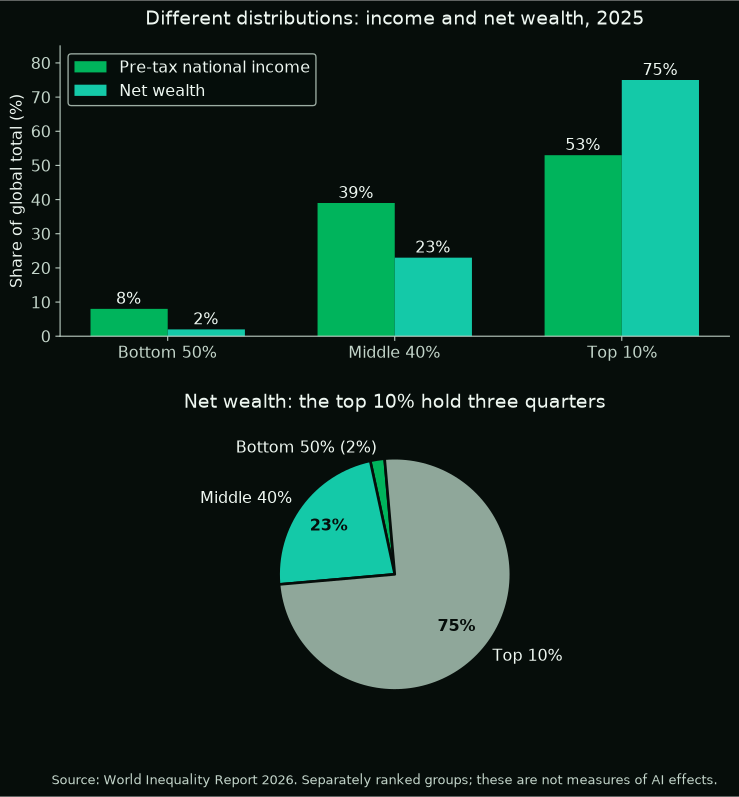
The contrast indicates why a discussion confined to wages would be incomplete. A worker may depend primarily on current earnings, while another person can meet needs through assets, borrowing against holdings or returns from ownership. A change in the work a person performs does not therefore have one predictable relationship to their economic security. Conversely, a person with relatively high earnings can face considerable insecurity if obligations and liabilities are substantial. These are conceptual distinctions, not new estimates of how many people occupy each position.
Historical distribution estimates also frustrate a simple claim that contemporary technology created inequality from nothing. The report's published income checkpoints show enduring concentration across the nineteenth and twentieth centuries and the 2025 benchmark. The chart displays those checkpoints rather than inventing an annual trajectory. A descriptive continuity does not imply that the underlying institutions or experiences were unchanged. Similar shares can result from different relations of land, industrial ownership, taxation, trade and household income. [GOV001]
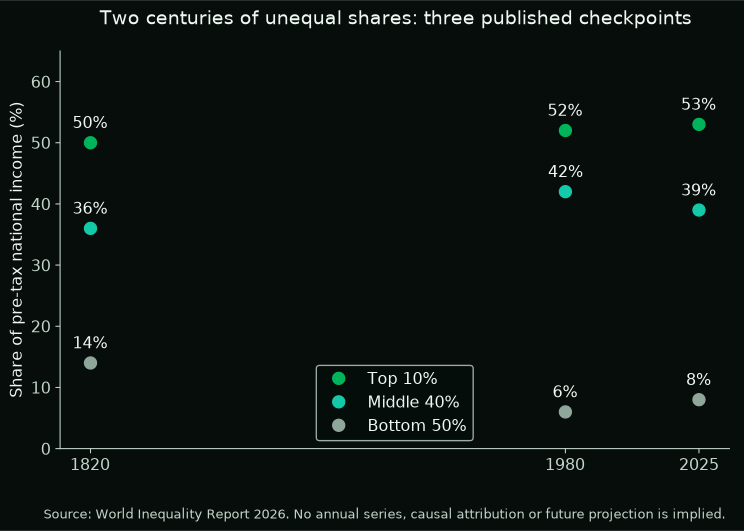
The historical question is consequently about mechanisms and changes in authority. An asset can become valuable through a productive contribution; it can also gain value through scarcity, institutional protection or expected control over future transactions. In an actual case, these sources may be mixed. The humanities should resist an account that equates market valuation automatically with moral desert, just as it should resist an account that equates every large return with extraction. Each removes the need to investigate how a benefit was produced, which risks were borne and who supplied the conditions for production.
The institutional comparisons reviewed elsewhere in the paper sharpen that investigation. Research on housing and finance examines arrangements through which assets and purchasing power interact; historical household-wealth research investigates particular populations and periods. Neither can be transferred directly into a forecast of global AI fortunes. Their value is to remind us that ownership has institutional histories and that apparently similar quantities can conceal different processes. [U08S04; U13S04; U19S09]
Wages, capital returns and adoption choices
An IMF working paper by Rockall, Tavares and Pizzinelli distinguishes wage displacement, complementarity and capital-return channels. Its household evidence concerns employed working-age people in UK survey waves covering2016–2020, while its distributional outcomes are generated by calibrated task-based models. The models show why a reduction in wage inequality can coexist with an increase in wealth inequality, and why firms' adoption decisions matter. Their results are conditional analyses, not observations of a completed AI transformation or a survey of trillionaires. Existing occupations, aggregate exposure held equal across compared technologies and competitive-market assumptions further bound the model; its adoption-cost changes are scenario inputs, rather than an observed economy-wide AI rollout. [GOV003]
The conceptual implication is that a favourable result on one measure can leave another form of disadvantage intact. If highly paid tasks become less scarce, earnings differences might narrow. If valuable capital remains concentrated, gains from ownership might nevertheless accumulate unevenly. Complementarity can change both relationships by making some workers more productive and better positioned to retain valuable tasks. There is therefore no single inequality outcome implied by the label AI. An assessment must specify which distribution, which mechanism, which horizon and which institutional response it means.
The model's emphasis on adoption also clarifies why an ethical appeal to users cannot carry the whole burden. Organisations decide whether and where to deploy systems under costs, regulations, expectations and competitive pressures. A considerate manager may still operate within incentives that favour reducing a category of labour. A well-designed training programme may improve a worker's skills without altering the organisation's ownership of the resulting benefit. The relevant research would trace the connection between skills, changed production and distribution, rather than assume that an increase in the first reaches the third.
There are counterarguments to a concentration-centred interpretation. Lower operating costs can support cheaper services, new entrants and new tasks. Shared tools can make capabilities accessible to people who could not afford a specialist provider. Large investment can finance infrastructure with substantial benefits. A market may distribute some gains through consumer prices even when ownership remains uneven. These possibilities deserve to be tested. They also do not settle whether prices fall enough, access is durable, quality improves or people gain authority over a service on which they depend.
The economic case for innovation and the political case for contestability therefore need to be considered together. A firm can legitimately seek returns for investment and useful service. People affected by its decisions can legitimately seek protection, explanation and a way to challenge harm. An institution that recognises only the first claim can turn technical success into dependence. An institution that disregards incentives and costs can make a desirable service harder to provide. Balancing the claims requires attention to actual designs and consequences, rather than a slogan about either unfettered innovation or universal redistribution.
Why compounding is an explanation aid, not a prediction
An original illustration makes the role of assumptions visible. Suppose a hypothetical fortune starts at $100 billion and grows at a constant nominal rate. The elementary relation is W(t) = 100×(1+g)^t, with wealth measured in billions of dollars and time in years. To reach $1 trillion, the continuous threshold is t = ln(10)/ln(1+g). Nothing in this construction establishes that an actual fortune will earn one of the selected rates.
| Assumed constant annual growth | Continuous years to the illustrative threshold | First whole year at or above the threshold |
|---|---|---|
| 5% | 47.19 | 48 |
| 10% | 24.16 | 25 |
| 15% | 16.48 | 17 |
| 20% | 12.63 | 13 |
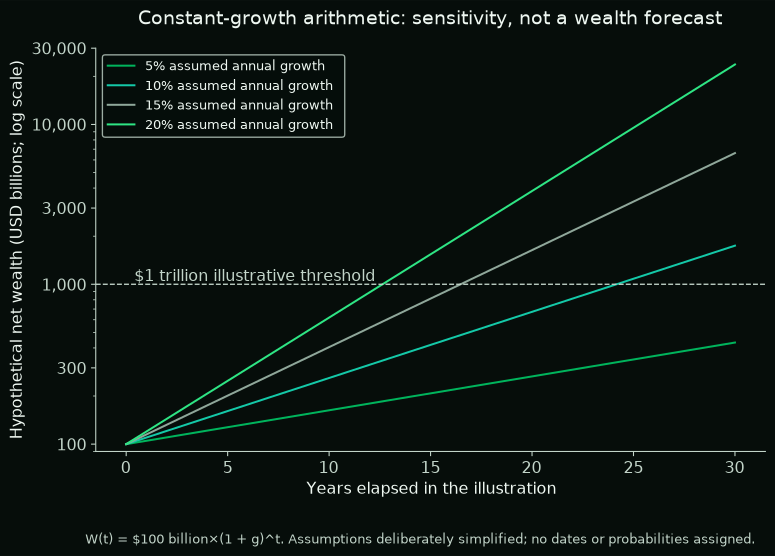
The large differences arise entirely from the declared rate assumptions. Their significance is epistemic: an apparently precise date can conceal a choice about a rate that the evidence does not establish. The illustration excludes tax, withdrawals, ownership dilution, inflation, liabilities and irregular shocks. It uses nominal values and cannot tell us when purchasing power, relative wealth or political influence would reach a corresponding threshold. A reproducible calculation should make these omissions easy to see, rather than lend them the authority of a forecast.
There is a further limitation when the illustration is moved from one fortune to society. The position of an owner depends partly on what happens to everyone else's wealth and to the value of the surrounding economy. A rising nominal fortune can coexist with a stable or falling share of total assets. A falling fortune can coexist with persistent control. The growth of an individual valuation and the concentration of collective resources require different denominators. Treating them as a single trend would make the calculation simpler and the interpretation wrong.
The reported crossings in 2026 supply a more modest but firmer lesson: thresholds based on market valuations can be crossed and recrossed. Their occurrence does not verify a long-term constant-growth assumption. A future-facing paper should be especially careful about this distinction because headlines create incentives to turn an arresting number into a destiny. The appropriate response is to separate observation, arithmetic and scenario, and then ask which institutions can govern the consequences of whichever path occurs.
Ownership, public standing and the meaning of development
Concentrated wealth becomes relevant to IDG when it changes the conditions under which other people can act. The ability to commission expertise, finance a service or sustain a long dispute can enlarge practical options. Those options can serve useful public purposes or private preferences. An account of agency must examine the terms on which affected people can respond. Receiving a benefit from an owner's decision is different from having standing in that decision. Being consulted is different from having a claim that can alter its outcome.
This distinction exposes a weakness in philanthropic interpretations of inner development. An owner may become attentive, generous and committed to a long horizon. These are possible ethical achievements. They do not establish a public entitlement to the resources the owner chooses to provide. A community whose access depends upon continuing goodwill remains vulnerable to a change of preference. Democratic provision needs arrangements through which claims can be justified, challenged and maintained beyond a particular person's disposition.
The point is not that philanthropy is worthless. It can fund neglected work and respond quickly to needs. The question is whether a practice enlarges the recipients' capacity to act or makes their position more dependent upon an unchallengeable benefactor. A serious account would examine participation in setting objectives, continuity of provision, disclosure of conflicts and possibilities of appeal. Inner development might improve the donor's conduct; institutional design determines whether other people's agency remains secure when that conduct changes.
Another objection is that attempts to distribute power can themselves entrench a professional or political elite. A public body may be less responsive than an organisation it supervises. A participatory process can consume time that only well-resourced participants possess. A regulation can impose fixed costs that established firms absorb more easily than smaller entrants. These are reasons to scrutinise the mechanism of reform. They do not justify assuming that existing concentration is neutral. Both public and private arrangements should be assessed through access, accountability, effective challenge and the consequences for people who cannot easily leave.
The institutional question also reaches workers and knowledge contributors. A person's creativity can help create a valuable product without granting ownership or continuing influence over its use. Public infrastructure and accumulated cultural knowledge can supply conditions for innovation without being reflected in an individual fortune. Attribution is difficult: no simple formula can assign an exact share of value to every contribution. That difficulty should lead to transparent arrangements for reward and participation, rather than to the claim that the current distribution is the only distribution compatible with innovation. [U08S03]
A balance that can be examined
The normative proposal is to evaluate innovation through the relation between productive reward and the conditions of public agency. A return should be considered alongside the service it finances, the risks it compensates, the claims of contributors and the dependencies it creates. The proposal supplies questions for investigation, rather than a universally optimal tax or ownership percentage. Actual fiscal choices require jurisdiction-specific evidence, behavioural responses, administration and political legitimacy. A model's conditional trade-off cannot substitute for that work.
Policies that broaden opportunity can act through different routes. Access to education and tools can improve capabilities. Material security can improve a person's ability to refuse harmful arrangements or participate in decisions. Competition and interoperability can make exit more practicable. Shared or negotiated claims on gains can connect productive participation to economic benefit. Public provision can secure important services independently of a provider's changing preference. These are possible institutional routes defended here; their relative performance must be investigated rather than presumed.
For firms, the corresponding responsibility is to make the bargain intelligible and revisable. People should be able to understand what they contribute, which benefits they can expect, what decisions are delegated and how disputes are handled. A deployment that increases output while making those relationships opaque may create value and diminish agency at the same time. Good profits and good human development can coexist when useful service, fair terms and correction support a continuing relationship. There is no guarantee that every arrangement can satisfy all interests without trade-offs.
An IDG-informed organisation should therefore be tested by what it permits people to question. Can workers dispute a measure of productivity? Can a customer challenge a consequential automated decision? Can a community oppose an investment that promises aggregate benefit while imposing concentrated harm? Can people withdraw consent without losing necessities? These questions connect Being, Thinking, Relating, Collaborating and Acting to economic arrangements. A development certificate or a favourable self-assessment cannot answer them.
The reported trillionaire is thus a starting point for institutional inquiry, rather than a complete moral verdict. The evidence establishes an exceptional concentration in a particular estimator's dated account and a broader unequal distribution in independently constructed global estimates. It does not establish that every technological gain is unjust or that future concentration is inevitable. The paper's argument is that the ability to influence a shared future should remain more widely distributed than ownership of its most valuable assets. That claim must be defended as a democratic norm and pursued through arrangements whose effects can be examined, including effects that contradict the hopes of their designers.
13. The material conditions of a practicable agency
Inner development makes a claim on resources even when its language concerns attention, judgement or care. Someone must have time to practise, a place in which practice is possible and sufficient security to experiment without intolerable consequences. These requirements are not peripheral obstacles awaiting personal resolution. They help define what the invitation to develop means. A workshop offered during paid hours and an identical workshop requiring unpaid attendance place different demands on participants. Calling both opportunities available conceals that difference. The question for this chapter is how institutions can make development practicable without claiming that material provision determines the quality of the person who receives it.
The argument distinguishes an available option from a capacity to recognise it, and both from an action that changes a decision. This distinction prevents several mistaken diagnoses. A worker may know how to question an automated assessment but face a credible threat of dismissal. Another may possess a protected appeal and lack help understanding the assessment. A third may understand the issue and appeal successfully without influencing the policy that produced it. These are hypothetical examples, not observations from a new study. They indicate different interventions: protection, assistance or changes in authority. A developmental exercise cannot be presumed to perform all of them.
Nussbaum's account separates cultivated capabilities from the external conditions needed for their exercise. It is a normative entitlement argument, not an estimate of what an IDG programme achieves. [U24S01] The distinction informs the position defended here: institutions owe people usable opportunities even when those people do not exemplify an approved developmental ideal. Access to security should not depend on demonstrating empathy, serenity or optimism to an evaluator. Equally, securing an opportunity does not establish that it will be used wisely. Material conditions alter what is practicable; they neither confer virtue nor remove the need to judge conduct.
Time, care and the cost of participation
Time is a distributional question because one person's availability can depend on another person's labour. A retreat, consultation or training programme may appear inexpensive when organisers count only venue and instruction costs. The accounting changes if participation requires replacement care, lost wages, transport or extra work by colleagues. These are costs that a proposed evaluation should investigate rather than assume away. A programme's apparent accessibility can therefore depend on keeping some burdens outside its budget. The ethical question is who bears those burdens and whether they had a consequential say in the arrangement.
Care provision requires particular attention. Paying for a participant's release from work may still leave responsibility for a child, an older relative or another dependent unresolved. Scheduling the exercise differently may help without resolving every need. The appropriate response should be developed with participants, rather than inferred from a universal image of the person who needs support. Some may prefer shorter sessions; others may need predictable scheduling or assistance at home. Providing options also protects against the assumption that everyone must disclose intimate circumstances to obtain reasonable accommodation. An institution can acknowledge dependence without making vulnerability a compulsory public performance.
There is bounded experimental evidence that changing working time can alter recovery. Schiller and colleagues analysed 580 full-time Swedish public-sector workers in 33 workplaces, selected after randomisation from an original 919 participants using follow-up and intervention-adherence criteria. An 18-month intervention planned a 25% hours reduction, retained salary and funded replacement staff. Diary outcomes indicated improved sleep and reduced perceived stress, with small effect sizes. One workplace was assigned to control because recruitment was infeasible; outcomes were subjective. The selected analysis is not an unrestricted intention-to-treat estimate. The study used 2005–2006 data and did not test IDG, moral conduct or an unfunded reduction in hours. [INS001]
The institutional detail matters to the argument. A reduction in nominal hours with unchanged demands could require greater intensity; a reduction accompanied by lost income could shift pressure elsewhere. Neither arrangement is equivalent to the evaluated package. The original inference is that protected time should be understood through its supporting conditions. A proposal to free time must identify whose tasks are covered, how coverage is financed and whether the beneficiary retains sufficient discretion over the time released. It should also ask whether relief for one group creates insecurity for the people recruited to replace them.
The strongest objection is that meaningful provision costs money and may reduce services. A hospital cannot release every employee simultaneously; an understaffed care organisation may be unable to recruit replacements at any reasonable price. Developmental opportunities then compete with immediate needs. This objection defeats an unqualified promise of universal protected time, but it does not justify treating every current allocation as necessary. Institutions should compare feasible alternatives and make the trade-offs inspectable. A modest programme with adequate coverage may be more defensible than a comprehensive programme whose costs are quietly transferred to workers or service users. Increased attendance is not sufficient evidence of improvement if provision elsewhere deteriorates.
Security without a theory of deficient people
Income security matters here because it can change the consequences of an action. A person able to withstand a temporary loss of earnings may have options that another person cannot safely exercise. This is a proposition about feasible conduct, not a claim that the economically secure reason better or care more. It would be equally mistaken to attribute hardship to undeveloped character and to claim that removing hardship automatically produces good judgement. Neither position supplies a defensible account of the choices people make within different constraints.
Carvalho, Meier and Wang randomly assigned survey timing around payday for 3,821 low-income US participants. Before-payday participants appeared more present-biased in monetary choices, but not in real-effort choices; cognitive performance and other decision measures did not show corresponding differences. The authors favour a liquidity explanation. Their variation was temporary and anticipated, rather than a permanent income change. The result challenges an automatic inference from constrained monetary choice to deficient self-control, while leaving other forms and durations of deprivation unresolved. [INS002]
The developmental implication concerns interpretation. Accepting a small benefit immediately can be a reasonable response to a pressing obligation, even if an observer prefers the larger later benefit. A programme that teaches patience without examining the participant's obligations may misdescribe a constraint as a disposition. Evaluators should therefore ask what the choice permits someone to pay for, which alternatives are realistically available and how the consequences differ across participants. They should not assume that one preference measure reveals a stable developmental rank.
The Australian poverty report provides a different kind of evidence: measured income hardship varies with transfer arrangements and housing costs. Its 2019–2020 comparisons are observational and do not isolate a randomised policy effect. [U19S06] This supports attention to institutional conditions without specifying a single optimal income policy. Transfers, services, predictable employment and affordable housing involve different forms of provision and authority. Their relative merits require evidence about costs, access, unintended effects and the circumstances of those affected. The chapter cannot infer the best instrument from a general commitment to security.
Material provision also has limits as an ethical strategy. Comfortable people may defend exclusion, withhold care or use their freedom to dominate others. Scarcity can coexist with remarkable judgement and solidarity. These possibilities prevent a deterministic account while leaving the obligation to address avoidable hardship intact. The normative justification for security should concern people's standing and opportunities, not an expectation that beneficiaries will repay provision with virtue. Institutional accountability may legitimately govern conduct; it should not turn basic security into a reward for adopting an approved personality.
Voice that reaches a decision
Workplace voice becomes consequential when there is a defined path from objection to response. An employee may be invited to discuss a system without having any influence over its adoption. Another may have a formal escalation route but face an implicit penalty for using it. The proposed institutional standard is therefore procedural and material: people should know where a concern goes, who must respond, what can be reconsidered and how participation is protected. The quality of interpersonal listening matters within this arrangement, but it cannot substitute for it.
Halliday argues that restrictions on workers' freedom should correspond to security guarantees, while allowing different legitimate combinations of freedom and protection. His analysis is normative, with no formula converting each restriction into a specified benefit. [U23S07] Applied here, the principle suggests that an organisation asking workers to accept closer technological supervision owes an account of what protection, discretion or compensation accompanies it. Flexibility should be examined from the worker's position as well as the manager's. A system that makes labour easier to redeploy may make a worker's own planning harder.
There are serious reasons to preserve managerial discretion. Decisions sometimes require confidential information, specialised knowledge or rapid action. Collective consultation can prolong uncertainty; a decision supported by a majority can still endanger a minority. Safety can require an immediate instruction rather than an open-ended discussion. These objections show why voice cannot mean that every operational decision is settled by a general vote. They also show why the scope of authority must be explained. A temporary emergency instruction differs from a permanent exemption from scrutiny. Confidentiality can justify restricted access to information without eliminating independent review.
Shared responsibility introduces a further difficulty. A qualitative study of one German medical machine-learning consortium found that participants located responsibility near their immediate roles while distancing later clinical consequences. The limited case does not establish prevalence or patient outcomes; it also identifies real constraints on individual expertise and control. [U25S10] The original lesson is to allocate responsibility alongside actual powers. Asking an individual to answer for a downstream process they cannot inspect or alter can be unjust. Announcing shared responsibility without identifying anyone able to stop or correct the process can leave affected people without a remedy.
Inner development may help someone recognise this problem, but organisational design must supply somewhere for recognition to go. A defensible arrangement would specify review authority, resources for investigation and the conditions for suspension. It would distinguish an honest disagreement from a concealed breach, and a reasonable uncertainty from negligent indifference. This is a proposed standard, not a proven governance intervention. Its practical adequacy should be tested through difficult cases, including cases in which the person raising a concern is mistaken. Protection for dissent should permit correction of the dissenter's claim as well as scrutiny of the system.
Access, investment and the terms of assistance
Access to AI is often treated as access to a product. For this inquiry, the more demanding question is whether assistance can be used without an unacceptable loss of independence. Affordability matters, but so do the ability to understand an output, obtain support and continue essential activity if the service changes. A free interface may impose other dependencies. A costly tool may offer useful discretion to some users while excluding others. These possibilities require inquiry into the actual terms of use; price alone cannot settle the distribution of opportunity.
The concern extends to institutional learning. Stilgoe's self-driving-car analysis examines how proprietary development can restrict social learning, while identifying constructive alternatives. It is a historical qualitative case, not a finding about every contemporary AI service. [U08S05] The proposed extension is that publicly important assistance should leave an adequate record of how consequential mistakes were investigated and corrected. Organisations may have legitimate commercial secrets. Yet if every relevant explanation is withheld, affected people must accept assurances from the same institution whose conduct is disputed. Independent scrutiny can sometimes reconcile confidentiality and accountability more effectively than either unrestricted disclosure or absolute secrecy.
Public investment raises the question of what the public receives in return. Mazzucato's mission-policy argument joins public direction and experimentation to the sharing of rewards from public risk; it is a conceptual policy account, not proof that any particular investment instrument succeeds. [U08S03] The normative position developed here is that public contribution warrants explicit terms. Those terms might concern access, pricing, ownership or obligations to sustain useful infrastructure. They should be decided before success makes retrospective negotiation difficult, and assessed against the public purpose that justified the investment.
The counterargument is that restrictive terms can discourage investment or prevent effective coordination. Investors may bear risks that a public agency cannot competently manage; a fragmented ownership structure may make development slower. Public authorities can also misidentify value, favour connected organisations or persist with failure. These possibilities undermine any presumption that public control is inherently enlightened. They require comparison between arrangements, rather than an assumption that privately captured returns are the natural reward for all innovation. The relevant question is which terms preserve incentives while making the publicly supported benefit widely usable.
A healthcare-anchor dissertation offers a useful warning about translating institutional commitment into shared authority. Sarkar found variation in equity definitions and limited formal shared decision-making in selected initiatives. The purposive, self-selected cases do not establish causal health or household-wealth effects. [U20S05] A university or hospital purchasing an AI service should accordingly ask who can revise the definition of benefit. Counting consultations or ethically approved purchases does not show that community priorities changed a budget. Participation can be assessed through identifiable decisions, including decisions the institution declined to change and the reasons it gave.
Capacity-building itself needs resources. The embedded-ethics toolbox developed from seven healthcare-AI projects identifies substantial staffing and methodological requirements, without a controlled estimate of effectiveness. [U25S09] This limits the plausibility of expecting every small organisation to reproduce an intensive model. Shared support, narrower review or prioritisation of consequential uses may be preferable. Such adaptations should disclose what they leave uncovered. Offering a lighter arrangement as complete protection would make access look inexpensive by omitting its unresolved demands.
Distribution and productive innovation
Wealth distribution and productive innovation concern different questions. An investment can create something valuable while its returns are distributed unfairly. A redistributive rule can improve access while having costs for investment or coordination. Neither proposition establishes the scale of those effects in a particular setting. The analytical task is to identify the mechanism: what activity produced a benefit, who contributed to it, who obtained control over the return and what obligations accompanied that control? The wealth chapter examines the relevant magnitudes; this chapter concerns their institutional interpretation.
Ryan-Collins's housing analysis identifies a credit–property feedback mechanism while acknowledging supply factors and contrasting institutions. It is evidence about advanced-economy housing, not all wealth creation. [U08S04] Its relevance is that appreciation of an asset should not automatically be equated with new productive capacity. Conversely, a large return does not by itself demonstrate extraction. An account of fairness must examine how the return arose and whose resources or restrictions made it possible. The same care is needed when distinguishing a successful new AI application from the ownership advantages surrounding its delivery.
The task-based economic framework of Acemoglu and Restrepo separates displacement, productivity and new human tasks. It draws on historical US industry evidence, rather than a contemporary generative-AI experiment. [U01S03] The original institutional inference is that gains and opportunities must be examined separately. Higher output could finance better conditions, further investment or larger returns to owners. The technology alone does not choose the allocation. A claim that diffusion benefits everyone must therefore describe a transmission mechanism, while a claim that it necessarily impoverishes workers must account for circumstances in which new tasks or other opportunities expand.
Environmental conditions and accountable demand
AI assistance requires physical infrastructure, so its diffusion cannot be evaluated only through the experience of the user. The IEA's 2026 central projection puts global data-centre electricity consumption at approximately 950 TWh in 2030, compared with a 2025 estimate of 485 TWh. These figures cover all data centres, not only AI, and the future value is a projection. Efficiency, uptake and more intensive applications remain uncertain. The report also identifies possible energy-system benefits, so increased demand alone does not settle the overall environmental judgement. [GOV018]
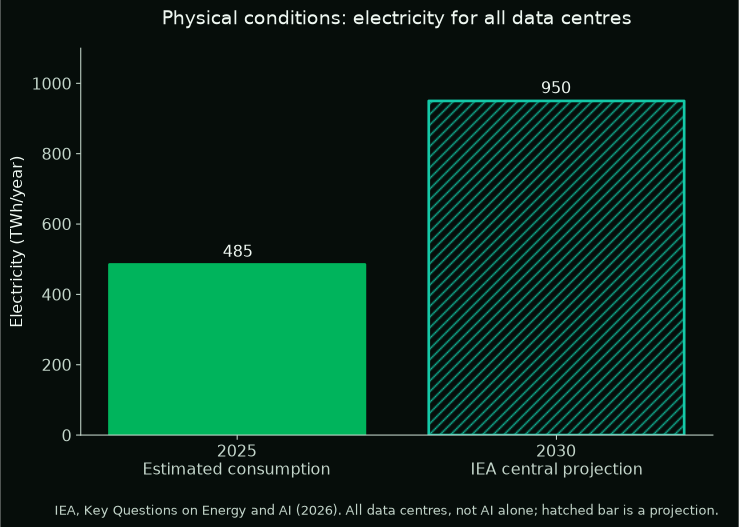
The original implication is that resource-conscious development must include institutions that authorise demand. An individual choosing a modest use cannot determine where capacity is built or how its electricity is supplied. A developer cannot independently decide the acceptable distribution of local burdens. Planning and procurement should identify the service sought, the alternatives available and the people affected by the supporting infrastructure. A global electricity total is useful context, but it does not tell a community whether a particular project improves its circumstances. That requires local evidence and comparison with other possible uses of scarce capacity.
There is an opposing argument with considerable force: AI may help manage energy systems, improve useful services and discover less resource-intensive processes. Slowing its development could postpone those benefits. However, a possible benefit needs a specified pathway before it can justify a particular burden. Equally, a projected burden should not be treated as an immutable destiny when technologies and institutional choices can change it. The appropriate assessment should compare realistic alternatives and revisit conclusions as evidence develops. A claim of eventual efficiency cannot excuse indefinite disregard of present costs, and a snapshot of present costs cannot determine every future use.
When reciprocity fails
The relationship between inner capacities and institutions is not always a reinforcing cycle. A protective rule can work without changing anyone's disposition. Reflection can reveal an injustice that remains politically entrenched. Security can make critical action possible while making comfortable withdrawal more attractive. A person's development may even sharpen conflict with an organisation that had expected improved cooperation. These possibilities are integral to the argument. They prevent institutional reciprocity from becoming a universal explanation that confirms itself whatever happens.
Evaluation should consequently follow the proposed mechanism through separate observations. Did provision change the feasible options? Did participants recognise and exercise an option? Did the responsible institution respond, and what followed for those affected? The answers may diverge. A failure at one stage should not automatically be attributed to a deficient person, nor should a favourable institutional outcome certify a curriculum. Costs, unequal access and adverse consequences need the same scrutiny as reported benefits. This research programme would make development answerable to the conditions of action while preserving the distinction between what people are enabled to do and what they have good reason to do.
14. Law, institutional judgement and the standing to dissent
This chapter compares selected public legal instruments and arguments; it does not offer a complete inventory of any jurisdiction's law. Statutory obligations, judicial holdings, executive directions and recommendations have different authority. Application dates are distinguished from enactment. The institutional criteria proposed below are original normative arguments, not findings that a particular regulatory intervention has already improved democracy.
From cultivated judgement to a claim on institutions
The legal question raised by inner development is who must respond when a person exercises it. Reflection can reveal an error, courage can enable its disclosure, and collaboration can assemble a persuasive challenge. None creates an obligation on an employer, public authority or technology provider to reconsider a decision. Law can supply that missing relation by identifying a claimant, a responsible institution and a procedure through which refusal must receive an answer. The connection is conditional: a legal procedure may also dissipate a challenge through delay, expense or a vocabulary that excludes the complainant's experience.
I use contestability to mean an effective opportunity to question a consequential decision and obtain an accountable response. It includes more than being shown information. An explanation can describe accurately how a decision arose while leaving its objectives unavailable for challenge. Conversely, a decision can sometimes be corrected without revealing every mathematical detail of a model. The institutional task is to connect the information a person needs with the authority required to alter an outcome. This definition does not imply that every objection deserves acceptance. It requires that the rejection of an objection can itself be examined.
Material standing describes the practical conditions under which a person can exercise that opportunity: time, security, representation and access to evidence. It differs from legal standing, which determines entitlement to bring particular proceedings. A claimant may possess the latter and lack the former. The distinction develops the monograph's central thesis. Institutions need reflective people to notice failures; people need institutions that make noticing consequential. Neither relationship warrants a numerical measure of democratic maturity. The chapter instead examines whether selected legal arrangements preserve a route from judgement to correction.
Oxford's work on artificial moral advisers raises a related concern about deference: an adviser may supply a conclusion without strengthening the user's reflective motivation. [U04S03] My institutional extension is that the user should not be required to accept the adviser's authority simply because an organisation has procured it. A competent individual may recognise the distinction yet remain subordinate to a compulsory interface. The legal problem therefore concerns the distribution of decision rights, including the position of people who never chose to become users. A welfare applicant, job candidate or protester can be affected by another party's system without entering an ordinary customer relationship.
Historical comparison without a story of inevitable progress
The English Bill of Rights, catalogued as 1688 although it received Royal Assent on 16 December 1689, declared the right of subjects to petition the monarch and condemned commitments and prosecutions for such petitioning. Its text also embodies a specifically Protestant settlement. [LAW008] These features make it a useful comparison precisely because it is not an early version of equal contemporary citizenship. A protected route to object can coexist with a restricted account of who belongs. An institutional history should ask both how authority became answerable and whose claims remained outside the recognised political community.
AI does not create the original problem of mediation between rulers and those affected by their decisions. It changes the technologies and organisations through which mediation occurs. Petitioning a named sovereign and contesting an automated assessment differ in scale, attribution and technical opacity. Yet both expose the gap between permission to speak and a duty to respond. This is a structural comparison, not a claim of historical equivalence. Modern data institutions have distinctive capacities; a seventeenth-century settlement cannot settle their legitimacy.
The comparison also cautions against describing legislation as a succession of moral improvements. A rule may expand one protected practice while narrowing another. Its defenders and opponents may each invoke liberty but mean different freedoms: security from arbitrary decisions, freedom to innovate, freedom from interference, or participation in collective rule. Berkeley's interdisciplinary fairness analysis provides a method of exposing such differences rather than pretending that a shared word resolves them. [U21S03] In legal inquiry, the consequence is to identify which interest a provision protects, against whom, and through which remedy. Counting ethics principles supplies none of these answers.
The European Union: rules, delayed duties and democratic authority
The EU AI Act is a binding regulation, but its obligations do not share a single application date. The 2026 Digital Omnibus on AI, Regulation (EU) 2026/1744, entered into force on 27 July 2026. Its amendment to Article 113 postpones Chapter III, Sections 1–3, except Article 6(5), to 2 December 2027 for Article 6(2)/Annex III systems and 2 August 2028 for Article 6(1)/Annex I systems. Other provisions have separate schedules. [GOV009; GOV010; GOV011] The precise limits matter: saying that all European AI regulation was postponed would erase obligations with different dates; retaining the original high-risk timetable would misdescribe the law at this chapter's cutoff.
The broader institutional issue is how legal classification converts a disputed social concern into a governable object. A risk category permits duties to be assigned before each person demonstrates injury. Such an approach can address a structural difficulty in individual complaint: people may not know that a system affected them, or may lack the resources to investigate it. It can also narrow attention to the categories a legislature has recognised. The democratic question then extends beyond compliance within a category to who can contest the categories themselves.
A regulation may create duties for providers and deployers while leaving choices about the purpose of a public service with elected institutions. That division can be justified. Technical supervision cannot replace democratic authorisation of what an institution is trying to achieve. Nor should elected authority remove the need for technical scrutiny. An agency's electoral mandate does not make an erroneous classification correct. The reciprocal framework therefore requires different opportunities for different objections: correction of a record, scrutiny of a model's use, and public argument about the institution's objective. Treating each as a request for a better explanation would obscure their different sources of authority.
The strongest objection to extensive regulation concerns the resources needed to comply. Documentation and supervision could burden entrants more heavily than incumbents, particularly where a fixed cost must be spread across different numbers of users. This is a plausible mechanism rather than an established effect of the amended Act. It deserves an empirical test. Harvard's power-sharing governance proposal acknowledges the problem of smaller-player entry; Chesterman's account of governance incentives questions whether institutional actors can reliably solve risks from which they benefit. [U05S04; U10S06] Together they prevent a simple opposition between public regulation and private concentration. The design of regulation can affect concentration, while concentration can affect the design and enforcement of regulation.
Proportional requirements, shared public expertise and accessible complaint procedures would be defensible responses to that objection. They remain proposals here. Simplification should be assessed by whose burdens it reduces: repetitive paperwork, the cost of demonstrating safety, or the claimant's access to correction. These are different achievements. Equally, an elaborate regime should not be praised merely because it demands many documents. If its records cannot support an independent challenge, administrative effort may produce a visible apparatus of responsibility without responsibility becoming usable.
The United Kingdom: meaningful intervention under changed rules
Section 80 of the Data (Use and Access) Act 2025 replaces UK GDPR Article 22 with Articles 22A–22D. It came into force, so far as not already in force, on 5 February 2026 through SI 2026/82, regulation 2(j), subject to the instrument's savings. Article 22C provides safeguards for significant decisions based solely on automated processing, including information, representations, human intervention and contesting the decision. The scheme changes earlier restrictions for non-special-category data while retaining particular restrictions concerning special-category data. [LAW001; LAW002; LAW003] It should neither be described as an unchanged general prohibition nor as abolition of safeguards.
The distinction between meaningful human involvement and a ceremonial signature is central to the monograph's argument. A person who confirms a model's result without time, evidence or authority to disagree cannot supply the same institutional judgement as a reviewer empowered to reconsider it. This is an evaluation criterion, not a claim that every existing implementation fails the statutory test. Its premises are straightforward: review requires a possibility of revision; revision requires sufficient understanding of the decision; institutional pressure can make formally available choices practically costly.
A right to human intervention consequently raises an organisational question as well as a technical one. Who is that human accountable to? What records can they inspect? Can they suspend an adverse outcome while an error is examined? Who bears the delay? A procedure that improves average accuracy can still distribute the burden of unresolved cases unjustly. Conversely, insistence on personal deliberation for every routine calculation may slow services without improving the claimant's position. Effective agency therefore requires a proportionate design that distinguishes routine processing from consequential disputes and recognises that faster delivery can itself be valuable.
Cambridge's transparency evidence proposes independent oversight, complaints and compensation, but it is a dated policy submission rather than evidence that those measures already work. [U06S04] Its importance for this chapter lies in separating disclosure from remedy. I further distinguish a remedy for an individual error from a mechanism that changes a recurring practice. If every applicant must repeat the same objection, a correction can be locally effective while the institution fails to learn. Collective representation and aggregate scrutiny may be needed where individual experience cannot disclose the pattern. This inference rests on a difference of scale, not on an assumption that all automated decisions are discriminatory.
The United States: disputed levels of rule-making
Selected US sources show disagreement about which level of government should govern AI. Executive Order 14365 of 11 December 2025 directs challenges to state AI laws and preparation of a legislative recommendation for a uniform federal framework. Its directions operate within applicable law; they do not themselves constitute a congressional statute repealing all state AI rules. The White House's March 2026 national framework explicitly presents legislative recommendations. [LAW004; LAW005] Executive policy, a proposal and an enacted law must therefore remain distinct even when their political objectives coincide.
Colorado's SB26-189 was signed on 14 May 2026. Its replacement automated-decision framework, including the general operative repeal and reenactment of the earlier AI provisions, takes effect on 1 January 2027; specified preparatory provisions take effect on passage. The legislature's enacted summary identifies requirements beginning on 1 January 2027, including documentation and opportunities for meaningful human review of adverse consequential decisions; enforcement belongs to the attorney general, without a new private right of action. [LAW006] California's official announcement records the signing of SB53 on 29 September 2025, with frontier-model transparency, incident reporting and whistleblower protections. [LAW007] These examples identify different institutional approaches; they are not a survey establishing the operative scope of every US obligation on 12 October 2026.
Uniformity has an intelligible democratic defence. A common standard can reduce uncertainty and prevent a person's protection from depending entirely on a state boundary. Decentralisation has a different defence: it can permit local political action and policy learning when central institutions hesitate. Neither argument decides the content of the standard. A uniform weak protection and a uniform strong protection share a geographical characteristic while distributing authority differently. Similarly, a state rule can be innovative or burdensome, protective or selectively exclusionary. The relevant evaluation concerns the relationship between jurisdictional coordination and the standing of affected people.
The enforcement distinction in Colorado also tests the idea that naming a right completes its institutional construction. Public enforcement can pool expertise and prevent claims from depending wholly on private wealth. It can also make action depend on agency priorities and resources. Private litigation can supply another route but can be expensive and uneven. Those are institutional possibilities rather than findings about this law's future performance. The appropriate research would examine complaint handling, regulatory capacity and practical access, alongside compliance costs. It would not infer democratic success from the number of statutory rights alone.
Dissent: public order and the authority to reopen a question
The Court of Appeal's decision in R (National Council for Civil Liberties) v Secretary of State for the Home Department [2025] EWCA Civ 571 concerned particular 2023 regulations redefining serious disruption. Paragraph 126 dismissed the appeal on the ground that the regulations exceeded the enabling power, while declining to uphold the separate selective-consultation ground. [GOV012] It did not invalidate all protest law or establish that all disruption is protected. Later-law checking identifies a new statutory development: section 165 of the Crime and Policing Act 2026, in force from 29 June 2026, requires attention to relevant cumulative disruption for processions and assemblies in England and Wales. [LAW010; LAW011]
The comparison shows why a lawful objective cannot settle the lawful means of pursuing it. Maintaining order may be a legitimate institutional responsibility, yet a minister's power to define a threshold remains bounded by the legislature's delegation. This matters for AI governance because an institution may present an expanded surveillance or classification practice as an efficient way to fulfil an existing responsibility. Efficiency does not establish that the authority to employ it exists. A developed capacity for systems thinking should expose that distinction; it should not make the institution more persuasive at explaining away its limits.
The Human Rights Committee's General Comment No. 37, issued in 2020, treats nonviolent collective civil disobedience as potentially within ICCPR Article 21 and distinguishes peacefulness from mere absence of disruption. It also recognises possible restrictions subject to legality, necessity and proportionality. [GOV013] This is treaty-body interpretation, not automatic immunity from domestic offences. Its relevance is that a rights inquiry cannot be reduced to whether people complied with every domestic procedural requirement. Otherwise an authority could remove protection by defining the protected practice as unlawful.
Public order remains a serious counterargument. People outside a movement also need access to work, care and public space. Their interests do not become morally insignificant because protesters describe their cause as urgent. Yet an undifferentiated requirement to avoid inconvenience can prevent dissent from reaching anyone with power to respond. The normative task is to judge burdens and available alternatives without treating the existing arrangement as inherently neutral. It requires evidence about particular consequences, rather than a general presumption that disruption is either virtuous or violent.
Yale's democratic theory distinguishes compelling reconsideration from dictating the eventual decision. Cambridge's analysis treats reasonable inquiry by disobedients as sensitive to exclusion and unequal epistemic resources; Oxford's polemic disputes the idealised political conditions assumed by some liberal accounts. [U16S05; U06S02; U04S04] I propose combining their pressures without erasing their differences: democratic dissent should reopen consequential questions while remaining answerable for its reasons and effects. It cannot derive an unrestricted mandate from the sincerity of its participants. Equally, authority cannot require dissidents to possess resources that exclusion has denied them before it agrees to listen.
This criterion affects the interpretation of IDG capacities. Courage need not mean accepting risk for an organisation's approved purpose; it may mean opposing that purpose. Collaboration may preserve a disagreement rather than produce consensus. Yates's discussion of scholarly incivility tests the temptation to equate participation with institutional etiquette. [U19S08] My further claim is that an organisation cannot evaluate development fairly if it alone defines the acceptable forms of criticism against itself. Some independent avenue of contest is needed. That conclusion does not protect abuse as a developmental achievement: other participants' standing remains part of the judgement.
What the legal comparison establishes
UNESCO's 2021 AI ethics recommendation invites voluntary national implementation and attends to dignity, pluralism and participation. [GOV008] Its breadth supplies a vocabulary through which institutions can explain their purposes; its status does not supply identical enforceable remedies across jurisdictions. A recommendation can shape deliberation without being a treaty, just as a binding rule can fail to secure practical access. Cultural plurality therefore requires both attention to different accounts of a good life and scrutiny of who can challenge the institutions translating those accounts into decisions.
The chapter's contribution is a distinction between cultivating a capacity, recognising a claim and financing its exercise. These processes can support one another, but success in one does not prove success in the others. AI governance should consequently be examined through the history of a challenge: how someone notices a problem, obtains evidence, finds an accountable respondent, secures review and participates in any wider change. This is an original research proposal. It remains vulnerable to cases in which informal correction works better than formal procedure, or additional obligations reduce useful access without improving accountability. Those possibilities belong in the inquiry. They do not justify assuming that thoughtfulness can compensate for a lack of consequential standing.
15. Dissent, developed judgement and democratic legitimacy
Human thought does not become politically valuable only after it becomes orderly. An objection can arrive through an unfinished argument, an unfamiliar image or a refusal whose implications its author has not fully worked out. Describing such thought as chaotic identifies its relationship to an observer's expectations; it does not establish a defect in the person thinking. Rebellion likewise names an opposition to authority, without deciding whether that authority deserves obedience. Inner development needs room for people to discover that an accepted arrangement is intolerable, including when the discovery makes cooperation more difficult.
This does not make confusion desirable or resistance self-justifying. A mistaken accusation can damage someone; a movement can reproduce domination internally. The claim defended here is that developed judgement must remain capable of consequential refusal. Its public value depends on reasons and responsibilities, rather than on the degree to which it reduces conflict. Institutions need capacities for correction, while people need institutions in which correcting an error can matter. Dissent tests the monograph's reciprocal thesis because it exposes situations in which personal understanding and authorised action come apart.
The categories determine what can be claimed
Political criticism, protest, civil disobedience and nonviolent resistance overlap without naming the same object. Criticism can consist entirely of argument. Protest adds public expression or pressure. For a possible measurement programme, this chapter defines civil disobedience as deliberate political noncompliance with an identified legal requirement, undertaken to contest an injustice or public arrangement. That is an operational proposal, not a definitive philosophical definition. Publicity, conscientiousness, nonviolence and acceptance of punishment are disputed conditions that researchers should code separately. Nonviolent resistance is a broader strategic repertoire; a lawful boycott can belong to it without being civil disobedience.
Legal status, moral justification and strategic effectiveness require different assessments. An act can contravene domestic law while retaining human-rights protection or a serious moral defence. A protected demonstration can advocate an unjust policy. A defensible refusal can fail to produce its intended result. Calling an act successful does not settle its legitimacy, while calling it unlawful does not answer the moral argument. Legal classification must identify the relevant jurisdiction, rule and date; moral appraisal must examine the reasons and burdens; strategic appraisal must specify an outcome and timeframe.
The Human Rights Committee's General Comment No. 37 distinguishes disruption from violence, recognises that nonviolent civil disobedience can fall within article 21, and cautions against attributing isolated violence to an entire assembly. Restrictions require legality, necessity and proportionality; public order includes respect for rights. This is the Committee's interpretation of the Covenant, not a blanket domestic immunity or a judgement on any proposed action. [CIV001, paras 7, 15–18, 36–44]
These distinctions prevent an attractive cause from making every tactic acceptable. They also prevent authorities from substituting discomfort for an account of danger. Researchers should identify who did what and who bore the consequences. Violence by opponents or officials cannot simply be entered as violence by protesters. Deliberate injury, intimidation and coercive exclusion require scrutiny independently of a campaign's reputation. Disruption deserves a differentiated assessment: obstructing an emergency service presents a different ethical problem from interrupting a ceremonial event. Neither is resolved by the label attached to its organisers.
Refusal and the authority of a shared decision
King's Letter from Birmingham Jail defends nonviolent pressure after unsuccessful negotiation, connects unjust law to unequal standing and exclusion from law-making, and challenges demands for delay. His defence also values disciplined conduct and openly accepting punishment. The polished institutional transcription consulted is a historical argument addressed to a particular struggle, not a statistical demonstration that confrontation always induces negotiation. [CIV002, passages on direct action, unjust laws and the white moderate]
The argument invites a distinction between preparation for action and preparation for compliance. Reflection can help someone identify obligations that a prevailing rule violates. Learning restraint may enable resistance without retaliation. Yet it would be wrong to turn the capacity to endure punishment into a universal test of sincerity. Imprisonment, lost employment or exposure of family members can fall unequally. An advocate's willingness to accept a penalty does not vindicate the penalty, and someone who challenges liability is not thereby an insincere dissenter. Moral seriousness cannot be measured through a compulsory demonstration of suffering.
Markovits argues that democratic disobedience can reopen issues suppressed by political inertia, distinguishing pressure for reconsideration from imposing the protesters' preferred outcome. He recognises that coercion can frustrate engagement; his discussion sets broader moral questions about violence aside. This is a normative argument about democratic authority, not causal evidence that an occupation improves democracy. [U16S05, pp.1898–1904, 1933–1943, 1948–1952]
The distinction supplies a strong answer to one objection and leaves another intact. A democratic decision can deserve reconsideration because the process excluded relevant people or obscured an injury. However, any group can claim exclusion; some will be mistaken, and some will use disruption to obtain privileges. A right to demand an explanation cannot become a standing entitlement to secure one's preferred policy. The grounds for reopening a decision should be examinable by people outside the movement, and a renewed process must permit rejection as well as acceptance. Otherwise, participation has become an instrument for ratifying a conclusion already fixed.
That answer remains insufficient where the process itself is what dissenters contest. Harcourt interprets Occupy through political disobedience directed at prevailing forms of political practice, challenging a model confined to specific policy demands. His account uses interpretive materials rather than a representative sample, and its contrast with civil disobedience remains contestable. [U24S04, pp.33–34, 39–41, 46–48, 51–55]
My proposed response is to distinguish accountability from compulsory accommodation to existing procedures. A movement need not formulate its claim as an immediately implementable amendment before its criticism can be heard. It should nevertheless remain answerable for its conduct and for the authority it exercises over participants. Open-ended imagination can expose alternatives that an established agenda cannot recognise. It becomes democratically troubling when leaders treat the absence of a settled programme as permission to evade scrutiny. Institutions and movements should both explain how someone affected can challenge their decisions.
The strongest defence of order concerns rights, rather than officials' preference for quiet. People depend on reliable transport, care, employment and protection against intimidation. A minority that repeatedly overrides a shared decision through disruptive capacity can exercise unequal power. Conversely, routine institutional arrangements may impose serious costs without attracting the name of disruption. Ethical assessment should compare the harm of an intervention with the harm and available remedies of the arrangement being challenged. It must also examine whether less harmful alternatives are genuinely accessible, rather than formally present but indefinitely ineffective.
A further objection concerns the limits of nonviolence itself. Someone defending a person against an immediate attack may have a serious moral argument for proportionate force. A categorical demand for passivity could protect the aggressor. That possibility does not make violence against unrelated people defensible, nor establish the legal position in a particular jurisdiction. Defensive necessity, retaliatory punishment and a campaign's chosen tactics must be assessed separately. A movement cannot transfer one person's possible justification for immediate protection into an unlimited authorisation for its own violence. Equally, an observer should not use an isolated defensive episode to erase the claims of everyone associated with a protest. The chapter's preference for practices that preserve others' standing therefore requires attention to circumstances, without turning injury into an acceptable shortcut to political authority.
What historical participation evidence permits
Chenoweth's cautionary update defines threshold participation as estimated peak-event participants divided by the target-country population in the final campaign year. Its NAVCO 1.2 table contains 18 campaigns at or above 3.5%, mixing predominant-method categories: 16 successes and two coded failures at the 2014 cutoff, or 88.89%. Bahrain and violent Brunei qualify the earlier universal observation; most successful nonviolent campaigns were below the threshold. These are historical associations in maximalist campaigns, not a necessary threshold, sufficient condition or future probability. The public rows have not been independently replicated here. [U05S01, technical appendix]
The implication for practical reasoning is substantial. Participation matters, but an aggregate can conceal different relations among participants, institutions and opponents. A large gathering need not maintain organisation after the event. A smaller coalition may possess influence that headcounts miss. A descriptive threshold cannot determine which strategy a future movement should choose, and the absence of a guaranteed strategy does not eliminate the need to act. Judgement under uncertainty requires explicit aims, attention to changing conditions and willingness to revise a strategy without treating revision as betrayal.
NAVCO 1.2's codebook describes 389 maximalist campaign records beginning in 1945–2013, outcomes through 2014, and at least 1,000 observed participants. Predominant-method classification combines tactics; success requires all stated campaign goals, limited success only some. Success normally uses a year after the peak, with evidenced later causal successes admitted; ongoing campaigns without attained goals at the end of 2014 count as failures. NAVCO 2.1 instead reports 384 campaigns and 2,717 campaign-years; five phase-pair mergers explain the difference. Codebooks were inspected in the source review, but public data rows were not reanalysed. Neither unit counts all acts of civil disobedience. [U05S02; U05S05]
No global civil-disobedience ratio can consequently be supplied from the consulted evidence. Campaign selection excludes many local, reformist and small actions. A campaign can contain legal protest, unlawful noncompliance and other activities, while a year's activity can include preparation. Arrests measure enforcement decisions as well as conduct. News reports miss some events and may dispute the relevant behaviour. Harmonised legal review and comprehensive observation are absent. Even perfect arithmetic would therefore answer the wrong question if a campaign count were presented as the share of protest acts that break the law.
For future work, each candidate measure needs its own defined denominator:
| Question | Numerator | Denominator and scope |
|---|---|---|
| Which events contain civil disobedience? | Events containing a legally reviewed act of deliberate political noncompliance | All observed protest events in a specified jurisdiction and period |
| How extensive is participation within events? | Participant-event observations involving such noncompliance | All observed participant-event observations in the same event sample |
| How many residents participate? | Distinct resident participants under a stated coding rule | Defined resident population in the same period; repeat participation deduplicated |
| Which campaigns use nonviolent methods predominantly? | Campaigns classified under an explicit predominant-method rule | All campaigns meeting the same inclusion criteria; not a civil-disobedience fraction |
These are proposed measures, not estimates. An event with one act and an event with extensive noncompliance both enter the first numerator once. The second measure counts a returning participant repeatedly; the third does not. Uncertain legal classification needs a separate category, rather than being silently counted as compliance. Independent coding, coverage assessments and sensitivity bounds would be necessary. Collecting identifiers to deduplicate people also creates privacy risks: measurement cannot acquire unlimited authority over the people it studies merely because a denominator would become more convenient.
Digital conflict requires evidence about mechanisms
Lee, Chan and Chen's March 2019 classroom survey obtained 908 valid responses from three Hong Kong universities; a 2014 comparison had 795. Political social-media communication correlated with persistence, and connections to political actors with lower pessimism. Neither political-use measure significantly predicted radicalism. Cross-sectional associations permit reverse causality; students do not represent all residents. The findings distinguish continuity from escalation without establishing effects in present-day Hong Kong. [U18S05, pp.4938–4947]
This distinction matters for an account of rebellious thought. Continued disagreement need not indicate that dialogue failed to develop anyone. People may understand the opposing position and continue to object because their interests or principles differ. Conversely, a network that sustains commitment can obstruct reconsideration. Evaluation should ask whether people can describe opponents' reasons accurately, revise factual claims and challenge their own leaders. Counting agreement alone would reward a process that achieved silence through fatigue or unequal authority. Counting participation alone could reward a process that intensified hostility without enlarging anyone's understanding.
Lee, Liang and Tang combine July 2014–June 2015 page-sharing, comments and polls. Their network includes 2,983 Facebook pages; incivility coding uses 73 swearing terms across 300 political pages and two forums. Polarisation is an interpolated index of extreme chief-executive performance ratings; incivility is the trailing ten-day average of daily proportions of comments containing swearing. Whole-period ARIMA finds no significant incivility–polarisation relationship; separated periods give stronger support, while the interaction hypothesis fails. Aggregate observational models, a narrow incivility proxy and page-sharing measures cannot identify individual causal pathways or establish that anger generally damages democracy. [U18S06, pp.4946–4956, Tables 3–4]
The normative question survives those empirical limits, but needs a more careful object. Repeated intimidation can inhibit participation; passionate criticism can make an ignored injury visible. Politeness is neither sufficient for equal standing nor irrelevant to it. A civil manner can conceal a refusal to recognise another person's rights. Harsh words can convey a defensible claim, yet their defensibility does not excuse threatening or degrading others. A deliberative institution should assess access, reasons and treatment together, without assigning moral deficiency to an unfamiliar rhetorical style. It should also preserve participants' ability to object to its standards.
Lee's content analysis of 1,767 newspaper reports across four Hong Kong newspapers, 2001–2012, finds that tactics, target responses and editorial orientation shape protest coverage. Some coverage becomes less negative, and political topics do not produce uniform hostility. Some event characteristics are inferred from the reports being analysed, and explanatory power is limited. Representation therefore requires scrutiny without assuming that every unfavourable account is distortion. [U18S07, pp.2731–2741]
A public argument must allow legitimate criticism of movements as well as criticism of authorities. An allegation should be assessed through available evidence and opportunities for response. Organisers should not be able to dismiss every adverse report as an attack on solidarity; officials should not be able to transform a disputed allegation into an established justification for suppression. Inner development could assist this discipline, but its success would have to be observed in decisions and conduct. A person who reports increased empathy may still refuse to correct a consequential false claim.
AI persuasion and the conditions of independent judgement
Salvi and colleagues' preregistered experiment involved 900 US Prolific adults, 600 structured debates, 30 topics and 12 conditions. Personalised GPT-4 increased the odds of stronger agreement relative to the human baseline by 81.2% (95% confidence interval +26.0% to +160.7%). This measures immediate reported agreement, not durable beliefs, behaviour or democratic consent. Paid participation, assigned sides and restricted debate format limit transfer beyond the experiment. [U22S05, methods and results]
The September 2026 correction changes the personalised-versus-unpersonalised GPT-4 comparison from P=.04 to P=.0678. The incremental advantage of personalisation is therefore not conclusively established by that comparison. The corrected result does not negate the separately reported human-baseline contrast. [U22S09]
Neither finding establishes that all publics are manipulable or that disagreement can be engineered away. Persuasion itself is not necessarily manipulation: a good explanation can reasonably change someone's view. The democratic concern is whether the speaker's identity, purposes and evidence can be examined, and whether an audience can contest the conditions of persuasion. A system optimised to secure assent might learn to exploit vulnerabilities; an educational system might be judged by comprehension and independent assessment. These are possible institutional objectives requiring evaluation, not mechanisms established by this experiment.
Disclosure alone cannot settle the issue. A person may know that a message is machine-generated while lacking time or resources to test its claims. Another may use an assistant to improve an argument against a powerful institution. Democratic assessment should examine access to assistance, control over its objectives and opportunities to obtain independent evidence. A measure of resistance to persuasion could itself be misleading: refusing a sound argument is not an achievement of autonomy. The desirable capacity is to assess reasons under conditions in which accepting or rejecting them remains meaningfully possible.
A developmental framework answerable to dissent
Chan's reconstruction of Confucian autonomy and Chiu's critique show that reflective endorsement and personal autonomy require distinct arguments. Chiu challenges the sufficiency of endorsement in a particular democratic-Confucian reconstruction. These philosophical disagreements neither describe all Confucian traditions nor establish that reflective people should obey. [U11S04; U11S05]
Likewise, no homogeneous Western identity can provide the chapter's benchmark. Constitutional promises, traditions of resistance and histories of exclusion require particular interpretation. The criterion advanced here is a defended normative proposal: affected people should retain standing to challenge consequential authority. Its application must permit disagreement about what standing requires. A development framework becomes suspect when an institution demands proof of maturity before considering a complaint, while exempting itself from scrutiny of the conditions that made the complaint necessary.
Nussbaum distinguishes developed internal capabilities from opportunities to exercise them, while defending substantive entitlements whose selection remains contestable. Her philosophical account supplies a comparison with inner development, rather than evidence that an IDG programme produces political agency. [U24S01, pp.38–44]
That distinction makes an institutional test possible. Participants should gain usable opportunities to question decisions, refuse participation in training and seek correction without avoidable retaliation. A future study could compare specified educational practices with institutional reforms, examine their interaction and follow outcomes beyond immediate self-reports. It should record whose claims receive answers, who withdraws and whether a challenged decision changes. It must also investigate adverse effects: increased rhetorical competence might strengthen domination, while a quieter meeting might reflect the departure of vulnerable participants.
The research should remain open to a result that complicates its founding thesis. Protected dissent might fail to improve a decision; a developmental practice might add nothing beyond a well-designed procedure. Some disagreements may be irreducible, and some objections may deserve rejection. The contribution of inner development would then concern how people bear responsibility for disagreement and exercise judgement without forfeiting others' standing. Democratic legitimacy requires the ability to make shared decisions, but also conditions under which an unfinished, inconvenient or rebellious thought can become a reason to reconsider them.
16. Futures for human agency: pathways, conditions and limits of prediction
A future can be examined without pretending to have measured its probability
The future is not an extension of a single curve. Capability, adoption, ownership, law, energy and public judgement can change at different speeds. A tool can improve while its terms of access deteriorate. A labour market can absorb a new task while a particular worker loses a livelihood. A society can become materially richer while making consequential decisions harder to contest. These are logically compatible possibilities. A serious account must specify which outcome it means before asking how likely that outcome is.
The pathways developed here are original conditional constructions. They are not forecasts generated by a fitted model, and their names describe the paper's normative appraisal rather than an observed classification. Favourable means improved substantive opportunities, secure standing, useful capabilities and correction of consequential harm. Adverse means erosion of those conditions, including where aggregate output rises. Mixed means durable gains in some respects alongside restrictions in others. None requires a prediction about machine consciousness or a fixed date for artificial general intelligence.
The distinction from published scenarios is important. An April 2026 IMF Note reports a December 2025 workshop comparing two diffusion trajectories over five years under a shared assumption of expert-level capabilities across broad cognitive and physical tasks. Its methodology deliberately varies adoption, rather than estimating a probability of that shared assumption. The authors' views are not an IMF Executive Board forecast. Institutional readiness, distribution and physical constraints enter its analysis. That exercise supports examining alternative conditions; it does not validate this monograph's pathways or supply probabilities for them. [GOV004]
A probability would require a defined event, horizon, reference information and a defensible procedure for estimation. “Society improves” does not identify such an event. Nor does a historical campaign success rate estimate the probability of rebellion under future AI conditions. An expert's judgement can be recorded and tested, but it should remain attributable to that expert and its elicitation method. No new calibrated expert survey was conducted here. The absence of a percentage is therefore a constraint imposed by the evidence, rather than a refusal to consider uncertainty.
Three planning horizons, measured from the October 2026 evidence cutoff, organise the discussion. The next two years concern decisions already being made about procurement, education, employment and enforcement. A three-to-ten-year horizon concerns cumulative dependence, distribution and the adequacy of institutions as deployments spread. Beyond ten years, changes in technical possibility and political organisation make the space of alternatives much wider. These intervals are choices for organising inquiry, not empirically discovered breakpoints. They should be revised when a particular institution's investment or legal cycle makes another interval more useful.
The favourable pathway: assistance with durable rights and widely usable gains
In the favourable pathway, improved assistance lowers barriers to understanding and participation while institutions preserve responsibility for decisions. A citizen can obtain an intelligible explanation without accepting a machine's answer as the final authority. A worker can use a tool without losing access to learning, bargaining or review. A school can provide help while evaluating what pupils understand when help is withdrawn. A community can use new analytical resources while retaining authority to decide which purposes they serve. These are specified features of the pathway, not present achievements attributed to AI generally.
Its first condition is access that remains useful when circumstances change. A temporary free offer may be valuable, but it cannot by itself establish a secure public capability. Access depends on language, disability accommodation, infrastructure, skills and the ability to challenge a provider's terms. A favourable arrangement would make essential services operable through alternatives when one supplier changes price, capacity or policy. The relevant evidence would include actual switching costs, continuity during outages, the availability of accessible human assistance and the distribution of successful appeals.
Its second condition is preservation of learning. Assistance can be designed to prompt a user to explain a judgement, examine an alternative or check a source. These are plausible educational mechanisms; they require evaluation rather than adoption as proven remedies. An arrangement would be favourable if immediate support coexisted with delayed understanding and the ability to recognise failure. Evaluators would need to test unfamiliar tasks and unaided performance, rather than count completions as learning. The classroom evidence examined earlier shows why this distinction is substantive. [U15S07; U15S10]
Its third condition is that productivity creates options people can use. An organisation might translate efficiency into lower prices, improved quality, shorter working time, higher compensation or new services. Which route is appropriate depends on its purpose, finances and obligations. The favourable pathway does not require one distribution formula for every organisation. It requires an intelligible account of who receives the gain, whose burden changes and how those affected can challenge that account. A higher output per hour becomes a developmental gain only if its consequences are appraised alongside security, learning, care and authority.
The fourth condition concerns power beyond a single workplace. Competition, interoperable systems, accountable public procurement and enforceable remedies can reduce dependence through different mechanisms. Each has costs and possible failures. An interoperability rule can expose sensitive information if badly designed; a procurement requirement can entrench firms able to meet expensive formalities. The favourable pathway is consequently a pattern of correction, not an institutional blueprint immune to criticism. Its strength would be demonstrated by changed conduct after a failure, including changes that a powerful provider initially opposed.
For IDG, this pathway would make the five domains publicly consequential without making them tests of eligibility. Being could support attention to an institution's own defensiveness. Thinking could support checking an attractive claim. Relating could widen recognition of burdens. Collaborating could make disagreement usable. Acting could turn a justified objection into a revised practice. These are proposed relationships, not measured effects of the Guide. Rights would remain available to a person who had completed no development programme and to someone unable to demonstrate the framework's preferred capacities.
Favourable conditions can still produce conflict. People can disagree about an infrastructure project, the appropriate pace of adoption or the distribution of benefits. Success would not mean eliminating that disagreement. It would mean that conflict can alter a decision through reasons, evidence, negotiation or lawful challenge while participants retain their standing. A society need not become emotionally harmonious to become more capable of correction. Some institutions may deserve sharper criticism as people acquire the means to understand them better.
The adverse pathway: efficient dependence and narrowing correction
The adverse pathway need not originate in a plan to deprive people of agency. It can arise when separate organisations pursue convenient metrics and the combined arrangement leaves nobody responsible for the result. A service rewards completion; a school rewards assessed performance; an employer rewards throughput; an investment market rewards expected returns. If each treats its own measure as sufficient, losses in learning, independence and standing can remain outside the accounting boundary. This is a proposed failure mechanism, not a finding that every current institution behaves this way.
One condition is a growing gap between assistance and verification. Users receive fluent recommendations while losing access to the evidence, expertise or time required to assess them. The problem is larger when systems mediate both the question and the answer. A person may be offered several choices whose underlying assumptions come from the same interested source. Formal consent then remains possible while meaningful alternatives narrow. Evidence of this condition would require observing actual information routes and the availability of challenge; satisfaction alone would neither confirm nor refute it.
A second condition is concentration of indispensable infrastructure. Concentration does not itself prove harmful conduct. It creates a reason to examine what happens when customers, workers or governments cannot readily leave. An indispensable supplier can negotiate terms that would not survive effective competition. A state can become dependent on private technical knowledge while retaining nominal legal authority. The adverse pathway combines such dependence with weak disclosure, ineffective remedies or retaliation against challenge. Its distinguishing feature is the difficulty of correcting an error, rather than simply the presence of a large company.
A third condition is displacement without adequate transition. People can lose tasks, earnings or status before replacement opportunities become usable. Training may help, but its effectiveness depends on whether the destination remains viable, employers recognise it and people can afford participation. An adverse transition can arise even if aggregate productivity ultimately increases. A later average benefit does not compensate every earlier injury automatically. The research would need to follow identifiable cohorts and mechanisms of compensation, rather than allow an aggregate gain to stand for a settled distributional question.
A fourth condition is the conversion of development language into a compliance test. Organisations could classify a persistent critic as insufficiently collaborative, a harmed person as unforgiving or an exhausted worker as lacking resilience. None of those classifications would answer the person's substantive claim. In this pathway, inner development becomes a managerial explanation for failing to alter an outer condition. Its attraction is that it offers an apparently humane language for demanding adaptation. A decisive warning sign would be an institution's use of developmental assessment to restrict a remedy or dismiss evidence of harm.
The interaction can become self-reinforcing. Restricted opportunities make it harder to gain experience of effective challenge. Repeated failure can encourage withdrawal; withdrawal can then be interpreted as evidence that participation is unnecessary. This sequence is a conditional hypothesis. People can also respond by organising, discovering alternatives or using a legal remedy. The adverse pathway becomes more plausible when those countermechanisms are obstructed, not simply when a survey reports distrust. Apparent public quiet can accompany either satisfaction or suppressed opportunity; it cannot determine which without further evidence.
The worst case considered here is an arrangement in which useful services coexist with durable inability to contest consequential power. People are productive, connected and continually assisted, yet their dependency gives institutions little reason to accept their objections. That description differs from a prediction of human extinction or universal machine domination. Those possibilities would require distinct definitions and evidence beyond the paper's scope. The institutional worst case is already demanding enough to warrant examination without borrowing the certainty or drama of a different risk claim.
The mixed pathway: real improvements with unresolved distribution
An intermediate pathway is not the arithmetic midpoint of best and worst cases. It can combine substantial health, educational or organisational benefits with worsening dependence in particular domains. A person may gain a useful communication aid and lose a meaningful way to challenge an employment decision. A community may receive better public information while its infrastructure costs fall disproportionately on people with little political influence. The gains do not cancel the injuries merely because both occur under the same technological label.
Mixed development is particularly difficult to govern because evidence can support opposed narratives. A provider can correctly cite a beneficial outcome; a critic can correctly identify a harmful distribution. Disagreement can concern whose outcomes count rather than whether a number is accurate. The appropriate response is to disaggregate purposes, groups and horizons. A service should be evaluated against a specified alternative, with changes in quality, burden, opportunity and correction examined separately. A composite index can conceal these conflicts unless its weights and exclusions remain contestable.
The mixed pathway also permits institutional lag without presuming permanent failure. A law may be enacted before its enforcement capacity is sufficient. A workplace may adopt a tool before negotiating rules for its use. Communities may need experience before they can articulate a previously unrecognised harm. These are possible transition conditions. They become an excuse when temporary gaps acquire no deadline, responsible actor or remedy. A credible claim that a problem is transitional must identify what would end the transition and how progress will be observed.
For Western identity, mixed outcomes may intensify competing accounts of belonging. Some people may associate technological change with opportunity; others may experience insecurity or loss of influence. Neither experience gives its holder exclusive authority to define the society. The relevant developmental task is to sustain institutions through which these accounts can contest decisions without being treated as evidence of civilisational deficiency. It includes admitting injuries produced by institutions the society values. A common identity becomes more defensible when its public commitments survive an inconvenient complaint.
Probability factors are mechanisms and observations, not invented percentages
The following factors identify what would change an assessment. Their direction is conditional: a factor can operate differently when ownership, enforcement or public purpose changes. They are not independent variables with estimated coefficients in a probability model.
| Factor to examine | Condition favouring wider agency | Condition favouring dependence | Evidence needed to distinguish them |
|---|---|---|---|
| Access and alternatives | Essential functions remain accessible and switching is practicable | A sole route becomes costly or withdrawable | Continuity tests, accessible alternatives and measured switching burdens |
| Learning and verification | Assistance preserves delayed understanding and error recognition | Completion rises while checking and unaided understanding deteriorate | Delayed tasks, unfamiliar cases, evidence tracing and interviews |
| Distribution of gains | Improved production reaches users, workers or secure public provision | Gains accrue mainly to owners while adjustment burdens remain uncompensated | Prices, quality, earnings, ownership, cohort transitions and funded commitments |
| Accountability | Reasons and remedies alter consequential decisions | Responsibility disperses while challenge has no consequence | Appeal records, correction timing, retaliation checks and independent audits |
| Public capacity | Enforcement and procurement expertise keep pace with dependencies | Formal authority lacks resources or information | Staffing, budgets, enforcement outcomes and dependency mapping |
| Energy and physical resources | Provision compares benefits, alternatives and local burdens | Global promises obscure local capacity constraints | Site-specific demand, grid and environmental assessments, affected-community evidence |
| Civic disagreement | Dissent informs revision and participation remains protected | Harmony metrics or sanctions suppress inconvenient objections | Procedural observation, representation checks and legal outcomes |
These factors interact. Affordable access may be offered on terms that increase dependence; public procurement may create scale while preserving alternatives; a correction procedure may reveal more reported errors because it makes them easier to report. A single indicator can therefore reverse meaning across contexts. Higher complaint numbers can signal deteriorating service or improved reporting. Lower turnover can indicate a valued workplace or inability to leave. A sound assessment would specify the competing interpretations before treating the indicator as evidence for one pathway.
Updating requires more than accumulating examples. If unaided learning remains stable under a specified deployment, that observation weakens the relevant learning-loss hypothesis in that setting. If a funded transition programme produces durable opportunities, it weakens a claim that displacement necessarily creates lasting dependence. If a transparent appeal procedure seldom changes outcomes because decisions are accurate, low reversal rates need not demonstrate failure. Investigators must examine the reasons and counterfactuals, including evidence that undermines the paper's preferred reforms.
Some observations warrant immediate action without a long-run prediction. A documented discriminatory decision, an inaccessible essential service or a retaliation practice can require remedy under the applicable rules. The future pathway does not decide whether a present injury matters. Conversely, a plausible future harm does not authorise any preventive intervention regardless of its costs or effects on liberty. Decisions need proportionality, an identified responsibility and means of revision. Uncertainty creates a reason for careful governance rather than unlimited precaution or unlimited permission.
Resilience without demanding endless adaptation
The most defensible preparation is to preserve options whose value spans more than one pathway. Independent expertise, accessible records, workable alternatives, enforceable remedies and opportunities for learning can help when AI develops quickly or slowly. These arrangements are not costless. Their value should be compared with the resources they consume and the benefits they prevent or enable. Robustness means that a measure performs acceptably across stated conditions, not that it is good in every conceivable future.
Inner development can contribute by helping people recognise uncertainty, resist flattering simplifications and act before a perfect forecast exists. Its ethical limit is that people cannot be required to absorb every institutional failure as an occasion for personal growth. Resilience is a resource to protect, not a substitute for compensation or repair. Courage can make an objection visible; a remedy must still be supplied by actors able to change the condition. Hope can sustain action; it cannot certify that the action is effective.
The future remains open in a disciplined sense. We can identify mechanisms, compare arrangements, retain evidence and specify observations that would change a judgement. We cannot transform conditional possibilities into facts by writing confidently about them. The decisive question is how societies retain the capacity to choose and correct as their circumstances change. A developed humanity would not be one that ceased to disagree. It would be one whose disagreements could still make a consequential difference.
17. A research programme for reciprocal development
What the argument commits us to
The monograph began with a person who understands a problem but cannot alter the conditions producing it. Its conclusion is neither that understanding is powerless nor that institutions must become adequate before anyone acts. People resist, learn and care within imperfect arrangements. Their actions can change those arrangements, fail to change them or strengthen an injustice. The contribution of reciprocal development is to make these possibilities distinguishable. It directs attention to the relations through which cultivated judgement becomes usable action, while refusing to infer moral authority from the possession of an impressive capacity.
Three propositions should now be separated. The analytical proposition distinguishes a capacity, an opportunity to exercise it and an action undertaken. An opportunity can exist without being recognised; a recognised opportunity can remain unused; an action can occur without achieving its purpose. This is a map of questions, not a causal discovery. The normative proposition is that people have standing to have their interests considered and consequential power justified, irrespective of whether they display an approved personality. The causal propositions concern particular mechanisms: whether protected time enables inquiry, whether assistance improves judgement, and whether a usable challenge procedure connects recognition to correction. These propositions require different arguments and can survive or fail separately.
This separation narrows the original language of co-determination. It does not mean that every improvement requires simultaneous changes in people and institutions, or that the combination always produces a positive interaction. An effective rule may protect someone without changing their disposition. A dissenter may act despite hostility. A training practice may add nothing to a competent procedure. The stronger empirical question concerns settings in which specified obstacles coexist. Where people recognise a problem but cannot safely raise it, protection should matter more than another awareness exercise. Where a usable route exists but a problem is difficult to interpret, appropriate assistance may matter. These are hypotheses about means, not definitions of development.
Standing before an assessment of competence
The normative commitment needs reasons beyond its usefulness for collective performance. People have interests that can be harmed even when they cannot explain the injury in an institution’s preferred language. Making protection depend on competence would allow those controlling education, communication and recognition to determine who deserves consideration. Equal standing resists that dependence: differences in ability or contribution do not by themselves justify treating another person as disposable. It does not confer identical authority over every decision. It establishes a claim to consideration, protection and an appropriate means of challenge, whose form depends on the power exercised and the interests at stake.
Agency here concerns abilities to understand, choose and act, including supported and partial exercises. Effective agency concerns their usable exercise in particular circumstances. Standing concerns a person’s normative status and claims; it is not a prize awarded for agency. Nussbaum’s capabilities argument helps distinguish internal development from substantive opportunity, while leaving the selection of entitlements open to philosophical dispute. Metz’s communal account provides a different resource, but its dignity threshold and recognition of other moral status should not be silently converted into this monograph’s unconditional protection principle. The comparison preserves disagreement about the grounds of standing. [U24S01; U24S02; IDG012]
Children, people with profound disabilities and people temporarily unable to communicate make the distinction consequential. Support or representation should seek their interests and preserve their available forms of expression; a representative’s convenience is not evidence of their consent. Future persons and ecological responsibilities create further limits to direct participation. Present agreement cannot exhaust the claims that a decision affects. Representation, precaution and substantive protections therefore supplement participation, while remaining open to challenge over whom they include and what they claim to know. The programme does not solve these disputes through one capacity score. It makes them part of deciding what responsible evaluation must protect.
Accountability follows the kind of power
The argument for accountability begins where one actor can impose consequential terms on another. Public coercion has a particularly demanding burden: those subjected to it cannot normally decline the governing authority as they might decline an optional service. Essential dependencies, public delegation and external harms can impose comparable demands on private actors. By contrast, an ordinary discretionary choice does not become a collective decision merely because someone else would prefer a different outcome. A right to criticise a gift is not automatically a right to receive it, own it or direct its donor. Equal consideration includes the interests and legitimate freedoms of the person asked to provide.
The resulting obligations are graded. Reasons identify the grounds of a decision. Remedy addresses a justified complaint or injury. Participation enables affected people to influence matters over which they have an appropriate claim. Decision authority determines who may settle the matter. These powers need not be held by the same people, and none automatically entails a veto. Their allocation should reflect severity, dependence, available exit, urgency and the actor’s actual control. Confidentiality may justify independent scrutiny instead of unrestricted disclosure. Immediate protection may require action before consultation, followed by review. The actor should explain why the narrower arrangement is adequate rather than invoke efficiency as a permanent exemption.
This account answers the objection that democratic scrutiny necessarily abolishes private association or managerial discretion. It requires justification proportionate to power, not a general vote on every operational choice. It also answers the objection from bureaucratic domination: a public authority does not become legitimate merely by replacing a company. Its own decisions, classifications and remedies need scrutiny. Tronto’s interview recognises difficulties in both state provision and common arrangements; Markovits distinguishes reopening a neglected question from authorising protesters to impose their preferred answer. These are philosophical resources for evaluating authority, rather than guarantees that a particular participatory design succeeds. [IDG013; U16S05]
Profit can be legitimate within these relations. Useful service, investment risk, fair terms, respect for rights and opportunities for correction can justify a return. A large return does not prove that these conditions exist, while its size alone does not disprove them. The IMF model reviewed earlier distinguishes wage, capital-return and adoption channels; it does not establish an observed distributional destiny for AI. [GOV003] Taxation, transfers, public provision, competition, employee claims and alternative ownership arrangements should consequently be compared through specified mechanisms. Revenue, investment incentives, access, administrative burdens and concentration of decision power may move differently. No single percentage or ownership form follows from reciprocal development. A defensible reform identifies the problem it addresses, considers feasible alternatives and exposes its own effects to correction.
Cultivation has purposes beyond public usefulness
The civic inquiry should not annex every purpose of cultivation. A person may value truthful understanding, excellent activity, contemplation or liberation without offering increased institutional participation as its justification. Aristotle’s account of excellent action includes choosing it for its own sake; SN22:59 directs its examination of identification towards release. These are distinct purposes within the inspected texts, not evidence that their traditions converge upon democratic productivity. [IDG009; IDG011] The monograph’s public criteria evaluate how institutions use and impose developmental practices. They do not exhaust the value of a life or determine whether a contemplative practice has fulfilled its own purpose.
This boundary protects reasonable refusal. Someone need not accept a workshop, disclose intimate experience or adopt a preferred account of selfhood to deserve fair treatment. A community may develop its own educational practice while accepting constraints against coercion and injury. Forgiveness illustrates the distinction. A personal moral ideal can be defended without granting an employer the right to compel its emotional or relational result. Forgiveness, restored trust, reconciliation and waiver of remedy are different possibilities. Obligations of repair continue even when the person harmed declines renewed association. Respect for plural purposes therefore qualifies the means of development without making every purpose immune from ethical criticism.
From a broad thesis to a feasible comparison
A first empirical programme should select consequential but manageable decision settings rather than attempt to measure humanity’s development. Suitable settings might include repeated service reviews or workplace processes in which staff and users can identify a problem, obtain a response and observe what changes. Recruitment should include independent organisations and varied participants, with a stated target population. Several teams within one organisation do not supply independent organisational histories. Feasibility work should establish what can be randomised, how people interact across sites and which outcomes can be assessed without manufacturing harm.
The value added by IDG should itself be compared rather than assumed. Its possible organising contribution is to prompt attention across self-examination, judgement, relationships, joint work and action in one revisable vocabulary. That breadth can also introduce translation burdens, duplication or an unhelpful moral authority. A matched non-IDG programme could address the same problems more simply. If it performs as well with lower burden or is more acceptable to participants, the Guide’s specific contribution should narrow.
A matched IDG/non-IDG comparison tests the Guide’s specific organising contribution; a mechanism-avoiding attention comparator tests an educational mechanism. They estimate different contrasts and should not be treated as the same control. Separate comparisons, or a feasible pre-specified multi-arm design, would be needed to examine both.
The educational comparison would assign organisational clusters to a specified capacity practice or an active attention comparator. The comparator should offer equivalent contact, facilitator attention and an intelligible useful activity, while avoiding the proposed developmental mechanism. It is an attention placebo in design terms, not an assumption that its activity has no value or effect. Participants should know that two legitimate approaches are being compared. Curriculum, facilitator preparation and permitted adaptations should be documented. Cluster allocation reduces some contamination from colleagues sharing a practice, but cannot eliminate it; contact across clusters and concurrent organisational changes need recording.
A provision study could cross educational assignment with protected time and an additional income payment in a factorial design. The time intervention would specify task coverage and retained pay; the payment would be independent of reported improvement or willingness to agree with the institution. Existing rights, wages and benefits would continue in every condition. The design would distinguish relief from time pressure, relief from financial constraints and educational support, rather than treating them as one generous package. It should proceed only if enough independent clusters and delivery resources are available to estimate the chosen contrasts. Otherwise, separate staged comparisons are more credible than an underpowered comprehensive trial. Sample planning belongs to a registered protocol informed by pilot variation and clustering, not to an invented number in this conclusion.
Earlier evidence gives reasons for these distinctions without predicting this study’s results. The working-time intervention included retained salary and replacement provision; its sleep and stress outcomes do not establish ethical change. The payday study concerned temporary liquidity and did not show a corresponding general cognitive deficit. The meditation review found that prosocial conclusions depended on outcomes and study conditions. [INS001; INS002; IDG007] Together they discourage diagnosing every constrained choice as deficient character or evaluating education against an untreated group alone. They do not determine whether time, money or a particular practice will improve agency in the proposed setting.
Outcomes that remain open to disagreement
The primary outcomes should follow the hypothesised sequence without assuming it succeeds. Did the intervention change the intended practice? Did people recognise a relevant issue? Could they use an available route? Did a responsible body give an adequate response? Did warranted correction occur, and who bore the costs? Some cases permit independent factual assessment, such as a documented error or failure to follow an established entitlement. Others involve reasonable disagreement about priorities. Those cases need a separate classification, not an imposed correct answer disguised as ground truth. A changed decision is not inherently a better decision; rejection of a complaint can be justified.
Assessment should include delayed unaided tasks and consequential conduct alongside immediate reports. A participant who produces a fluent argument with an assistant may not retain the ability to identify its limits later. The moral-advice analysis favours assistance that supports reflection, but supplies no experimental guarantee of enduring improvement. [U04S03] Follow-up should therefore examine what people can explain, question and revise after the tool or facilitator is absent. It should also examine whether institutional opportunities remain usable after personnel change or a difficult dispute. Confidence, agreement and satisfaction can be informative secondary outcomes without substituting for judgement or rights.
Mixed methods can investigate how a result was produced. Interviews, observation, decision records and accessible participant accounts can reveal burdens missed by a numerical average. They should include people who withdrew, declined the educational practice or remained dissatisfied, where participation is freely chosen. Analysis should examine whose testimony was translated, who controlled the framing and whether participants understood the available alternatives. Qualitative interpretation cannot retrospectively rescue every failed hypothesis by discovering an unmeasured need for deeper development. It can identify a revised explanation, which should then receive a distinct prospective test.
Disability inclusion must shape the design before recruitment. Accessible materials, flexible modes of response, communication support and appropriate representation can prevent the instrument from rewarding fluency in a narrow register. Consent should be understandable, ongoing and distinguishable from compliance with workplace authority. Declining research must not worsen employment, care or access to essential services. Independent recruitment and complaint routes can help separate research from managerial evaluation. Data collection should minimise identifying material, restrict access and specify retention and withdrawal arrangements. Linking complaints to individual developmental profiles would require a compelling purpose and protection against retaliation; convenience is insufficient. These safeguards are conditions of the proposed enquiry, not evidence that it has already become inclusive.
Failures that would change the conclusion
The programme should specify failures before examining outcomes. If education changes self-description without delayed judgement or conduct, its claimed contribution should narrow. If protected time improves access but transfers excessive work to others, the provision model requires revision. If financial support changes feasible choices without altering measured cognition, that result should not be recoded as hidden mental improvement. If the combined conditions add nothing beyond institutional provision, the proposed interaction is unsupported in that setting. If an apparent gain depends on excluding people with communication difficulties, the outcome cannot vindicate a general claim about development.
There are failures of governance as well as treatment effects. A challenge process that generates explanations but cannot secure any warranted correction may be procedurally active and practically weak. A reform that protects some workers while closing a service to its users creates a distributive conflict requiring justification. Conversely, an effective procedure can deserve defence even when participants dislike its decision. Rights and standing constrain evaluation independently of the measured gain. A favourable result cannot authorise retaliation, compelled disclosure or the denial of an existing entitlement; an unfavourable result does not erase a person’s claim to fair treatment.
The final contribution is therefore a disciplined relationship between judgement and revision. Cultivated capacities can help people understand and contest their circumstances. Institutions can make those capacities practicable while remaining objects of their criticism. Neither provides an automatic moral guarantee, and their combination need not produce harmony. The research programme asks where assistance enlarges usable freedom, where provision changes the costs of acting and where power remains answerable when those affected refuse its preferred account. It leaves room for justified profit, plural lives and binding common decisions. It also leaves room for evidence that an attractive developmental practice adds little, or makes an existing hierarchy more effective. A framework deserves continuing use when it can bear those conclusions and enable the people living with its consequences to change what happens next.
Download the chart data (CSV). Historical estimates, exposure categories, projections and hypothetical arithmetic retain their stated units and limits.
References
- CIV001 — United Nations Human Rights Committee (2020). General comment No. 37 (2020) on the right of peaceful assembly (article 21). Primary treaty-body interpretation. Source.
Version and reading scope
Version inspected: Published English General Comment, original-language official HTML.
Reading scope: Title/date and targeted paragraphs 7,15–18,36–44,47–50,67–71; associated framing; not claiming exhaustive footnote audit.
- CIV002 — Martin Luther King Jr. (1963). Letter from Birmingham Jail. Primary historical political argument. Source.
Version and reading scope
Version inspected: Bates institutional transcription with author note identifying polishing for publication; not asserted to be original manuscript or diplomatic edition.
Reading scope: Selected full-text passages: direct action and negotiation, unjust laws, accepting punishment, delay and responses to criticism (retrieved lines 15–70); remainder not claimed fully read.
- COL001 — Bertrand Jayles; Hye-rin Kim; Ramón Escobedo; Stéphane Cezera; Adrien Blanchet; Tatsuya Kameda; Clément Sire; Guy Theraulaz (2017). How social information can improve estimation accuracy in human groups. academic_or_scholarly_work. Source · DOI 10.1073/pnas.1703695114.
Version and reading scope
Version inspected: Final published six-page PDF, CC BY-NC-ND 4.0, university-hosted
Reading scope: Entire six-page main article, figures and methods; external supplement not inspected.
- COL002 — Michael Henry Tessler; Michiel A. Bakker; Daniel Jarrett; Hannah Sheahan; Martin J. Chadwick; Raphael Koster; Georgina Evans; Lucy Campbell-Gillingham; Tantum Collins; David C. Parkes; Matthew Botvinick; Christopher Summerfield (2024). AI can help humans find common ground in democratic deliberation. academic_or_scholarly_work. Source · DOI 10.1126/science.adq2852.
Version and reading scope
Version inspected: Published record and abstract only; final main article not read.
Reading scope: Complete official abstract, bibliographic and author metadata; article/supplement not accessed.
- COL003 — Anil R. Doshi; Oliver P. Hauser (2024). Generative AI enhances individual creativity but reduces the collective diversity of novel content. academic_or_scholarly_work. Source · DOI 10.1126/sciadv.adn5290.
Version and reading scope
Version inspected: Final published article in PMC, CC BY 4.0.
Reading scope: Substantive main HTML, results, discussion, limitations, methods and figure captions; supplement uninspected.
- ECO001 — Forbes (2026). Forbes Declares Elon Musk as the World’s First Trillionaire. financial_reporting. Source.
Version and reading scope
Reading scope: Full primary corporate release read; announcement dates and estimatedwealthchecked
- ECO002 — Alison Durkee (2026). Elon Musk becomes a trillionaire again after SpaceX stock soars. financial_reporting. Source.
Version and reading scope
Reading scope: Full Forbeslicensedpublicarticle read; selectedwealthclaims, no irrelevant personalcontentretained
- ECO003 — Forbes Staff (2026). The top10richestpeople in the world(October2026). financial_reporting. Source.
Version and reading scope
Reading scope: Fullmonthlylist retrieved; Muskdatedsnapshotchecked; restnotnecessaryforcurrentanalysis
- ECO004 — Space Exploration Technologies Corp. (2026). Space Exploration Technologies Corp. Announces Pricing of Initial Public Offering. primary_corporate_announcement. Source.
Version and reading scope
Reading scope: Full issuerrelease retrieved; offering/tradingparagraphs inspected
- ECO005 — Space Exploration Technologies Corp. (2026). Space Exploration Technologies Corp. Announces Closing of Initial Public Offering, Including Full Exercise of Underwriters’ Option. primary_corporate_announcement. Source.
Version and reading scope
Reading scope: Full issuerrelease retrieved; offering/tradingparagraphs inspected
- EDU001 — Stephanie Russo Carroll; Ibrahim Garba; Oscar L. Figueroa-Rodríguez; Jarita Holbrook; Raymond Lovett; Simeon Materechera; Mark Parsons; Kay Raseroka; Desi Rodriguez-Lonebear; Robyn Rowe; Rodrigo Sara; Jennifer D. Walker; Jane Anderson; Maui Hudson (2020). The CARE Principles for Indigenous Data Governance. academic_or_scholarly_work. Source · DOI 10.5334/dsj-2020-043.
Version and reading scope
Version inspected: Publisher version of record, repository cover plus twelve article pages.
Reading scope: Selected abstract, rationale, development, supporting concepts, implementation, conclusion and publication metadata; references not audited.
- EDU002 — Pratik Joshi; Sebastin Santy; Amar Budhiraja; Kalika Bali; Monojit Choudhury (2020). The State and Fate of Linguistic Diversity and Inclusion in the NLP World. academic_or_scholarly_work. Source · DOI 10.18653/v1/2020.acl-main.560.
Version and reading scope
Version inspected: Final twelve-page conference paper; publisher PDF and metadata checked.
Reading scope: Selected introduction, taxonomy/data choices, conference-analysis methods, findings and conclusion; technical appendix and references not audited.
- GOV001 — World Inequality Lab (2026). Global Economic Inequality, World Inequality Report2026. institutional_report_or_dataset. Source.
Version and reading scope
Reading scope: Official full chapter retrieved; selected statistical definitions, 2025 shares and historical endpoints inspected
- GOV002 — World Inequality Lab (2025). World Inequality Report2026 Technical Notes. institutional_report_or_dataset. Source.
Version and reading scope
Version inspected: World Inequality Report2026
Reading scope: 76page full PDF retrieved; pages13–14 figure1.3 definitions inspected
- GOV003 — Rockall, Emma J.; Tavares, Marina Mendes; Pizzinelli, Carlo (2025). AI Adoption and Inequality, IMF Working Paper2025/068. institutional_report_or_dataset. Source.
Version and reading scope
Reading scope: 64pagePDFretrieved; introduction/data pp1–12, modelassumptionsappendixpp50–52 and conclusionpp44–45inspected; no fullreplication or completeappendixaudit
- GOV004 — Barhoumi, Karim, et al. et al. (2026). Global Economic and Financial Implications of Artificial Intelligence: Lessons from a Scenario-Planning Exercise, IMF Note2026/002. institutional_report_or_dataset. Source.
Version and reading scope
Reading scope: Executive summary, scenario section (printed pp.12–18), conclusion (pp.20–21) and methodology Appendix 2 (pp.25–26) inspected in the 30-page PDF
- GOV005 — Gmyrek,Paweł; Berg,Janine; Kamiński,Karol; Konopczyński,Filip; Ładna,Agnieszka; Nafradi,Balint; Rosłaniec,Konrad; Troszyński,Marek (2025). Generative AI and Jobs: A Refined Global Index of Occupational Exposure. institutional_report_or_dataset. Source · DOI 10.54394/HETP0387.
Version and reading scope
Reading scope: 76pagefullPDFretrieved; abstract/titleandselectedfiguresroot; agentR07verified methods,surveylimitationspp18–19,exposurepp38–39,employmentpp43–45,conclusionpp46–47
- GOV008 — UNESCO (2021). Recommendation on the Ethics of Artificial Intelligence. primary_legal_or_normative_instrument. Source.
Version and reading scope
Reading scope: Full official legalHTML retrieved; adoption/preamble inspected, policy sections further reviewpending
- GOV009 — European Commission (2026). AI Omnibus enters into force. primary_legal_or_normative_instrument. Source.
Version and reading scope
Reading scope: Full officialnewsHTML read and crosschecked officialFAQ/policy andCouncilindexedrelease
- GOV010 — European Union (2026). Regulation(EU)2024/1689, consolidated version. primary_legal_or_normative_instrument. Source.
Version and reading scope
Reading scope: Official indexed consolidation retrieved; fulltextdirectrootfetchlimited
- GOV011 — European Parliament and Council (2026). Regulation(EU)2026/1744, Digital Omnibus on AI. primary_legal_or_normative_instrument. Source.
Version and reading scope
Reading scope: Official indexed Danishtext dates corroborateCommission; Englishfulltextpending
- GOV012 — Court of Appeal of England and Wales (2025). R(National Council for Civil Liberties) v Secretary of State for the Home Department,[2025]EWCA Civ571. primary_legal_or_normative_instrument. Source.
Version and reading scope
Reading scope: 41page fulljudgment retrieved; introductorystatutoryhistory, interpretation andoverall conclusionpara126 inspected
- GOV013 — UNHuman Rights Committee (2020). General commentNo.37(2020)on rightofpeacefulassembly(article21). primary_legal_or_normative_instrument. Source.
Version and reading scope
Reading scope: Official indexedfullPDF located; preciseparas/fullreadingpending
- GOV014 — OECD (2024). OECD Survey on Drivers of Trust in Public Institutions:2024Results. institutional_report_or_dataset. Source.
Version and reading scope
Reading scope: Full overviewHTML retrieved; 2023survey dateandcross-country summary inspected; methodologyfurtherreviewpending
- GOV018 — International Energy Agency (2026). Key Questions on Energy and AI:ExecutiveSummary. institutional_report_or_dataset. Source.
Version and reading scope
Reading scope: Fullofficialsummaryread; updatedphysicalconstraints/consumptionandprojectionsections inspected
- HIS001 — Zhu Xi; translated selection compiled by Wm. Theodore de Bary and Irene Bloom (1189). Preface to the Great Learning by Chapter and Phrase. Translated primary philosophical/educational programme. Source.
Version and reading scope
Version inspected: Sources of Chinese Tradition, second edition, volume 1 (1999), pp.722–725; authorised Columbia University educational excerpt
Reading scope: Complete longer selection, webpage lines82–105, and introductory/editorial context; no original-language collation
Recorded document date: 1189-02-20 (date supplied by consulted translation). Display year follows this date; inspected translation or edition is separately identified.
- HIS002 — Immanuel Kant (1784). What is Enlightenment?. Primary philosophical essay in translation. Source.
Version and reading scope
Version inspected: English text in Paul Halsall Internet Modern History Sourcebook, electronic form1997; translator not established on consulted page
Reading scope: Essay paragraphs corresponding to webpage lines24–61; site attribution and reproduction conditions checked
Recorded document date: 1784. Display year follows this date; inspected translation or edition is separately identified.
- HIS003 — Harriet Connor Brown, editor; Joint Suffrage Procession Committee; Benjamin M. Dale, cover artist (1913). Official Program of the Woman Suffrage Procession, Washington, D.C.. Primary campaign programme; original artwork reproduction. Source.
Version and reading scope
Version inspected: Library of Congress digitised text derivative; original cover facsimile supplied by U.S.Capitol Visitor Center, crediting LOC Prints and Photographs
Reading scope: 54-page searchable derivative selectively inspected: physicalPDFpages1–13, foreword and argument; schedule and advertisements; original cover visually inspected
- HIS004 — United States Congress (1935). National Labor Relations Act (Wagner Act): original first page and amended transcript. Primary legislation; institutional historical metadata. Source.
Version and reading scope
Version inspected: National Archives, Record Group11: original first-page image; separately labelled Transcript as Amended Since1935
Reading scope: Original first page visually inspected at full displayed resolution; webpage historical metadata and amended transcriptSection1 checked. Later amendments are not attributed to original1935
- HIS005 — Thomas Babington Macaulay (1835). Minute on Indian Education (selected passages). Primary colonial administrative argument, edited selection. Source.
Version and reading scope
Version inspected: G.M.Young, ed., Macaulay, Prose and Poetry (1957), pp.721–724,729; excerpt hosted by Internet Modern History Sourcebook
Reading scope: Complete second selection, webpage lines36–54; surrounding1833speech distinguished, not treated as minute
Recorded document date: 1835-02-02. Display year follows this date; inspected translation or edition is separately identified.
- HIS006 — UNESCO states parties (1945). Constitution of the United Nations Educational, Scientific and Cultural Organization. Primary international constitutional/normative instrument. Source.
Version and reading scope
Version inspected: Basic Texts2026; legalpage updated30January2026; later amendments explicitly listed
Reading scope: Adoption/amendment statement; entire preamble; ArticleI purposes/functions; ArticleII/IV context inspected
- IDG001 — Thomas Jordan (2021). Inner Development Goals: Background, method and the IDG framework. institutional report. Source.
Version and reading scope
Reading scope: Full accessible report examined; first n checked against IDG006; second n checked appendix tables.
- IDG002 — Doreen Ankrah; Jamie Bristow; Daniel Hires; Jan Artem Henriksson (2023). Inner Development Goals: from inner growth to outer change. published institutional account. Source.
Version and reading scope
Reading scope: Full article read; historical capacity count agrees IDG001.
- IDG003 — Inner Development Goals (n.d.). Guide – Inner Development Goals. current official webpage. Source.
Version and reading scope
Reading scope: Live fetch2026-10-12; 25 verified graphic, PDF and external Auburn current article.
- IDG004 — Inner Development Goals / The New Division (2025). Inner Development Guide official graphic. official graphic. Source.
Version and reading scope
Reading scope: Downloaded and visually inspected; 25 counted; cross-checked IDG003/005 and Auburn.
- IDG005 — Inner Development Goals / The New Division (2025). Inner Development Guide 2025. official public PDF. Source.
Version and reading scope
Reading scope: Accessible public PDF retrieved; title metadata and copyright2025; definitions not quoted.
- IDG006 — Jonathan Rhodes; Jaime Blakeley-Glover; Andrew Miller; Alan Taylor; Isabelle Rochmankowski (2023). Inner Development Goals and the Meaning, Awareness and Purpose (MAP) Model for Climate Coaching. final exploratory empirical publication. Source · DOI 10.5281/zenodo.8320461.
Version and reading scope
Reading scope: Full final article read; sample counts checked university record https://pearl.plymouth.ac.uk/psy-research/426/ ; DOI10.5281/zenodo.8320461.
- IDG007 — Ute Kreplin; Miguel Farias; Inti A. Brazil (2018). The limited prosocial effects of meditation: A systematic review and meta-analysis. systematic review and meta-analysis. Source · DOI 10.1038/s41598-018-20299-z.
Version and reading scope
Reading scope: Full article read; DOI10.1038/s41598-018-20299-z.
- IDG008 — Christine Wamsler; Gustav Osberg; Walter Osika; Heidi Herndersson; Luis Mundaca (2021). Linking internal and external transformation for sustainability and climate action: Towards a new research and policy agenda. systematic review/conceptual synthesis. Source · DOI 10.1016/j.gloenvcha.2021.102373.
Version and reading scope
Reading scope: Open-access article examined including methods, results and conclusions; DOI10.1016/j.gloenvcha.2021.102373.
- IDG009 — Aristotle; translated W.D.Ross (n.d.). Nicomachean Ethics, Book II. historical philosophical primary text. Source.
Version and reading scope
Reading scope: Complete BookII read; no precise ancient composition date asserted.
- IDG010 — Confucius; translated James Legge (2002). The Analects of Confucius (from the Chinese Classics). historical philosophical primary translation. Source.
Version and reading scope
Reading scope: Public ebook accessed; initial guessed URL404; substituted indexed ebook. Date is digital release, not composition.
- IDG011 — Early Buddhist discourse; translated Thanissaro Bhikkhu (n.d.). The Five (Brethren): Pañca Sutta, SN22:59. religious primary text translation. Source.
Version and reading scope
Reading scope: Complete discourse and note read; old1993translation crosschecked https://www.accesstoinsight.org/tipitaka/sn/sn22/sn22.059.than.html.
- IDG012 — Thaddeus Metz (2011). Ubuntu as a moral theory and human rights in South Africa. original philosophical publication. Source.
Version and reading scope
Reading scope: Full article read; African Human Rights Law Journal11(2)532–559.
- IDG013 — Brunella Casalini; Lucia Re; interviewee Joan Tronto (2021). The political dimension of care. An interview with Joan Tronto. primary interview / normative political theory. Source · DOI 10.14718/SoftPower.2021.8.2.10.
Version and reading scope
Reading scope: Full interview/introduction examined; DOI10.14718/SoftPower.2021.8.2.10. Upload2024 not publication date.
- IDG014 — Donella Meadows (1999). Leverage Points: Places to Intervene in a System. original systems essay. Source.
Version and reading scope
Reading scope: Full essay examined; current archive modification date not publication date.
- IDG015 — IPBES (2022). Summary for Policymakers of the Methodological Assessment Report on the Diverse Values and Valuation of Nature of the Intergovernmental Science-Policy Platform on Biodiversity and Ecosystem Services. intergovernmental evidence synthesis. Source · DOI 10.5281/zenodo.6522392.
Version and reading scope
Version inspected: Official consulted summary for policymakers; exact downloaded edition not established
Reading scope: Official resource retrieved; approval July2022 independently checked official assessment landing page.
- IDG016 — Jonathan Rhodes; Jaime Blakeley-Glover; Andy Miller; Alan Taylor (2025). Measuring and training Inner Development Goals: Developing inner drivers for achieving sustainability goals. peer-reviewed chapter metadata/abstract only. Source · DOI 10.1515/9783111453729-010.
Version and reading scope
Reading scope: University record read; DOI10.1515/9783111453729-010; chapter9pp143–159.
- IDT001 — United Nations General Assembly (1948). Universal Declaration of Human Rights. Primary normative declaration. Source.
Version and reading scope
Version inspected: Official current English transcription of General Assembly resolution 217 A (III); adoption date is distinct from webpage retrieval/cache date
Reading scope: Full official declaration retrieved; preamble and articles 17–30 inspected; particularly 17,21–22,25–26,29–30
- IDT002 — Frederick Douglass (1852). What to the Slave is the Fourth of July?. Primary public address, later autobiographical extract. Source.
Version and reading scope
Version inspected: Abridged primary extract, reproduced from My Bondage and My Freedom (Miller, Orton & Mulligan, 1855), pp.441–445; hosted by The American Presidency Project, Gerhard Peters and John T. Woolley
Reading scope: Complete supplied primary extract, retrieved lines 12–43; not the complete original oration
Recorded document date: 1852-07-05. Display year follows this date; inspected translation or edition is separately identified.
- IDT003 — B. R. Ambedkar (1949). Concluding address in the Constituent Assembly, 25 November 1949. Primary parliamentary constitutional speech. Source.
Version and reading scope
Version inspected: Public transcription of Constituent Assembly Debates; concluding address paragraphs 11.165.319–11.165.330; not a contemporary paraphrase
Reading scope: Transcription's Ambedkar concluding paragraphs .319–.330, especially constitutional methods .323, hero-worship .324, democracy/equality .325 and nation/fraternity .328–.330; no whole debate or official PDF full-read claim
- INS001 — Helena Schiller; Mats Lekander; Kristiina Rajaleid; Carina Hellgren; Torbjörn Åkerstedt; Peter Barck-Holst; Göran Kecklund (2016). The impact of reduced worktime on sleep and perceived stress – a group randomized intervention study using diary data. workplace-level controlled intervention with randomisation exception. Source · DOI 10.5271/sjweh.3610.
Version and reading scope
Version inspected: publisher version of record
Reading scope: Specified main-text sections and relevant tables; additional material, external references and raw data not audited.
- INS002 — Leandro S. Carvalho; Stephan Meier; Stephanie W. Wang (2016). Poverty and Economic Decision-Making: Evidence from Changes in Financial Resources at Payday. randomised survey timing around payday. Source · DOI 10.1257/aer.20140481.
Version and reading scope
Version inspected: published typeset final article, author-hosted institutional PDF
Reading scope: Selected study-design, monetary/real-effort choice, risk, cognitive, subgroup and conclusion passages; supplements and replication package not audited.
- LAW001 — UK Parliament (2025). Data (Use and Access) Act 2025, section 80. primary_statute. Source.
Version and reading scope
Reading scope: Official current section fetched HTTP200; Articles22A–D and commencement annotations inspected in memory.
- LAW002 — Secretary of State (2026). Data (Use and Access) Act 2025 (Commencement No. 6 and Transitional and Saving Provisions) Regulations 2026. primary_statutory_instrument. Source.
Version and reading scope
Reading scope: Official regulation2 fetched HTTP200; regulation5 identified in official contents.
- LAW003 — UK Government (2025). Data (Use and Access) Act 2025: Explanatory Notes, section80. official_explanatory_notes_not_statute. Source.
Version and reading scope
Reading scope: Official HTML paras634–647 inspected.
- LAW004 — President of the United States (2025). Executive Order14365: Ensuring a National Policy Framework for Artificial Intelligence. primary_executive_order. Source.
Version and reading scope
Reading scope: Official full HTML available; sections3–9 read.
- LAW005 — The White House (2026). National Policy Framework for Artificial Intelligence: Legislative Recommendations. primary_executive_legislative_proposal. Source.
Version and reading scope
Reading scope: Official4page PDF retrieved; cover/status and proposal sections inspected.
- LAW006 — Colorado General Assembly (2026). SB26-189: Automated Decision-Making Technology. official_enacted_bill_summary_and_status. Source.
Version and reading scope
Reading scope: Official billpage enacted summary/status and signed-act table inspected; signed PDF click failed.
- LAW007 — Governor of California (2025). Governor Newsom signs SB53, advancing California’s world-leading artificial intelligence industry. primary_official_enactment_announcement. Source.
Version and reading scope
Reading scope: Official indexed announcement read; signing message located; legislative fulltext HTTP403.
- LAW008 — Parliament of England (1688/1689). Bill of Rights [1688], introductory text. primary_historical_statute. Source.
Version and reading scope
Reading scope: Official full introduction fetched HTTP200; petition clause, Protestant language and dateannotation X1 inspected.
Recorded document date: 1689-12-16 Royal Assent; official statutory catalogue1688. Display year follows this date; inspected translation or edition is separately identified.
- LAW010 — UK Parliament (2026). Crime and Policing Act2026, section165. primary_statute. Source.
Version and reading scope
Reading scope: Official current s165 fetched HTTP200; subsections1–3 and commencement annotation inspected.
- LAW011 — Secretary of State (2026). Crime and Policing Act2026 (Commencement No.1 and Saving Provision) Regulations2026, regulation2. primary_statutory_instrument. Source.
Version and reading scope
Reading scope: Official regulation2 fetched HTTP200; commencement header andparagraph2(1)(q) inspected; official circular004/2026 corroborates.
- META001 — QS Quacquarelli Symonds (2026). The world’s top100universities / QS World University Rankings2027. ranking_search_frame. Source.
Version and reading scope
Reading scope: Officialtop100pagefirst25rowsread; first21crosscheckedQSpressPDF; last4QSprofilesandMelbourne/TUMinstitutionalannouncements
- U01S03 — Daron Acemoglu; Pascual Restrepo (2019). Automation and New Tasks: How Technology Displaces and Reinstates Labor. peer-reviewed economic framework and historical empirical decomposition. Source · DOI 10.1257/jep.33.2.3.
Version and reading scope
Version inspected: final published version
Reading scope: C01 targeted rereading: introduction and framework printed pp.3–11; decomposition assumptions p.15; historical-period figures pp.17–19. Earlier dossier-wide reading statement retained. No complete appendix, proof or dataset audit claimed.
- U01S05 — Michelle Vaccaro; Abdullah Almaatouq; Thomas Malone (2024). When combinations of humans and AI are useful: A systematic review and meta-analysis. preregistered systematic review and meta-analysis. Source · DOI 10.1038/s41562-024-02024-1.
Version and reading scope
Version inspected: arXiv author manuscript v2 dated 2024-10-29; final publication metadata independently checked
Reading scope: C01 targeted rereading of arXiv v2 HTML: title/version; Introduction; Results2.1 and creation-task passage2.2; Discussion limitations; Methods4.1 eligibility. Original manuscript reading statement retained. External supplement, raw effects and code not audited.
- U01S06 — Daron Acemoglu; Dingwen Kong; Asuman Ozdaglar (2026). AI, Human Cognition and Knowledge Collapse. theoretical working paper; explicitly not peer-reviewed. Source.
Version and reading scope
Version inspected: May 2026 revision; landing page says February 2026 updated May 2026
Reading scope: C01 targeted rereading: cover/title/abstract; Environment3.1 opening; Equilibrium3.3 and Substitutes/Complements3.4; Propositions3/5; aggregation12/14 and synthetic-data15 passages. No complete 70-page reading, proof replication or empirical validation claimed.
- U02S02 — Erik Brynjolfsson; Danielle Li; Lindsey Raymond (2025). Generative AI at Work. academic_or_scholarly_work. Source · DOI 10.1093/qje/qjae044.
Version and reading scope
Version inspected: Author prepublication manuscript arXiv:2304.11771v2, submitted 2024-11-06, header 2024-11-07; final QJE 140(2), 889–942, May 2025 metadata crosschecked
Reading scope: Entire main argument pp.1–36 plus main figures/tables pp.43–57 read; supplementary appendix pp.58–106 not comprehensively read.
- U02S03 — James Fishkin; Alice Siu; Larry Diamond; Norman Bradburn (2021). Is Deliberation an Antidote to Extreme Partisan Polarization? Reflections on “America in One Room”. academic_or_scholarly_work. Source · DOI 10.1017/S0003055421000642.
Version and reading scope
Version inspected: Published version, American Political Science Review 115(4), 1464–1481; open access CC BY 4.0
Reading scope: Complete 18-page published article read, including tables and conclusion; external online supplementary material not comprehensively read.
- U02S04 — Jan G. Voelkel et al. (2024). Megastudy testing 25 treatments to reduce antidemocratic attitudes and partisan animosity. academic_or_scholarly_work. Source · DOI 10.1126/science.adh4764.
Version and reading scope
Version inspected: Author accepted manuscript at University of Warwick WRAP; published Science 386(6719), eadh4764, 2024-10-18; accepted 2024-08-29
Reading scope: Complete main argument, methods, figure captions and tables in 31-page accepted manuscript read; references scanned; separate supplement not comprehensively read.
- U03S01 — Rafael A. Calvo; Dorian Peters; Karina Vold; Richard M. Ryan (2020). Supporting Human Autonomy in AI Systems: A Framework for Ethical Enquiry. Original conceptual framework and illustrative case analysis; not a participant experiment. Source · DOI 10.1007/978-3-030-50585-1_2.
Version and reading scope
Version inspected: Published open-access chapter, Ethics of Digital Well-Being, pp. 31–54
Reading scope: Full chapter HTML retrieved and read; explicit open-access notice.
- U04S03 — Ethan Landes; Cristina Voinea; Radu Uszkai (2024). Rage against the authority machines: how to design artificial moral advisors for moral enhancement. Peer-reviewed journal article; design and moral-epistemology argument. Source · DOI 10.1007/s00146-024-02135-3.
Version and reading scope
Version inspected: Version of record, AI & Society 40, 2237–2248
Reading scope: ORA full record and publisher article HTML read
- U04S04 — Max Muir (2019). Civil disobedience: a reasonable polemic. DPhil thesis, Politics and International Relations; historically informed political-theory polemic. Source · DOI 10.5287/ora-zbqyk2xae.
Version and reading scope
Version inspected: Public deposited DPhil thesis
Reading scope: ORA full record and abstract read. Introduction, methodology, cases and conclusion examined through provider targeted full-PDF extraction; not represented as a line-by-line complete thesis reading.
- U05S01 — Erica Chenoweth (2020). Questions, Answers, and Some Cautionary Updates Regarding the 3.5% Rule. Carr Center Discussion Paper 2020-005; not a peer-reviewed estimate of future probabilities. Source.
Version and reading scope
Version inspected: PDF dated April 2020; HKS web citation date 2024-04-08 is an inconsistent catalog field
Reading scope: Full 14-page public PDF parsed; technical appendix read
- U05S02 — Erica Chenoweth; Christopher Wiley Shay (2019). NAVCO 1.2 Dataset and Methodological Appendix Accompanying NAVCO 1.2. Primary research dataset and codebook. Source · DOI 10.7910/DVN/0UZOTX.
Version and reading scope
Version inspected: Dataverse V2.0, published 2020-01-12; data corrections as of 2020-01-11; codebook last updated 2019-11-06
Reading scope: Public metadata and full 15-page codebook parsed; data rows not independently reanalyzed
- U05S03 — Joshua Simons; Eli Frankel (2022). A More Equal Future? Political Equality, Discrimination, and Machine Learning. Technology & Democracy Discussion Paper 2022-05. Source.
Version and reading scope
Version inspected: Public 14-page paper, April 2022
Reading scope: Full public PDF parsed and read
- U05S04 — Danielle Allen; Sarah Hubbard; Woojin Lim; Allison Stanger; Shlomit Wagman; Kinney Zalesne; Omoaholo Omoakhalen (2025). A roadmap for governing AI: technology governance and power-sharing liberalism. Final open-access original research article, AI and Ethics 5, 3355–3377. Source · DOI 10.1007/s43681-024-00635-y.
Version and reading scope
Version inspected: Final journal article; distinct from January 2024 Ash Center occasional paper
Reading scope: Full final HTML parsed; sections 1–6 including normative propositions, governance tasks, implementation, and conclusions read
- U05S05 — Erica Chenoweth; Christopher Wiley Shay (2019). NAVCO 2.1 Dataset and NAVCO 2.1 Campaign-Year Data Codebook. Primary annual research dataset and codebook. Source · DOI 10.7910/DVN/MHOXDV.
Version and reading scope
Version inspected: Dataset page V2.1, metadata date 2025-05-09; files dated 2019. Codebook last revised 2019-11-03
Reading scope: Public metadata and 27-page codebook parsed; methodological introduction and definitions read, not every variable independently validated
- U06S02 — Alexander Bryan (2023). The Epistemic Dimensions of Civil Disobedience. peer-reviewed published online-first version; not preprint. Source · DOI 10.1111/jopp.12310.
Version and reading scope
Version inspected: peer-reviewed published online-first version; not preprint
Reading scope: full-text PDF retrieved; selected passages inspected
- U06S03 — Eleanor Drage; Kerry Mackereth (2022). Does AI Debias Recruitment? Race, Gender, and AI’s “Eradication of Difference”. peer-reviewed published version. Source · DOI 10.1007/s13347-022-00543-1.
Version and reading scope
Version inspected: peer-reviewed published version
Reading scope: full-text PDF retrieved; selected passages inspected
- U06S04 — Ann Kristin Glenster (2022). Written evidence: How can the use and governance of Artificial Intelligence be more transparent?. final institutional parliamentary-evidence report; not peer-reviewed journal article or preprint. Source · DOI 10.17863/CAM.124195.
Version and reading scope
Version inspected: final institutional parliamentary-evidence report; not peer-reviewed journal article or preprint
Reading scope: full-text PDF retrieved; all substantive pages inspected
- U07S02 — Angela A. Hung; Charles R. Plott (2001). Information cascades: Replication and an extension to majority rule and conformity-rewarding institutions. academic_or_scholarly_work. Source · DOI 10.1257/aer.91.5.1508.
Version and reading scope
Version inspected: Final published article, 13-page PDF; separate 1998 submitted working paper not substituted
Reading scope: Institutional rules, experimental design/Table1, results statements, and complete conclusion read; regression derivations and every numeric table not independently reconstructed.
- U07S05 — Dani Kiyasseh; Jasper Laca; Taseen F. Haque; Maxwell Otiato; Brian J. Miles; Christian Wagner; Daniel A. Donoho; Quoc-Dien Trinh; Animashree Anandkumar; Andrew J. Hung (2023). Human visual explanations mitigate bias in AI-based assessment of surgeon skills. academic_or_scholarly_work. Source · DOI 10.1038/s41746-023-00766-2.
Version and reading scope
Version inspected: Final published full article at PMC; CC BY4.0. Repository date2023-04-04 differs from publisher/PMC first-publication date2023-03-30.
Reading scope: Main results, Table2, Discussion and Methods data/annotation/evaluation sections read; separate supplement and raw videos not retrieved. Not every figure/technical detail exhaustively verified.
- U08S03 — Mariana Mazzucato (2018). Mission-oriented innovation policies: challenges and opportunities. peer-reviewed conceptual policy article. Source · DOI 10.1093/icc/dty034.
Version and reading scope
Version inspected: final published version
Reading scope: Full PDF availability and parser page count verified; targeted argument, method and limitation passages inspected; not exhaustive line-by-line review or independent replication.
- U08S04 — Josh Ryan-Collins (2019). Breaking the housing–finance cycle: Macroeconomic policy reforms for more affordable homes. peer-reviewed political economy and historical-data synthesis. Source · DOI 10.1177/0308518X19862811.
Version and reading scope
Version inspected: author accepted manuscript; UCL marks Accepted Version, filename Submitted proof 14 June 2019.pdf, PDF cover says For Review Only
Reading scope: Full PDF availability and parser page count verified; targeted argument, method and limitation passages inspected; not exhaustive line-by-line review or independent replication.
- U08S05 — Jack Stilgoe (2018). Machine learning, social learning and the governance of self-driving cars. peer-reviewed qualitative sociotechnical case analysis. Source · DOI 10.1177/0306312717741687.
Version and reading scope
Version inspected: author accepted manuscript
Reading scope: Full PDF availability and parser page count verified; targeted argument, method and limitation passages inspected; not exhaustive line-by-line review or independent replication.
- U08S06 — Kirsty Fife; Andrew Flinn; Julianne Nyhan (2023). Documenting resistance, conflict and violence: a scoping review of the role of participatory digital platforms in the mobilisation of resistance. peer-reviewed original scoping literature review and environmental scan. Source · DOI 10.1007/s10502-023-09416-8.
Version and reading scope
Version inspected: final published version; repository in-press metadata lags publisher issue metadata
Reading scope: Full PDF availability and parser page count verified; targeted argument, method and limitation passages inspected; not exhaustive line-by-line review or independent replication.
- U09S05 — Jan Lorenz; Heiko Rauhut; Frank Schweitzer; Dirk Helbing (2011). How social influence can undermine the wisdom of crowd effect. academic_fullwork. Source · DOI 10.1073/pnas.1008636108.
Version and reading scope
Version inspected: Published journal article; six-page final-layout PDF on CMU teaching server, crosschecked with NLM metadata and ETH record
Reading scope: Full six-page main article parsed; design, measures, figures and discussion inspected. Supplement/raw data not inspected.
- U10S05 — Sor-hoon Tan (2005). Cultural Crossings against Ethnocentric Currents: Toward a Confucian Ethics of Communicative Virtues. academic_primary_full_work. Source · DOI 10.5840/ipq200545450.
Version and reading scope
Version inspected: acceptedVersion, not final journal pagination
Reading scope: Web download returned 403; Firecrawl parsed full 14-page PDF. Selected main arguments inspected; not retaining full text.
- U10S06 — Simon Chesterman (2023). The Tragedy of AI Governance. academic_primary_full_work. Source.
Version and reading scope
Version inspected: working paper; anticipates a fuller edited-volume version, not verified here
Reading scope: Full PDF text accessible; main argument and concluding limitations inspected
- U11S04 — Joseph Chan (2002). Moral Autonomy, Civil Liberties, and Confucianism. peer-reviewed philosophical article. Source · DOI 10.1353/pew.2002.0012.
Version and reading scope
Version inspected: published/final journal article
Reading scope: Targeted passages in full retrieved work
- U11S05 — Yvonne Chiu (2017). Democracy without Autonomy: Moral and Personal Autonomy in Democratic Confucianism. peer-reviewed philosophical article. Source · DOI 10.1353/pew.2017.0005.
Version and reading scope
Version inspected: published/final journal version
Reading scope: Targeted passages in full retrieved work
- U12S08 — Justin C. Cheung; Shirley S. Ho (2025). The effectiveness of explainable AI on human factors in trust models. academic_or_scholarly_work. Source · DOI 10.1038/s41598-025-04189-9.
Version and reading scope
Version inspected: Published version of record
Reading scope: Downloaded full PDF; read abstract p.1; method pp.4–5; measures p.6; analysis/results pp.7–8; discussion/limitations/conclusion pp.9–10. Supplements/raw data not read.
- U12S09 — Melvin Chen (2021). Trust and Trust-Engineering in Artificial Intelligence Research: Theory and Praxis. academic_or_scholarly_work. Source · DOI 10.1007/s13347-021-00465-4.
Version and reading scope
Version inspected: Published version of record
Reading scope: Read complete substantive HTML sections 1–7 and relevant notes 5, 12, 18, 25; downloaded publisher PDF checked pagination. Reference list not independently checked.
- U13S03 — Yihua Yang; Xiao Hu; Qinghe Qu; Fang Lai; Yaojiang Shi; Matthew Boswell; Scott Rozelle (2013). Roots of Tomorrow’s Digital Divide: Documenting Computer Use and Internet Access in China’s Elementary Schools Today. peer-reviewed primary descriptive school-survey study. Source · DOI 10.1111/j.1749-124X.2013.12022.x.
Version and reading scope
Version inspected: published journal PDF
Reading scope: All 19 PDF pages available to parser; targeted method, sample, results and caveats inspected; no dataset replication.
- U13S04 — Yu Xie; Yongai Jin (2015). Household Wealth in China. peer-reviewed primary observational household/panel analysis. Source · DOI 10.1080/21620555.2015.1032158.
Version and reading scope
Version inspected: published journal PDF with publisher cover
Reading scope: All 28 PDF pages available to parser; targeted methods, estimates and limitations inspected; no microdata downloaded or replication performed.
- U13S06 — 王中江 [Wang Zhongjiang] (2022). “自我”与“他者”:儒家关系伦理的多重图像. primary philosophical textual argument in an academic journal. Source.
Version and reading scope
Version inspected: Institutional public HTML reprint dated 29 February 2024, credited to original PKU journal; official publisher page confirms title/author/year/pages
Reading scope: Official publisher metadata and public institutional reprint inspected across §§I–IV. No original journal PDF independently verified; retain as primary-authored reprint with version caveat.
- U15S07 — Hamsa Bastani; Osbert Bastani; Alp Sungu; Haosen Ge; Özge Kabakcı; Rei Mariman (2025). Generative AI without guardrails can harm learning: Evidence from high school mathematics. peer-reviewed preregistered classroom randomized controlled trial. Source · DOI 10.1073/pnas.2422633122.
Version and reading scope
Version inspected: corrected publisher version of record, HTML
Reading scope: Full main article available; design, randomization unit, Table 1, mechanism sections, Discussion, metadata and correction inspected. SI Appendix and individual logs not audited.
- U15S08 — Christian Terwiesch; Lennart Meincke; Karan Girotra; Ethan Mollick; Gideon Nave; Karl Ulrich (2026). Artificial intelligence and its impact on creativity and diversity: An empirical study of large language model-generated product ideas. peer-reviewed primary ideation comparison and follow-up computational experiments. Source · DOI 10.1177/10591478261474243.
Version and reading scope
Version inspected: current publisher OnlineFirst HTML; first publication July 22, 2026; separate author accepted manuscript link dated July 23, 2026 not substituted
Reading scope: Full publisher HTML available; primary design, outcomes,Table 1,Table 3,model interventions,coverage,conclusion/limitations,rights and affiliations inspected; supplement not read.
- U15S10 — Correction for Bastani et al., Generative AI without guardrails can harm learning: Evidence from high school mathematics (2025). PNAS (issuing journal). publisher correction. Source · DOI 10.1073/pnas.2518204122.
Version and reading scope
Version inspected: published correction, PNAS 122(34), e2518204122
Reading scope: Correction statement read in full.
- U16S05 — Daniel Markovits (2005). Democratic Disobedience. academic_or_scholarly_work. Source.
Version and reading scope
Version inspected: Published 56-page essay, publisher-hosted PDF.
Reading scope: Focused full-work inspection: introduction 1898–1904; Part IV 1933–1943; conclusion 1948–1952 and theory overview/cross-references. Not every footnote independently audited.
- U18S05 — Francis L. F. Lee; Michael Chan; Hsuan-Ting Chen (2020). Social Media and Protest Attitudes During Movement Abeyance: A Study of Hong Kong University Students. academic_primary_full_work. Source.
Version and reading scope
Version inspected: Final published journal version; IRIS explicitly labels attached file Version of Record.
Reading scope: Abstract/bylines; printed pp.4938–4940 methods and measures; pp.4943–4947 selected regression results, discussion and limitations. Not claiming all 20 pages read.
- U18S06 — Francis L. F. Lee; Hai Liang; Gary K. Y. Tang (2019). Online Incivility, Cyberbalkanization, and the Dynamics of Opinion Polarization During and After a Mass Protest Event. academic_primary_full_work. Source.
Version and reading scope
Version inspected: Final published journal PDF, CC BY-NC-ND.
Reading scope: Printed pp.4940–4941 framing; pp.4946–4950 methods; pp.4951–4956 results/discussion/limits, including Tables 3–4. References not comprehensively read.
- U18S07 — Francis L. F. Lee (2014). Triggering the Protest Paradigm: Examining Factors Affecting News Coverage of Protests. academic_primary_full_work. Source.
Version and reading scope
Version inspected: Final published journal PDF, CC BY-NC-ND.
Reading scope: Printed pp.2725–2733 framing/methods; pp.2737–2741 selected findings/discussion/limits; references not comprehensively read.
- U19S05 — Toby Walsh (2017). The Singularity May Never Be Near. academic_primary_full_work. Source · DOI 10.1609/aimag.v38i3.2702.
Version and reading scope
Version inspected: Published typeset journal version read; author-hosted PDF separately inspected and is differently typeset manuscript.
Reading scope: Full argument pp 58–62 and references read across final PDF pages 1–5; author manuscript also inspected.
- U19S06 — Peter Davidson; Bruce Bradbury; Melissa Wong (2023). Poverty in Australia 2023: Who is affected. academic_primary_full_work. Source · DOI 10.26190/unsworks/28757.
Version and reading scope
Version inspected: Final published report; screen PDF places two printed pages on many physical sheets. DOI verified against official UNSW publication list; resolver failed in web tool.
Reading scope: Selected full-text: cover/credits; executive summary printed pp 9–10; report/methods pp 15–20; income-source discussion pp 37–38 and 41–42; Indigenous-status caveat pp 63–64; Attachment 1 opening pp 65–66. No claim to read all 41 physical pages.
- U19S07 — Kathy Bowrey; Irene Watson; Solamalemalo Saeumalo Hai-Yuean Fa’atapepe Menime Tualima; Holly Regan (2022). Submission to the IP Australia Interim Report Scoping Study on Stand Alone Legislation to Protect and Commercialise Indigenous Knowledge. academic_primary_full_work. Source.
Version and reading scope
Version inspected: Public submitted consultation document, email addresses already redacted by publisher; not a peer-reviewed journal article. Actual title-page date supersedes catalogue-year inference.
Reading scope: Complete text pp 1–3 read.
- U19S08 — Ben Yates (2025). Defending Academic Freedom for the Uncivil Scholar. academic_primary_full_work. Source.
Version and reading scope
Version inspected: Final journal typeset article.
Reading scope: Selected full-text: pp 1070–1073 introduction; pp 1080–1086 norm-breaching expression/doctrine; pp 1090–1091 civil-disobedience analogy; pp 1095–1102 harm/balancing/conclusion. Other pages located for context; no all-page reading claim.
- U19S09 — Peter Davidson; Bruce Bradbury; Melissa Wong (2024). Inequality in Australia 2024: Who is affected and how. academic_primary_full_work. Source · DOI 10.5281/zenodo.15208515.
Version and reading scope
Version inspected: Final published public report; current PDF has 76 physical pages and printed pagination through 87 with layout gaps.
Reading scope: Selected full-text: credits p 2; key findings pp 12–13; executive opening p 14; methodology pp 31–32 and 34; wealth distributions and source decomposition pp 67–69; selected age/tax caveats pp 72–75. Not entire report.
- U20S05 — Sonia Sarkar (2020). Health System Investments to Address Social and Economic Determinants of Health: The Healthcare Anchor Model. academic_or_scholarly_work. Source.
Version and reading scope
Version inspected: Submitted Doctor of Public Health dissertation; manuscript-shaped chapters are not assumed separately published.
Reading scope: Title, abstract, survey results/limitations, interview methods/results, chapter 6 equity analysis and limitations, concluding synthesis extracts. Particular depth printed pp.95–111 (PDF 110–126); not complete dissertation reading.
- U20S06 — Heidi Morefield (2019). Developing to Scale: Appropriate Technology and the Making of Global Health. academic_or_scholarly_work. Source.
Version and reading scope
Version inspected: Submitted PhD dissertation, May 2019; separate 2023 Chicago book has a changed title and was not treated as the read version.
Reading scope: Title/abstract; introductory context and methodological limits (especially printed pp.16–17 / PDF25–26); selected archival passages; conclusion, especially printed pp.199–202 / PDF208–211. Not a cover-to-cover reading.
- U21S02 — Dylan Hadfield-Menell; Anca Dragan; Pieter Abbeel; Stuart Russell (2017). The Off-Switch Game. academic_primary_full_work. Source · DOI 10.24963/ijcai.2017/32.
Version and reading scope
Version inspected: Final published proceedings PDF
Reading scope: Abstract/introduction; formal model and rational/noisily rational human results; designer tradeoff and entire conclusion pp220–226; references through227.
- U21S03 — Deirdre K. Mulligan; Joshua A. Kroll; Nitin Kohli; Richmond Y. Wong (2019). This Thing Called Fairness: Disciplinary Confusion Realizing a Value in Technology. academic_primary_full_work. Source · DOI 10.1145/3359221.
Version and reading scope
Version inspected: Peer-reviewed, final typeset article deposited in UC Berkeley Previously Published Works; one repository cover plus36 article pages. arXiv v1 dated26September2019 is distinct.
Reading scope: Title/metadata, infrastructure framing, Methods pp7–8, discussion pp24–26, analytic appendix pp27–30, and cited criminal-justice case sections. Full PDF available; no exhaustive line-by-line reading claimed.
- U21S04 — Annette Bernhardt; Lisa Kresge; Reem Suleiman (2021). Data and Algorithms at Work: The Case for Worker Technology Rights. academic_primary_full_work. Source.
Version and reading scope
Version inspected: Final institutional research/policy report, November2021; CC BY4.0 stated at printedp28.
Reading scope: HTML overview/method statement; PDF cover/contents, harms pp15–16, algorithm/discrimination/organizing/assessment/enforcement principles pp23–26, path aheadp27 and acknowledgments/author credits p28. Not all industry examples/endnotes read.
- U22S05 — Francesco Salvi; Manoel Horta Ribeiro; Riccardo Gallotti; Robert West (2025). On the conversational persuasiveness of GPT-4. academic_primary_full_work. Source · DOI 10.1038/s41562-025-02194-6.
Version and reading scope
Version inspected: Infoscience typeset prepublication journal proof: 12 physical pages, placeholder publication date, uncorrected comparison. Publication metadata verified at publisher. Read together with 2026-09-03 author correction U22S09; corrected interpretation takes precedence.
Reading scope: Main article introduction/design, results, discussion/limitations and methods inspected across PDF pp1–7; references and reporting material inspected selectively. Supplementary information/data/code not independently audited. Full correction read via publisher search retrieval.
- U22S07 — Rémi Petitpierre; Frédéric Kaplan; Isabella di Lenardo (2021). Generic Semantic Segmentation of Historical Maps. academic_primary_full_work. Source.
Version and reading scope
Version inspected: Final open proceedings paper,CC BY 4.0
Reading scope: Main text printed pp228–244 (physical pp1–17), including corpus, experiments, results and discussion; references inspected selectively.
- U22S08 — Frédéric Kaplan; Isabella di Lenardo (2017). Big Data of the Past. academic_primary_full_work. Source · DOI 10.3389/fdigh.2017.00012.
Version and reading scope
Version inspected: Published open-access Hypothesis and Theory article; HTML
Reading scope: Main HTML conceptual sections and conclusion read; figures/captions selectively inspected; historical references not independently checked.
- U22S09 — Francesco Salvi; Manoel Horta Ribeiro; Riccardo Gallotti; Robert West (2026). Author Correction: On the conversational persuasiveness of GPT-4. author_correction. Source · DOI 10.1038/s41562-026-02588-0.
Version and reading scope
Reading scope: Full publisher correction retrieved by search; direct open encountered authentication-cookie redirect. No authentication attempted.
- U23S04 — Tim Miller (2019). Explanation in artificial intelligence: Insights from the social sciences. academic_primary_full_work. Source · DOI 10.1016/j.artint.2018.07.007.
Version and reading scope
Version inspected: Author arXiv v 3 revised 2018-08-15; first submitted 2017-06-22;66 PDF pages; journal version distinct
Reading scope: Selected full-text passages: introduction/scope/findings; philosophical definitions; selection/evaluation; social/conversational explanation; conclusion. Not claiming every page read.
- U23S05 — Simon Coghlan; Tim Miller; Jeannie Paterson (2021). Good Proctor or “Big Brother”? Ethics of Online Exam Supervision Technologies. academic_primary_full_work. Source · DOI 10.1007/s13347-021-00476-1.
Version and reading scope
Version inspected: Full author preprint v 1 submitted 2020-11-15;14 PDF pages, PDF running date 2020-11-17. Preprint title adds AI Ethics. Final published full text restricted and not read.
Reading scope: Preprint introduction, philosophical approach, sections 4.5–4.8 and 5; especially physical PDF pp.2,8–10; metadata/affiliations checked on publisher page.
- U23S06 — Luke J Burchill; Aneta Kotevski; Daniel LM Duke; Jeanette E Ward; Megan Prictor; Karen E Lamb; Michelle Kennedy (2023). Ethics guidelines use and Indigenous governance and participation in Aboriginal and Torres Strait Islander health research: a national survey. academic_primary_full_work. Source · DOI 10.5694/mja2.51757.
Version and reading scope
Version inspected: Repository cover plus 5-page early publisher layout;6 physical pages. CC BY reported on repository cover. Issue pagination differs.
Reading scope: Full 5-page manuscript body and publisher methods/results/limitations; supplements not read.
- U23S07 — Daniel Halliday (2021). On the (mis)classification of paid labor: When should gig workers have employee status?. academic_primary_full_work. Source · DOI 10.1177/1470594X211015467.
Version and reading scope
Version inspected: 23-page author manuscript; precise accepted/preprint status unverified. Publisher version restricted.
Reading scope: Manuscriptpp.1–3,6,9,13,16,19–21, framing/history, pricing/exclusion, compensation objection, policy conclusion.
- U24S01 — Martha C. Nussbaum (2003). Capabilities as Fundamental Entitlements: Sen and Social Justice. academic_or_scholarly_work. Source · DOI 10.1080/1354570022000077926.
Version and reading scope
Version inspected: Publisher-formatted published article; later online posting 2011-01-20
Reading scope: Selected introduction, rights, capability list/pluralism, Sen disagreement, dependency/care and conclusion passages, printed pp.33–34,38–44,50–51,55–56. Not exhaustive.
- U24S02 — Martha C. Nussbaum (2020). Harassment and Capabilities: Discrimination and Liability in Wetzel v Glen St. Andrew Living Community, LLC. academic_or_scholarly_work. Source.
Version and reading scope
Version inspected: Published legal essay
Reading scope: Substantial selected passages pp.2437–2444,2449–2452; intervening precedent discussion sampled.
- U24S03 — Anders Humlum; Emilie Vestergaard (2026). Still Waters, Rapid Currents: Early Labor Market Transformation under Generative AI. academic_or_scholarly_work. Source · DOI 10.3386/w33777.
Version and reading scope
Version inspected: March13,2026 author working paper; earlier title Large Language Models, Small Labor Market Effects
Reading scope: Abstract/introduction; identification pp.17–21; conclusion pp.33–34; appendix B sampling/response tables pp.20–25; selected model and coworker robustness passages. Not full appendix/derivations.
- U24S04 — Bernard E. Harcourt (2012). Political Disobedience. academic_or_scholarly_work. Source · DOI 10.1086/668049.
Version and reading scope
Version inspected: Publisher-formatted article posted by author March27,2019
Reading scope: Selected pp.33–34,39–41,46–48,51–55; not exhaustive.
- U25S07 — Daniel W. Tigard (2020). Responsible AI and moral responsibility: a common appreciation. academic_primary_full_work. Source · DOI 10.1007/s43681-020-00009-0.
Version and reading scope
Version inspected: Published version of record, deposited publisher PDF
Reading scope: Abstract; introduction; varieties, normative, possessive and descriptive responsibility sections; conclusion opening; publication, affiliation and licence information. Bibliography not systematically read.
- U25S08 — Svenja Breuer; Sophia Witz; Jon Skerlj; Maximilian Braun; Marieke Bak; Abdeldjallil Naceri; Daniel Tigard; Sami Haddadin; Alena Buyx; Iris Eisenberger; Ruth Müller (2024). Putting Embedded Ethics and Social Science into practice: the role of peer-to-peer relationships. academic_primary_full_work. Source · DOI 10.1080/23299460.2024.2426854.
Version and reading scope
Version inspected: Publisher version of record in official University of Augsburg repository
Reading scope: Publisher cover; abstract; introduction; approach; project/case/methods (article pp.6–8); selected collaborative-practice findings including acceptance framing (pp.10–11); conclusions (pp.16–17); affiliation and licence information. References and every detailed example not exhaustively read.
- U25S09 — Theresa Willem; Marie-Christine Fritzsche; Bettina M. Zimmermann; Anna Sierawska; Svenja Breuer; Maximilian Braun; Anja K. Ruess; Marieke Bak; Franziska B. Schönweitz; Lukas J. Meier; Amelia Fiske; Daniel Tigard; Ruth Müller; Stuart McLennan; Alena Buyx (2024). Embedded Ethics in Practice: A Toolbox for Integrating the Analysis of Ethical and Social Issues into Healthcare AI Research. academic_primary_full_work. Source · DOI 10.1007/s11948-024-00523-y.
Version and reading scope
Version inspected: Version of record; publisher HTML and publisher PDF in official Cambridge repository
Reading scope: Abstract, metadata; embedded-ethics rationale; project stages and methodology; selected toolbox subsections (reviews, peer interviews, focus groups, bias and workshops); interdisciplinary dissemination; strengths/limitations/resource needs; publication/licence information. Not every example or bibliography item read.
- U25S10 — Theresa Willem; Alena Buyx; Ruth Müller (2025). Suspended responsibility: The trouble with integrating researchers into shared-responsibility models for machine learning-supported decisions. academic_primary_full_work. Source · DOI 10.1177/13634593251377105.
Version and reading scope
Version inspected: Current publisher HTML version of record; first-online 2025 and issue 2026 dates distinguished
Reading scope: Abstract; introduction; methodology/table1; empirical case and responsibility sections; agential/local/temporal shifts; discussion; metadata, licence and version history. References not systematically read.