Search the blog
Abstract
AI subscriptions are sold as simple monthly choices. Their practical limits increasingly depend on models, reasoning effort, context, tools, speed, shared usage pools and separate credit balances. This paper examines that mismatch through a dated comparison of OpenAI, Anthropic, Google, Microsoft and xAI, extended to Z.ai, DeepSeek and Alibaba's Qwen. It combines official tariff documentation with academic studies, government and financial-stability research, and clearly attributed corporate and financial reporting. The analysis identifies a comparability problem: this sample supplies clearer prices than comparable guarantees of useful work. Some providers publish relative allowances; Z.ai also publishes a token-to-credit formula. Neither approach establishes equivalent task quality across suppliers. Historical productivity studies show substantial benefits in some settings and worse outcomes in others, so perceived usefulness cannot substitute for measured completion and checking time. The paper proposes a common entitlement statement, cost previews, separate visible meters, controlled overages and resumable work. Its economic calculations show how workload, contribution and retention interact under stated hypothetical assumptions. IPO implications are examined as conditional risks to revenue quality and confidence; the evidence does not establish subscription confusion as a cause of either OpenAI's or Anthropic's listing timetable. The appropriate bargain is predictable access to useful work at a disclosed cost, with a sustainable return for the supplier.
Keywords: AI subscriptions; token accounting; usage limits; consumer choice; price discrimination; inference economics; Z.ai; IPO risk; verified task completion.
1. Introduction: an ordinary purchase with an extraordinary amount of small print
A buyer asks a reasonable question: which AI subscription will let me do my work without continually stopping? The answer ought to start with that work. Instead, it often starts with a product name, a model name and a ladder of prices. The buyer then has to discover which activities share an allowance, what resets when, whether a long conversation costs more, and whether buying more credits solves the particular limit they have reached.
Calling this a “token fiasco” captures the frustration, but it is too broad to explain it. The products in this study use several different units. A token may be part of a model's text representation. A context window describes how much information can be processed in one interaction. A subscription allowance is a service entitlement. A credit may represent money, weighted computation or a restricted feature budget. A successful task is something else again. Confusing these quantities makes a comparison look precise while leaving the actual purchasing decision unresolved.
The question is also changing quickly. The current OpenAI Pro help page lists three monthly prices and describes a reduction in the included allowance for one cohort at an unchanged price. Claude's current Max plans include restricted API credits, which cannot pay for interactive app overages. Google's current Gemini limits are compute-based. Grok describes a weekly allowance shared across products. These are dated observations of published terms, rather than recollections of what the plans used to offer. [2][8][13][19]
This paper asks four questions. What can a customer actually establish before subscribing? Where do the current designs make choice unnecessarily difficult? How can the contract become clearer while providers still cover expensive workloads? And what, if anything, can be said responsibly about the implications for forthcoming public listings and long-term viability?
The argument is critical but does not require a conspiracy. Limits can be necessary. Different prices can be legitimate. A provider that lets every subscriber consume unlimited scarce resources may eventually make the service worse for everyone. The failure occurs when the service envelope is difficult to understand, expensive choices arrive without a useful preview, or yesterday's comparison remains online after the underlying entitlement changes. The remedy is not costless intelligence. It is an intelligible bargain.
2. Method and evidence: what this study can establish
This is a structured desk study, not a survey of subscribers, an experiment on every product, or an audit of private company finances. The source cutoff is 11 October 2026. Prices and terms were retrieved on that date; the publication date may be later. The five-provider core is a purposive comparison of prominent general-purpose consumer AI offers, not a measured market-share ranking. The Chinese extension adds contrasting commercial models. Microsoft is included as a seller of AI-enabled products; it is not treated as an independent frontier-model developer equivalent to every other company here.
The research collected four kinds of evidence: official pricing and usage documentation; final academic publications and explicitly identified working papers; government, regulator and institutional research; and corporate disclosures or reputable financial reporting. Product claims are checked against related official pages where possible. Two pages from the same company corroborate its published offer, but they are not an independent test of performance. Repeated syndications of one Reuters article are one report, not several confirmations.
Each numerical claim has an identified unit, date and population. Advertised US-dollar prices remain dollars. Verified UK list prices are shown separately. No exchange rate is used to turn a US offer into a supposedly exact UK checkout price. Tax treatment, app-store billing, eligibility, promotions and account-specific availability can alter the final charge. Where the retrieved pages do not establish that charge, the paper does not pretend otherwise.
Missing information is recorded as missing. An undisclosed token budget is not zero. A “higher” usage tier is not converted into a guaranteed number of completed reports. An annual-effective monthly price is not described as a cancellable monthly purchase. A historical launch promise is not assumed to cover models and tools introduced years later.
The study distinguishes five claim types throughout: documented offers; findings measured in specified populations; reported financial disclosures; calculations from published numbers; and original analysis or illustrative scenarios. Only the last category uses invented numerical inputs, and those inputs are visibly labelled as hypothetical. They are sensitivity exercises, not forecasts or estimates of any company's costs.
Validation consisted of source retrieval, version reconciliation, cross-checking material figures, arithmetic checks and critical review. It cannot establish perfect accuracy or exhaustive coverage of all account variants. Its stronger claim is narrower: no undisclosed quota, private cost, consumer prevalence or future stock return is supplied to fill a gap. The references and accompanying research records make the evidence trail inspectable.
3. Literature: useful intelligence is not the same as a useful subscription
3.1 Why fixed prices attract people
A monthly bill offers certainty. That has value even when a customer could sometimes pay less per use. DellaVigna and Malmendier's historical health-club study examined 7,752 members. Customers choosing monthly contracts costing more than $70 attended 4.3 times a month on average, paying more per expected visit than an available ten-visit pass. It provides evidence about optimistic usage expectations in that setting, not an estimate of how many AI subscribers overpay. [33]
Lambrecht and Skiera's research on internet tariffs found reasons for flat-rate preference beyond simple expenditure minimisation: protection from bill uncertainty, dislike of a running meter and mistaken usage expectations. Their findings challenge the assumption that all underuse is irrational. A person may willingly pay for freedom from checking a meter. The implication for AI is a hypothesis about contract design, not a measured psychological profile of its buyers. [34]
The reverse mistake is to assume that paying a fixed fee proves the customer understood the offer. A supplier can offer bill certainty while leaving capacity uncertain. A buyer may know the renewal amount precisely and still have little idea whether a demanding working day will finish. These are separate forms of predictability.
3.2 Productivity evidence is encouraging, but conditional
The final 2025 Quarterly Journal of Economics paper by Brynjolfsson, Li and Raymond studied 5,172 customer-support agents. AI assistance increased issues resolved per hour by 15% on average, with different effects across experience and skill. The earlier working paper reported a different sample and approximately 14%; those versions must not be combined. The final result concerns a particular supervised workplace, not a guaranteed return on a current consumer plan. [35]
Noy and Zhang's final Science article reports an experiment with 453 college-educated professionals carrying out writing tasks. Average task time fell 40%, while assessed quality improved 18%. Those are two distinct measures. They do not mean that every profession gets 40% more output, or that the most expensive subscription produces the largest gain. [36]
The counterexample matters. METR's early-2025 trial involved 16 experienced developers and 246 tasks in repositories they knew well. With the tools studied, completion took 19% longer, with a 95% confidence interval from 2% to 39% longer. Its February 2026 follow-up explains why selection and measurement problems made the newer estimates unreliable. The defensible lesson is to measure one's own completed work; neither the older slowdown nor the newer uncertain estimates justify a universal verdict on today's coding assistants. [37][38]
These studies are not pooled into a single “AI productivity percentage”. They differ in occupations, tools, tasks, controls and denominators. A gain in resolved issues per hour, a reduction in writing time and an increase in coding time cannot simply be averaged. A subscription assessment should retain these differences rather than hide them behind a polished league table.
3.3 Cheaper computation does not automatically mean a cheaper bill
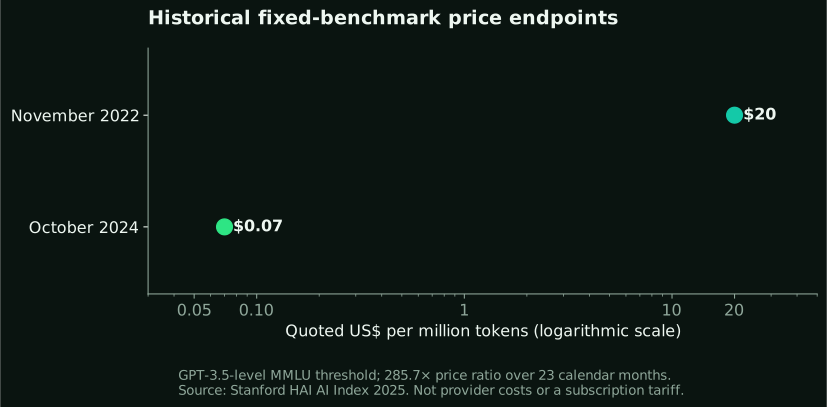
Stanford's AI Index reports that the cheapest quoted price meeting a GPT-3.5-level MMLU threshold fell from $20 per million tokens in November 2022 to $0.07 in October 2024. The ratio is approximately 285.7. These dated endpoints are 23 calendar months apart; the summary page's “18 months” wording is not repeated here. This is a benchmark-qualified price comparison, not a record of any provider's internal production cost. [39]
Epoch's September 2026 analysis extends the question to fixed benchmark performance with reasoning budgets included. It estimates an average cost decline of approximately 47% per quarter, while warning about benchmark gaming, noisy data, aggregation and the idealised ability to keep switching to the cheapest model. It is research evidence about a frontier, not a promise of retail savings. [40]
More capable agents may make more calls, read more context, reason longer and attempt repairs before producing one visible answer. The buyer can therefore see a short final response after a large amount of hidden computation. Falling cost for a fixed capability and rising expenditure on a more ambitious workflow can coexist. The practical question is whether the additional work produces enough verified value to justify its consumption.
3.4 University evidence that challenges easy conclusions
A 2024 MIT-linked meta-analysis of 106 experiments found that human–AI combinations improved on humans alone on average, yet underperformed the better standalone human or AI condition. Those are different comparisons. Its standardised effects cannot be relabelled as percentages, and much of the evidence predates the present generation of assistants. It argues for measuring the actual workflow, rather than assuming that adding human review automatically creates the best outcome. [41]
The final 2026 Organization Science paper on the “jagged technological frontier” adds a task-level warning. In its historical experiment with 758 consultants using 2023 GPT-4, AI increased completed tasks and reduced time for suitable work, but reduced correctness by 19 percentage points on a task outside that frontier. This is not a current-model benchmark. It shows why a more generous allowance cannot repair a mismatch between the tool and the task. [42]
Choice research also restrains the criticism of tier proliferation. Scheibehenne and colleagues' meta-analysis of 50 experiments found a virtually zero average choice-overload effect with substantial variation. More options alone are therefore not proof of harm. The concern in this paper is missing or unstable decision-relevant information, not simply the existence of several plans. [43]
4. Findings: the offers that can be verified
4.1 Monthly prices, with their currencies left intact
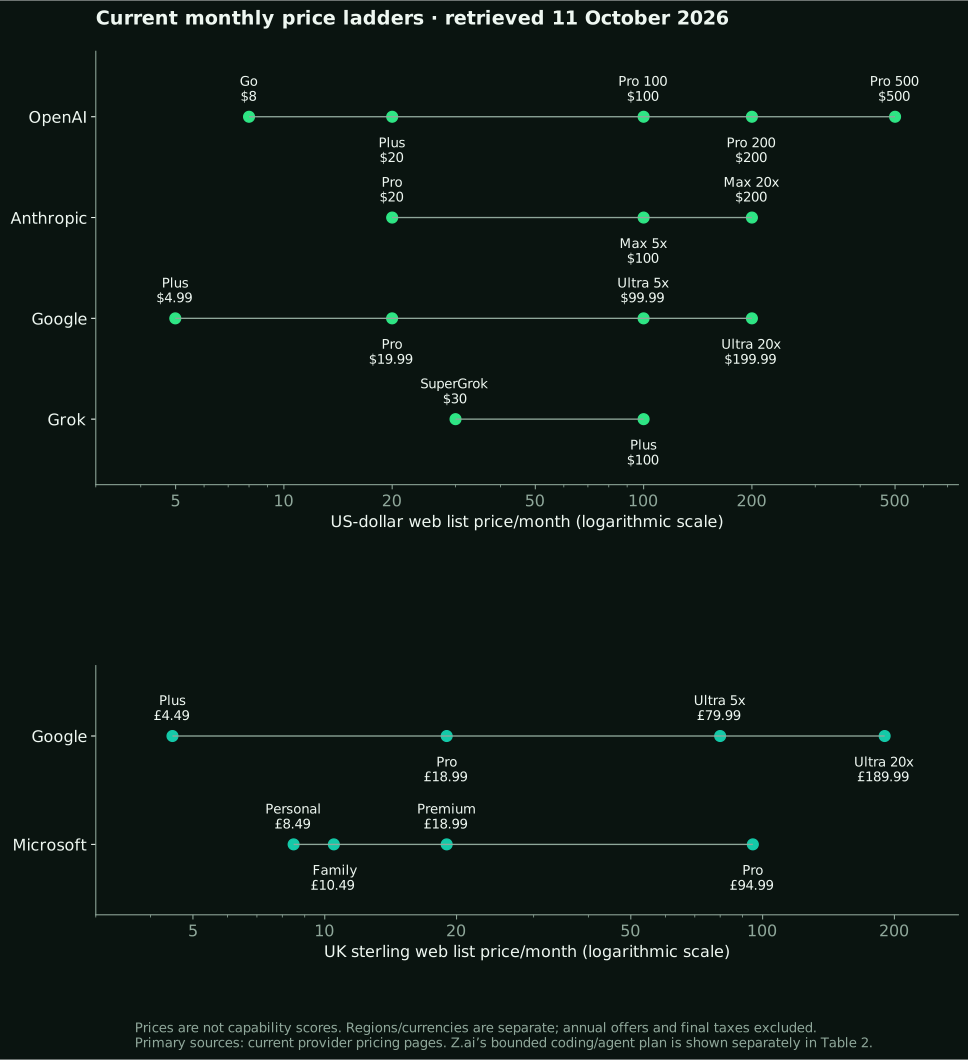
Table 1 is a tariff inventory. It is not a quality ranking, an endorsement, a checkout quotation or a claim that equally priced plans do the same work. Free access exists across the core providers, but the table concentrates on paid choice. Business and enterprise procurement require a separate review of seats, administration, data contracts and service commitments.
| Provider | Verified monthly list prices | Annual distinction or important boundary | Sources |
|---|---|---|---|
| OpenAI | Go $8; Plus $20; Pro $100, $200, $500 | Individual paid plans listed here are monthly; no annual option established for them. GBP checkout price not verified in this study. | [1][2][3] |
| Anthropic | Pro $20; Max 5x $100; Max 20x $200 | Pro $200 per year paid up front, equivalent to $16.67/month; $17 is the rounded headline. Max monthly. Applicable tax excluded on pricing page. | [5][6] |
| Google, US | AI Plus $4.99; Pro $19.99; Ultra 5x $99.99; Ultra 20x $199.99 | Pro also $199.99/year on Google One's US page. Other annual checkout arrangements not inferred. | [11][14] |
| Google, UK | AI Plus £4.49; Pro £18.99; Ultra 5x £79.99; Ultra 20x £189.99 | Direct UK published prices; regional eligibility remains relevant. | [12] |
| Microsoft, UK | 365 Personal £8.49; Family £10.49; Premium £18.99; Pro £94.99 | Annual Personal £84.99, Family £104.99, Premium £189.99; Pro monthly only. Office/cloud bundle rather than a stand-alone model tariff. | [16] |
| xAI / Grok | SuperGrok $30; SuperGrok Plus $100 | Lite and Heavy appear in the comparison, but their prices were not established by the primary pages retrieved. | [18] |
An upgrade should not be judged by price alone. Microsoft includes applications a customer might otherwise buy. Google includes other benefits whose value depends on eligibility and actual use. An API credit is valuable only to someone who can use that particular API entitlement. Treating every bundled item as cash saved exaggerates the value for a buyer who did not need it.
4.2 What the plans enable, and where capacity becomes hard to interpret
OpenAI's Plus documentation describes broader reasoning and tool access, voice, image creation, file analysis and research where available. API billing is separate. These capabilities suit varied work, but the documentation does not turn them into a guaranteed number of finished tasks. [1]
For Work and Codex, current documentation says Pro has no five-hour cap, though weekly limits may apply. Plus figures are task-dependent estimates. For supported modes, Fast uses 2.5× included capacity versus 2× purchased credits; Ultrafast uses 8× versus 6×. These are budget multipliers, not speed guarantees. [3]
The study does not generalise one reset rule across all ChatGPT plans or treat every chat, voice and agent activity as one universal pool.
Claude Pro and Max cover document work, projects, coding and longer tasks. Its published usage rules combine five-hour and weekly limits; different app and Code surfaces share capacity. The Max 5x and 20x labels refer specifically to per-session capacity relative to Pro, rather than guaranteed monthly output. Model choice, effort and conversation complexity affect use. A second client does not create another allowance. [5][6][7]
Google's personal plans combine Gemini, research and selected Google-app or creative tools, with regional restrictions. Its published Gemini allowance is compute-based: five-hour refreshes operate within a weekly limit. Plus is described relative to the free baseline, Pro relative to that same baseline, and Ultra relative to Pro. A “20x” label here cannot be compared with Claude's “20x” as if both were units of electricity or equivalent completed work. [11][13]
Microsoft combines Copilot with Microsoft 365 applications. Its current help distinguishes feature caps from monthly AI credits, while the public offer often describes capacity qualitatively. Researcher and Analyst are associated with Premium and Pro. The current published terms reserve AI benefits for the subscription owner even where other application benefits can be shared. A six-person application bundle is not six independent AI subscriptions. [16][17]
Grok combines web and X search, voice, connectors and creative tools. Its FAQ describes a single paid weekly pool across products, weighted by computation, with a usage breakdown. Once included capacity is exhausted, top-ups or an upgrade are available. Auto top-up introduces another spending decision, so the subscription price need not be the complete monthly bill. The pool improves flexibility, but no universal task-to-budget conversion is established here. [18][19]
4.3 The strongest current example of a changed bargain
OpenAI's canonical Pro article says qualifying customers—those with an active Pro 200 subscription at some point from 22 September through 29 September 2026 at 10 am Pacific time—keep an earlier allowance through 29 October 2026 while their subscription is active, after which the included allowance decreases while the $200 monthly price remains. The retrieved documentation does not disclose an exact old-to-new quantity from which this paper could calculate a percentage reduction. A dramatic graph of the alleged cut would therefore be fabricated. [2]
The design criticism is narrower and stronger: a customer needs a before-and-after entitlement statement to evaluate an unchanged price. Saying that models are more efficient does not tell that customer whether their own workload will finish. Efficiency is a supplier-side explanation; task completion is the buyer's test.
Changes can also help customers. Anthropic's 6 May 2026 announcement described doubled Claude Code five-hour limits and the removal of peak-hour reductions for Pro and Max. Historical direction alone does not establish today's quota, but it rebuts the idea that every change is a hidden reduction. The relevant standard is equally clear notice for improvements and restrictions. [10]
4.4 The multiple-credit problem
Claude Max now includes $100 or $200 in monthly API credits, subject to eligibility and linking. These expire at the billing-cycle boundary and cannot cover interactive Claude Code or app overages. Paid usage credits for those surfaces are separate. A customer can therefore hold a positive API credit balance and still be stopped—or charged extra—in the interface they actually use. [8][9]
OpenAI's purchased credits likewise cover eligible features and do not constitute an unrestricted API balance or unlock every model. Google distinguishes Gemini allowances from credits used by particular creative or development products. Grok distinguishes included weekly capacity from extra usage credit. This is a family of accounting boundaries, not one interchangeable commodity called a token. [4][15][19]
The right correction is a clear balance sheet inside the product: which meter applies here, what remains, when it resets, where purchased funds can be spent and what they cannot buy. The customer should not have to discover the boundary after funding the wrong ledger.
5. The Chinese extension: lower price anchors, different contracts
Chinese providers widen the choice, but a fair comparison must identify the product. Z.ai sells a bounded plan usable in supported agents, including coding and office scenarios. DeepSeek's consumer assistant and developer API are separate. Alibaba distinguishes its Qwen assistant from Model Studio inference. A coding-client-compatible plan does not buy the models or subscription of the company whose client it supports. [20][22][27][29]
| Z.ai GLM Coding Plan | Month-to-month USD | Annual-effective USD/month displayed | Five-hour credits | Weekly credits |
|---|---|---|---|---|
| Lite | $18 | $12.60 | 2,000 | 10,000 |
| Pro | $80 | $56.00 | 12,000 | 60,000 |
| Max | $168 | $117.60 | 28,000 | 140,000 |
Table 2 combines the subscription page and official usage overview. Annual-effective prices are not monthly cancellable offers; collection timing and final tax treatment were not independently verified at checkout. [20][21]
Z.ai is instructive because it publishes an explicit relationship between tokens and credits. For GLM-5.3, the model formula weights uncached input by 6.9, cached input by 1.7 and output by 24, then divides by 10,000. Model credits are halved off peak. Both session and weekly caps apply; supported tools share the quota. The published token-budget illustrations assume high cache-hit rates, so they are not fixed entitlements. [21][22]
Consider an arithmetic example, excluding tools: 100,000 uncached input tokens and 10,000 output tokens cost 93 credits at the standard rate. If 90,000 of the input tokens are cached and only 10,000 are uncached, the same output costs 46.2 credits. Those results follow the disclosed formula; they are not measured averages or promises about how many tasks a customer can finish. The example explains why “the same amount of text” can consume a different allowance. [21]
The July 2026 Z.ai change notice also preserves distinctions between older prompt-based plans and new credit plans. Quoting a legacy prompt allowance beside a new price produces a comparison that no actual customer necessarily receives. General-purpose API use is restricted separately from the subscription's supported-agent scope. [23][24]
DeepSeek's official consumer-app launch described free access, while its current API charges separately for cached input, uncached input and output, with peak and off-peak rates. Qwen's consumer offer is also distinct from its paid cloud API. These free surfaces matter to occasional users, but no fixed universal free-chat quota or independent quality parity is established by this study. Production API traffic should not be assumed free because a chat interface is free. [26][27][29][30]
Jurisdiction must be checked by product rather than nationality. DeepSeek's consumer policy describes processing and storage in China. Z.ai's international policy and Qwen's current international policy describe Singapore arrangements. These are published policies, not an audit of every subcontractor. Alibaba also distinguishes storage region from inference scope; choosing an endpoint alone does not prove all inference occurs in that region. [28][25][31][32]
For a small firm, that means adding confidentiality, permitted use, region and retention to the purchase checklist. Lower price is useful; it is not a substitute for those requirements. The commercial inference is that alternative packages may put pressure on expensive incumbents' price anchors. The data here do not reveal the challengers' unit margins, establish universal interchangeability or prove that either business model is profitable.
6. Where the design went wrong
6.1 Selling access as though it answered a capacity question
The first problem is the gap between a feature list and a service promise. “Can create presentations” describes access to a capability. “Can complete my weekly reporting workflow within the included allowance” describes capacity under particular conditions. The former is commonly advertised; the latter may require a trial where published terms do not establish it.
There is an understandable reason. Jobs vary. A reliable report with many sources may consume more than a casual summary. Still, uncertainty does not justify leaving the buyer with no useful estimate. Providers could publish ranges for disclosed reference workloads, including the share of attempts that fail or require human repair. A range with a method is more honest than a confident “unlimited” impression qualified elsewhere by several interacting constraints.
The second problem is an unstable denominator. Relative allowance labels help within a provider's plans only if the baseline is clear and reasonably stable. They do not establish a physical quantity, a service level or a comparison across companies. A buyer should be able to inspect the baseline date, affected models, reset windows and known exclusions. Otherwise a multiplier lends the appearance of measurement without the information needed to reproduce it.
6.2 Hiding the expensive choice inside an easy button
Reasoning, speed and agency are increasingly choices about resources, not merely labels about quality. The current OpenAI schedule distinguishes allowance-consumption multipliers from purchased-credit rates. For the specified modes, a faster option can exhaust included capacity sooner even if it finishes in less wall-clock time. A label such as Fast is not a measured promise of a particular speed improvement. [3]
The criticism is not that speed should be free. Low latency can have real value. The missing step is a preview of the trade-off: approximate allowance effect, expected duration, alternative mode, and an agreed stop before a long run exceeds the user's budget. A hurried customer should not discover the price of urgency only through an unexpectedly depleted meter.
Similarly, an agent that keeps repairing its own mistakes can spend resources while appearing helpful. Providers and users need to distinguish productive iteration from unbounded retry. A visible checkpoint, saved intermediate result and resumable task protect both sides. They can reduce wasted computation as well as the irritation of starting again.
6.3 Making the customer learn the company's accounting system
Multiple ledgers can reflect legitimate technical differences. They become a product failure when the customer must understand internal routing before knowing which balance will be used. A top-up that applies to one activity but not another needs an exclusion shown at purchase and at the point of use. A family plan needs to say who receives AI access beside the price, not merely beside an explanation elsewhere.
The same care applies to changing plans. The customer's question is not just “what features are added?” It is “what entitlement disappears, what resets, and which funds survive?” A comparison should include downgrade and cancellation behaviour, existing-user cohorts, renewal timing and any separate account linking. Without that, apparent simplicity at signup becomes complexity during ordinary use.
6.4 Mistaking willingness to pay for understanding
Some people want the latest model for enjoyment or experimentation. Others need a reliable production tool. Both uses can be legitimate, but a generic premium ladder treats them as if more sophistication were always the right answer. A sensible recommendation can be “use the free tier”, “keep the plan you already have”, or “pay for a bounded burst”.
This may reduce a short-term upgrade. It may also make the next paid decision more credible. There is no measured causal estimate here that transparency necessarily increases revenue. That claim needs a test. Providers should evaluate retention, support burden, completion quality and contribution together, rather than treating a larger renewal bill as evidence that the user's need has been met.
6.5 What government and regulator research adds
The UK Competition and Markets Authority's online-choice-architecture review distinguishes how choices are structured, explained and pressured. Its work on complex language helps explain why a condition can be technically disclosed yet easily missed. ASIC and the Dutch AFM likewise caution that more disclosure does not necessarily improve financial decisions. These are evidence reviews and financial-services research, not findings of unlawful conduct by the AI providers compared here. [54][55]
Their useful implication is a comprehension test. Before and after a redesign, ask customers to identify the applicable allowance, the next reset, the effect of a mode switch, the beneficiary in a family bundle and the maximum extra bill. Measure correct answers and actual behaviour. A longer help page is not a sufficient remedy if customers still cannot answer those questions.
The UK government's April 2026 subscription-contract response estimates £1.6 billion a year spent on unwanted subscriptions across the wider subscription economy. That is not an AI-specific loss estimate. It anticipates commencement of the new regime in spring 2027; this paper does not describe those prospective provisions as already in force at its cutoff. The policy focus on information, reminders and exit is relevant to a subscription's whole lifecycle, without determining a legal finding about any plan here. [56]
6.6 The strongest counter-argument
A subscription supplier cannot promise a fixed number of successful outcomes when customers bring unpredictable tasks, files and expectations. Publishing every weighting can encourage exploitation. Strong models and fast responses can cost more than a routine answer, and a flat fee distributes that uncertainty across customers. These are serious objections to a simplistic demand for unlimited use or identical quotas.
They do not defeat the proposal made here. A provider can disclose ordinary scope and reference workloads without promising success or revealing abuse controls. It can state that an estimate is uncertain, offer an upper spending bound, and preserve work when capacity runs out. The customer does not need a guarantee that every task will succeed. The customer needs enough information to choose deliberately and avoid an unexpected financial commitment. The contract can recognise uncertainty instead of making the buyer discover it through interruption.
7. Which subscription fits which user?
A useful decision starts with recurring work, not prestige. Table 3 offers a testing order, not an objective ranking. The capabilities are documented; the suitability judgements are the paper's analysis and require a personal trial.
| User need | Sensible first test | Evidence to record before paying more |
|---|---|---|
| Occasional questions, light drafting or learning | Existing free access, including eligible DeepSeek or Qwen surfaces | Accuracy, correction time, interruptions, confidentiality and ease of cancelling any trial |
| Varied documents, research and spreadsheets | A modest general-purpose paid tier; compare ChatGPT, Claude and Gemini on the same task class | Whether the entire document workflow finishes, source reliability, export quality and human checking time |
| Work mostly inside Word, Excel, PowerPoint or Outlook | Existing Microsoft 365 entitlement before buying another assistant | Actual app integration, owner-only AI eligibility, relevant agent limits and duplication of software already paid for |
| Repeated agentic coding or office automation | Compare included agent capacity and a supported Z.ai plan separately | Correctness, permission boundaries, both reset windows, context consumption, retries and compatibility with the required model |
| Creative video, imagery or voice | The product's specific media allowance, rather than its general chat price | Cost per usable asset, resolution, duration, failed generations and the applicable extra-credit ledger |
| All-day intensive or business-critical work | A measured higher-tier or business procurement trial | Peak reliability, capacity distribution, data contract, administration, spending stop and recovery from interrupted tasks |
Run a small trial before annual commitment. Choose five to ten recurring task types and set acceptance rules in advance: what counts as a correct answer, usable spreadsheet or safely tested code? Record failures. Count active human review and rework separately from waiting time. Retain the model, mode and date, since a later update can alter both quality and consumption. Do not compare one plan on easy tasks and another on the hard leftovers.
For a month's measured workload, define cost per verified completion as:
V = (P + A + wH/60) / Q
Here P is the subscription charge, A authorised additional usage, w the chosen hourly value of human review, H total review and rework minutes, and Q outputs passing the agreed rubric. Failed attempts belong in the workload; if Q is zero, the ratio is undefined rather than zero. Calculate it separately for comparable task classes, or hold the task mix fixed. A count of unlike passing outputs is not value-adjusted. Review time is a chosen opportunity cost, not necessarily cash expenditure; do not double-count overlapping active review when several tasks run concurrently. This measure should sit beside quality and total output, not replace them.
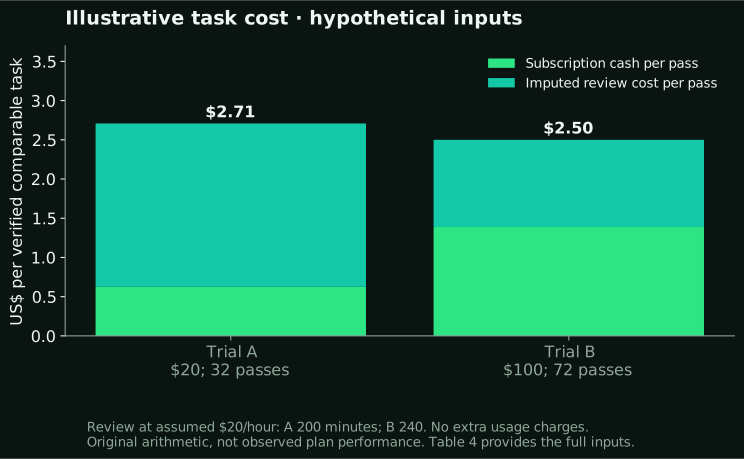
Table 4 is purely illustrative. It assumes comparable task classes and is not a test of the providers in Table 1.
| Assumed monthly trial | Subscription | Attempts / verified passes | Review minutes at $20/hour | Cash per pass | Total cost per pass |
|---|---|---|---|---|---|
| Trial A | $20 | 40 / 32 | 200 | $0.63 | $2.71 |
| Trial B | $100 | 80 / 72 | 240 | $1.39 | $2.50 |
Under these invented inputs, the dearer plan has a slightly lower total cost per passing output, yet the cheaper one has lower cash cost per output. Different review time or workload can reverse the result. A customer unable to use the larger output volume should not pay for it merely because this illustration makes it look efficient.
8. A bargain that can serve customers and pay its way
8.1 Publish the entitlement before collecting the money
A common disclosure statement should have two layers. The first should answer plain questions: who is the plan for, what is included, how much ordinary work it is intended to support, what happens at the limit and how much the bill can grow? The second should expose the technical detail: model and tool scope, weighted units, session and weekly resets, priorities, credit expiry and exclusions.
A useful reference workload should disclose context size, output length, reasoning mode, tools, cache assumptions and task quality. Report a distribution rather than a single reassuring average. A heavy user needs to know the chance of interruption; a light user needs to know whether the free tier already meets the need. Reference tasks are estimates under conditions, not guarantees about every request.
Before a costly action, the product should offer a budget estimate or upper bound, say when it cannot estimate reliably, and request a cap. Automatic top-ups should be an affirmative choice with a visible ceiling. Separate ledgers should remain separate in the display. A buyer must be able to disable further purchases without disabling access already paid for.
Material changes should include a dated before-and-after comparison and a usable exit route. Legacy cohorts need explicit treatment. Failed or interrupted work should have a documented charging policy, with saved checkpoints where possible. Abuse prevention can remain effective without concealing ordinary entitlement arithmetic; publishing a budget rule does not require revealing every detection threshold.
8.2 Charge for expensive work without making every customer an engineer
One promising design is stable basic access plus deliberately budgeted intensive work. Routine tasks can use a less expensive route, with the reason for escalation shown when a stronger or faster route is proposed. Customers should be able to reject the upgrade or choose to wait. A provider should not claim a cheap route is equivalent if it fails the task's acceptance criteria.
This proposal does not require a single model or a single pricing unit. It requires the unit to become visible when it affects a choice. Business users may prefer granular metering; households may prefer a spending envelope. Either can be sustainable if the provider understands the workload distribution and prices it honestly.
The economics are straightforward to state and difficult to estimate without private data. Let monthly contribution per subscriber be m = P − C − F, where P is recognised revenue net of taxes, discounts and refunds, C variable serving cost and F other variable account, payment and support costs, including refund-processing fees but excluding amounts already deducted from P. Contribution still has to cover research, training, fixed staff, capital commitments and financing. It is not net profit.
API list prices are prices charged to API customers. They are not a measurement of C. Using them to calculate a provider's subscription margin would substitute a retail tariff for an undisclosed production cost. The same error occurs when company-wide compute spending is divided by consumer subscribers, despite expenditure on training, API customers and other products.
8.3 Efficiency, workload and retention can pull in opposite directions
In an illustrative case, set P = $20, C = $10 and F = $2: contribution is $8. If unit serving cost falls 10% but workload rises 50%, C becomes $13.50 and contribution falls to $4.50. The efficiency improvement does not protect the margin because use grows faster. These are assumed inputs, not disclosed company results.
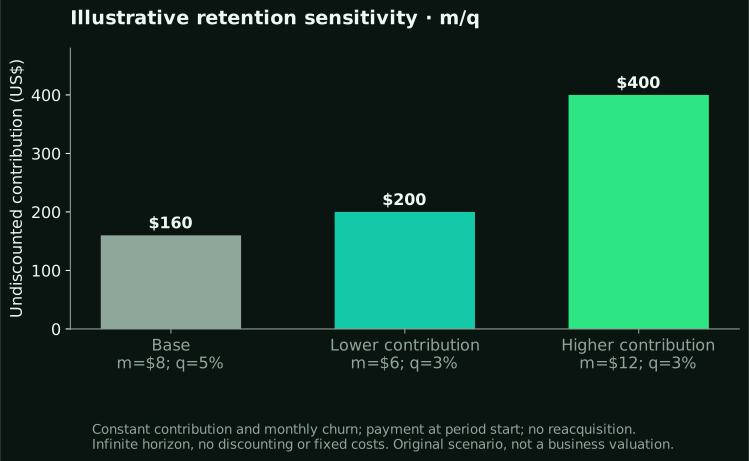
Retention can work the other way. With a constant monthly cancellation rate q, stable contribution m, no reacquisition and payment at the start of each period, undiscounted contribution per initial customer is m/q. This simple geometric model is not a valuation of a business. It excludes acquisition, discounting, changing behaviour and fixed costs.
Suppose a service contributes $8 a month with 5% monthly churn: the model yields $160 per initial customer. A different service contributing $12 with 3% churn yields $400. A more generous hypothetical service with contribution reduced to $6 but churn reduced to 3% yields $200: lower contribution is offset in this model. It need not win quickly; a longer retention tail can take years to outweigh the lower early contribution. Nothing here establishes that clearer subscriptions cause those changes. The point is that margin and retention must be examined together. A provider can lose by giving away too much computation, or by conserving computation so aggressively that useful customers leave.
The proposed empirical test is therefore broader than renewal revenue. Randomise eligible disclosure or pricing treatments, with protection for existing contracts. Predefine task success, interruption frequency, complaints, refunds, support cost, paid conversion, retention and contribution. Monitor heavy and light users separately. Publish the method and distribution. A favourable average can hide poor reliability precisely where a user most needs the service.
9. IPOs: subscription design is a risk channel, not an explanation for every problem
9.1 What has actually been announced
Anthropic announced a confidential draft S-1 submission on 1 June 2026; OpenAI announced one on 8 June. Neither announcement confirms a completed listing or fixes an offer price. Reuters reported in September that Sam Altman said OpenAI would not list in 2026. Later reporting described timetable changes. This paper does not manufacture a firm listing date or a forecast of opening-day returns. [47][48][49]
The study has not independently inspected either company's publicly filed audited IPO statements. Financial numbers from a confidential prospectus are therefore identified as Reuters reporting of that document. Corporate announcements are identified as company disclosures. This distinction matters when precise-looking numbers circulate more rapidly than the documents needed to interpret them.
9.2 Revenue quality matters more than a dramatic headline
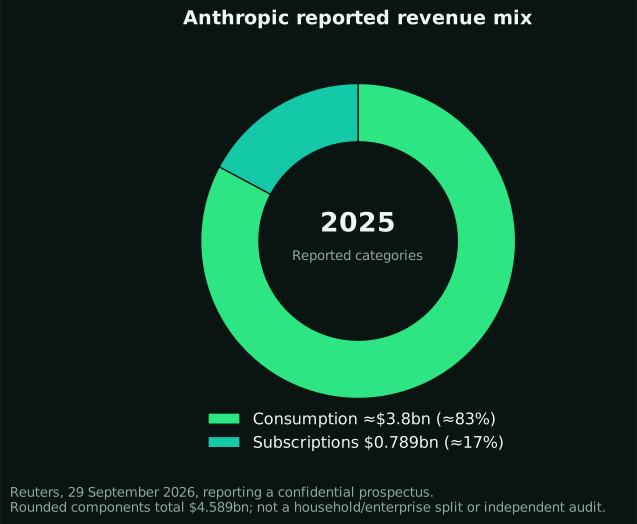
Reuters reported Anthropic's 2025 revenue at nearly $4.6 billion, including approximately $3.8 billion of consumption revenue and $789 million of subscriptions. Those categories are roughly 83% and 17% of their rounded sum. They are not a household-versus-enterprise split. The reported mix prevents consumer-plan complaints from being treated automatically as the dominant source of company-wide financial risk. [50]
Anthropic's own announcements give point-in-time annualised run-rate milestones: approximately $9 billion at the end of 2025, more than $30 billion in April 2026 and more than $47 billion earlier in May. Those are different quantities from revenue recognised during a complete year. They should not be placed on a chart as if they were annual sales, or connected to a made-up future trajectory. [51][52]
Reuters' October reporting describes OpenAI's September annualised metric near $50 billion after an earlier comparison figure near $70 billion. The reported explanation concerns comparison and channel-accounting definitions. It is not evidence that $20 billion of recognised revenue disappeared, or proof that demand collapsed. An investor needs a reconciliation, not a slogan about a fall. [53]
9.3 The immediate post-listing question
If an offering proceeds, unclear subscriptions could affect the credibility of forecast revenue through cancellations, refunds, support expense or difficulty retaining customers after a price or quota change. A sudden restriction could invite questions about capacity and margins. These are plausible mechanisms derived from the business model, not measured effects on either company's stock price.
The effect could also be small relative to enterprise consumption, distribution partnerships, training costs, financing and competitive conditions. Investor reaction is conditional on what was expected, what was disclosed and what subsequently changes. A paper cannot assign a numerical IPO discount to dissatisfaction without actual retention, revenue and market data.
Nor does this research establish that subscription confusion caused an IPO delay. Safety, governance, financing and market considerations appear in the reporting and must remain separate. Claiming an immediate listing failure from customer frustration would turn a legitimate concern into an unsupported causal story.
9.4 Long-term viability requires better disclosure on both sides of the meter
Investors should ask for cohort retention, product contribution, channel concentration, realised versus annualised revenue, refund and dispute rates, capacity utilisation and cash commitments. Consumer subscriptions, enterprise seats and metered consumption should be separated. Accounting for partner distribution should be reconciled consistently before comparing competitors.
The critical long-term test is whether useful workloads generate enough durable revenue to pay for serving them and for the wider enterprise. A higher average bill can conceal weaker retention. More tokens can conceal unsuccessful retries. Strong adoption can coexist with a weak cash position. Neither subscriber counts nor technical benchmark scores answer the profitability question on their own.
A transparent product does not remove capital risk, but it makes one part of the revenue promise testable. That can help investors distinguish a durable paid habit from introductory enthusiasm. The provider benefits too: it learns whether customers value the actual service envelope rather than the expectation created by an attractive headline.
9.5 Institutional research: capital, consumption and the quality of demand
The Bank of England's July 2026 Financial Stability Report makes a direct connection to this paper's topic: longer reasoning and some agentic workflows can require larger input and output token volumes, increasing usage costs and making widespread adoption harder. Capability may precede dependable revenue. That observation supports compute-aware pricing; it does not justify an undisclosed change in an existing customer bargain. [57]
The FTC's January 2025 cloud-partnership study describes investment interests, spending commitments and potential switching costs involving the major cloud suppliers and OpenAI or Anthropic. Its evidence has an earlier cutoff and is not a legal finding of misconduct. It helps explain why the upstream commercial system matters when assessing consumer prices. [58]
BIS Bulletin 137, published on 1 October 2026, documents overlapping investment and commercial relationships among AI firms. Its study identifies commercial relationships in 16.1% of AI-to-AI investment deals by count and 46.4% by disclosed deal value. These are different denominators. They are not estimates of fictitious revenue or proof that every such arrangement is harmful. Financing can help secure scarce inputs while also making the independence of end-user demand harder to interpret. [59]
Financial institutions offer conflicting emphases rather than a single agreed forecast. Table 5 records their evidence types. Public summaries were read; unavailable proprietary underlying analyses are not claimed as inspected.
| Publication | Finding or argument | Evidence type and boundary |
|---|---|---|
| Goldman Sachs Global Institute, May 2026 | $7.6 trillion baseline cumulative infrastructure capital for 2026–2031 | Explicit scenario, not spending already observed or a forecast; depends on architecture, facilities, replacement and power assumptions. [60] |
| Goldman Sachs Research, May 2026 | Agent adoption could drive 24-fold monthly token-use growth to 120 quadrillion by 2030 | Analyst forecast using simulated workflows and adoption extrapolation; activity is not proven useful output or subscription demand. [61] |
| J.P. Morgan Asset Management, January 2026 | Highlights the gap between infrastructure monetisation and application economics | Public strategist analysis; its cited proprietary return-hurdle calculation was not inspected and is not used as measured provider cost. [62] |
| Morgan Stanley, September 2026 | Emphasises implementation, governance and workflow investment in adoption | Public transcript-based analysis and interpretation; corporate statements are not audited causal savings. [63] |
| BlackRock Investment Institute, September 2026 | Connects the build-out to capital and refinancing pressures | Asset-manager outlook with disclosed methods and proxies, not neutral proof of any subscription's margin. [64] |
The optimistic and cautious accounts can both be partly right. Hardware suppliers can receive substantial payments while application suppliers are still discovering viable economics. Agents can increase activity while some tasks fail to deliver value. Better workflow design can produce benefits while raising implementation costs. Aggregating these layers into one number called “the AI market” conceals the cash flows the investor needs to examine.
The link to IPO analysis is conditional. If unclear entitlements weaken paid retention, a capital-intensive provider may have less predictable revenue to meet commitments. If credible task benefits and durable willingness to pay emerge, the investment can be supported. The institutional evidence does not assign either path a probability or establish that subscription confusion explains a named company's financing decisions.
10. Past, present and future: what to expect without inventing a forecast
The historical shift is from a relatively simple premium chat offer towards multiple models, tools, tiers and meters. OpenAI's February 2023 Plus launch advertised $20 a month. Its December 2024 Pro launch advertised $200 and specified-model unlimited access. Google's May 2025 Ultra launch advertised $249.99 in the US. Today's offers differ, so an old article can be accurate about its publication date and wrong as buying advice now. [44][45][46]
The present market has at least three competing packages: a broad assistant subscription; an application or storage bundle; and a bounded agent or metered API offering. Free consumer access and hosted or local open models add alternatives. There is no reason every user should converge on the highest tier, and no evidence here that one package dominates every workload.
For 2027–2030, three scenarios deserve watching. They are conditional paths, not probabilities or predicted revenues.
| Scenario | What would make it plausible | What customers and investors should measure |
|---|---|---|
| Clearer service envelopes | Better budget previews, consistent entitlement statements, resumable agents and measured reference workloads | Fewer disputes and interruptions, retention by cohort, useful task completion and contribution after support costs |
| Persistent complexity with optional overages | Growing model and tool variety, frequent cohort changes and several non-interchangeable credit balances | Effective bill distribution, misunderstood top-ups, support burden, heavy-user churn and success after spending caps |
| Price pressure and consolidation | Cheaper comparable capability, bundles subsidised by other businesses and increased use of alternative or local models | Actual task substitution, switching costs, margins by product, customer concentration and financing needs |
The first path is preferable, but it will not emerge from benevolent language alone. Providers need the economic incentive to make the offer understandable. Buyers need to reward verified usefulness rather than model prestige. Researchers and institutions can supply common measurement practices, while investors can ask for the missing cohort and cost disclosures.
None of these paths requires unlimited capacity. Predictable limits can be fairer than an unlimited impression followed by surprises. Nor does lower pricing alone prove better competition: a cheap product that is unreliable for the intended task may provide little value, while a bundle can make switching costly. Those effects have to be measured, not inferred from a price chart.
11. Limitations and unresolved questions
This is a public-source study with a time cutoff. Offers may change after retrieval. Search indexes and even official pages can be stale; current topic-specific pages are prioritised, and unresolved conflicts are retained in the research record. The study does not establish every regional checkout, legacy cohort, promotion, tax treatment or account rollout.
There is no universal cross-provider token budget. No hands-on test across all paid plans was performed, no representative subscriber survey was collected, and no customer complaints dataset establishes prevalence. Suitability suggestions are a testing framework. The critique concerns observable disclosure boundaries, not proof of intent, unlawful conduct or a measured industry-wide rate of dissatisfaction.
Academic results retain their original populations and versions. Institutional research can identify risks and model scenarios but cannot certify private provider costs. Company disclosures and confidential-prospectus reporting are not substituted for an audit. Actual subscription margins, inference costs, churn and causal IPO effects remain unknown in this evidence base.
Future scenario numbers are illustrative arithmetic. They are not presented as data about a real company, a predicted return or a recommended investment. The paper does not claim peer review, an academic degree for its author, or perfect verification. A durable correction process and dated evidence trail are part of rigorous publication, not admissions that accuracy is optional.
Appendix A. Documentation comparison, retrieved 11 October 2026
This is a reproducible map of the relevant accounting boundaries, not a consumer-comprehension score. Absolute guaranteed completed-task capacity was not established across the offers. Sources identify the product scope and retrieval date; gaps remain gaps.
| Offer examined | Relevant meters and reset rules | Boundary a buyer must check | Sources |
|---|---|---|---|
| ChatGPT Work / Codex | Shared agentic allowance; Pro currently no five-hour cap; weekly limits may apply | Eligible purchased-credit features differ from API billing and other ChatGPT surfaces | [3][4] |
| Claude Pro / Max | Shared app/Code use; five-hour session and weekly limits | Monthly API credits do not pay interactive overages | [7][8][9] |
| Gemini personal plans | Compute-weighted five-hour and weekly limits | Relative baseline, model/effort and separate feature-credit products | [13][15] |
| Microsoft individual plans | Feature caps and monthly AI credits | AI beneficiary, application and entry point; no fixed current universal credit count established | [17] |
| Grok paid plans | Shared weekly compute pool | Product weighting, extra-credit expiry and optional spending ceiling | [19] |
| Z.ai Coding Plan | Five-hour and weekly credit caps | Supported-client scope and shared quota; separate general API tariff | [22][24] |
| DeepSeek / Qwen consumer and API surfaces | Consumer free quotas not quantified here; API tariffs separate | Product-specific billing and privacy, model, region and use conditions | [26][27][29][30] |
12. Conclusion
AI subscriptions can create real value. The evidence also shows why a monthly price and a promising feature list are not enough to establish that value for a particular person. The buyer needs to know whether the work will finish, how much checking it will need and what happens when the allowance runs out.
Charging for computation is legitimate. The problem identified in this comparison is leaving the customer to translate a changing technical and accounting system into an ordinary purchase. The proposed correction is a visible contract: clear scope, dated entitlements, measured workload ranges, controlled escalation and a spending stop the user understands.
That contract can protect profits as well as users. It makes expensive work deliberate, reduces avoidable waste and gives retention a place beside margin. Whether it succeeds is an empirical question. Providers should test it, buyers should trial their actual work, and investors should demand reconciled revenue and cohort evidence rather than treating growth headlines as a substitute for sustainable economics.
Download the chart data (CSV). Historical observations, advertised prices, reported financial figures and hypothetical scenarios are labelled separately.
References
- [1] OpenAI (2026). What is ChatGPT Plus? Official documentation. Available at: https://help.openai.com/en/articles/6950777-what-is-chatgpt-plus (accessed 11 October 2026).
- [2] OpenAI (2026). About ChatGPT Pro tiers. Official documentation. Available at: https://help.openai.com/en/articles/9793128-about-chatgpt-pro-tiers (accessed 11 October 2026).
- [3] OpenAI (2026). Pricing: ChatGPT Work and Codex. Official documentation. Available at: https://learn.chatgpt.com/docs/pricing (accessed 11 October 2026).
- [4] OpenAI (2026). Using Credits for Flexible Usage in ChatGPT (Personal plans). Official documentation. Available at: https://help.openai.com/en/articles/12642688-using-credits-for-flexible-usage-in-chatgpt-personal-plans (accessed 11 October 2026).
- [5] Anthropic (2026). Claude plans and pricing. Official documentation. Available at: https://claude.com/pricing (accessed 11 October 2026).
- [6] Anthropic (2026). What is the Max plan? Official documentation. Available at: https://support.claude.com/en/articles/11049741-what-is-the-max-plan (accessed 11 October 2026).
- [7] Anthropic (2026). How do usage and length limits work? Official documentation. Available at: https://support.claude.com/en/articles/11647753-how-do-usage-and-length-limits-work (accessed 11 October 2026).
- [8] Anthropic (2026). Monthly API credits for Max and Team plans. Official documentation. Available at: https://support.claude.com/en/articles/17154008-monthly-api-credits-for-max-and-team-plans (accessed 11 October 2026).
- [9] Anthropic (2026). Manage usage credits for paid Claude plans. Official documentation. Available at: https://support.claude.com/en/articles/12429409-manage-usage-credits-for-paid-claude-plans (accessed 11 October 2026).
- [10] Anthropic (2026). Higher usage limits and a SpaceX compute deal. Company announcement. Available at: https://www.anthropic.com/news/higher-limits-spacex (accessed 11 October 2026).
- [11] Google (2026). Gemini subscriptions: United States. Official documentation. Available at: https://gemini.google/subscriptions/ (accessed 11 October 2026).
- [12] Google (2026). Gemini subscriptions: United Kingdom. Official documentation. Available at: https://gemini.google/gb/subscriptions/?hl=en-GB (accessed 11 October 2026).
- [13] Google (2026). Gemini Apps limits and upgrades for Google AI subscribers. Official documentation. Available at: https://support.google.com/gemini/answer/16275805?hl=en (accessed 11 October 2026).
- [14] Google (2026). Google AI plans with cloud storage: US plan calculator. Official documentation. Available at: https://one.google.com/about/google-ai-plans/ (accessed 11 October 2026).
- [15] Google (2026). Manage your AI credits with Google One. Official documentation. Available at: https://support.google.com/googleone/answer/16287445?hl=en (accessed 11 October 2026).
- [16] Microsoft (2026). Copilot pricing plans for individuals: United Kingdom. Official documentation. Available at: https://www.microsoft.com/en-gb/microsoft-365-copilot/pricing/individuals (accessed 11 October 2026).
- [17] Microsoft (2026). How AI usage works across Microsoft 365 subscriptions for individuals. Official documentation. Available at: https://support.microsoft.com/en-us/microsoft-365-copilot/ai-credits-and-limits-for-microsoft-365-subscriptions (accessed 11 October 2026).
- [18] xAI (2026). Grok plan pricing. Official documentation. Available at: https://x.ai/pricing (accessed 11 October 2026).
- [19] xAI (2026). FAQ: Grok website and apps. Official documentation. Available at: https://docs.x.ai/grok/faq (accessed 11 October 2026).
- [20] Z.ai (2026). Subscription plans: monthly and annual-effective selections. Official documentation. Available at: https://z.ai/subscribe (accessed 11 October 2026).
- [21] Z.ai (2026). GLM Coding Plan overview and credit formula. Official documentation. Available at: https://docs.z.ai/devpack/overview (accessed 11 October 2026).
- [22] Z.ai (2026). GLM Coding Plan FAQ. Official documentation. Available at: https://docs.z.ai/devpack/faq (accessed 11 October 2026).
- [23] Z.ai (2026). Plan update announcement. Official documentation. Available at: https://docs.z.ai/devpack/notice/usage-revision (accessed 11 October 2026).
- [24] Z.ai (2026). Subscriptions, fees and payment terms. Official documentation. Available at: https://docs.z.ai/legal-agreement/subscription-terms (accessed 11 October 2026).
- [25] Z.ai (2026). International privacy policy. Official documentation. Available at: https://docs.z.ai/legal-agreement/privacy-policy (accessed 11 October 2026).
- [26] DeepSeek (2026). Models and pricing. Official documentation. Available at: https://api-docs.deepseek.com/quick_start/pricing/ (accessed 11 October 2026).
- [27] DeepSeek (2025). Official consumer-app launch. Company announcement. Available at: https://www.deepseek.com/news/deepseek-app/ (accessed 11 October 2026).
- [28] DeepSeek (2026). Consumer privacy policy. Official documentation. Available at: https://cdn.deepseek.com/policies/en-US/deepseek-privacy-policy.html (accessed 11 October 2026).
- [29] Alibaba / Qwen (2026). Qwen consumer assistant. Official documentation. Available at: https://qwen.ai/ (accessed 11 October 2026).
- [30] Alibaba Cloud (2026). Model Studio model pricing. Official documentation. Available at: https://www.alibabacloud.com/help/en/model-studio/model-pricing (accessed 11 October 2026).
- [31] Qwen (2026). International privacy policy, effective 7 September 2026. Official documentation. Available at: https://qwen.ai/privacypolicy (accessed 11 October 2026).
- [32] Alibaba Cloud (2026). Model Studio regions and deployment scopes. Official documentation. Available at: https://www.alibabacloud.com/help/en/model-studio/regions (accessed 11 October 2026).
- [33] DellaVigna, S. and Malmendier, U. (2006). Paying Not to Go to the Gym. American Economic Review 96(3), 694–719. DOI:10.1257/aer.96.3.694. Peer-reviewed academic research. Available at: https://www.aeaweb.org/articles?id=10.1257/aer.96.3.694 (accessed 11 October 2026).
- [34] Lambrecht, A. and Skiera, B. (2006). Paying Too Much and Being Happy About It: Existence, Causes, and Consequences of Tariff-Choice Biases. Journal of Marketing Research 43(2), 212–223. DOI:10.1509/jmkr.43.2.212. Academic manuscript for peer-reviewed article. Available at: https://www.marketing.uni-frankfurt.de/fileadmin/Publikationen/Lambrecht_Skiera_Tariff-Choice-Biases-JMR.pdf (accessed 11 October 2026).
- [35] Brynjolfsson, E., Li, D. and Raymond, L.R. (2025). Generative AI at Work. Quarterly Journal of Economics 140(2), 889–942. DOI:10.1093/qje/qjae044. Final peer-reviewed journal article. Available at: https://danielle-li.github.io/assets/docs/GenerativeAIatWork.pdf (accessed 11 October 2026).
- [36] Noy, S. and Zhang, W. (2023). Experimental evidence on the productivity effects of generative artificial intelligence. Science 381, 187–192. DOI:10.1126/science.adh2586. Final publisher abstract indexed by NLM; full final article not retrieved. Available at: https://pubmed.ncbi.nlm.nih.gov/37440646/ (accessed 11 October 2026).
- [37] Becker, J., Rush, N., Barnes, B. and Rein, D. (2025). Measuring the Impact of Early-2025 AI on Experienced Open-Source Developer Productivity. METR. Research institute RCT report. Available at: https://metr.org/blog/2025-07-10-early-2025-ai-experienced-os-dev-study/ (accessed 11 October 2026).
- [38] METR (2026). We are Changing our Developer Productivity Experiment Design. Research institute methods update. Available at: https://metr.org/blog/2026-02-24-uplift-update/ (accessed 11 October 2026).
- [39] Stanford HAI (2025). AI Index: Research and Development, inference-price endpoints. University research synthesis. Available at: https://hai.stanford.edu/ai-index/2025-ai-index-report/research-and-development (accessed 11 October 2026).
- [40] Emberson, A. and Roodman, D. (2026). The plunging price of thought. Epoch AI. Research institute analysis. Available at: https://epoch.ai/publications/the-plunging-price-of-thought (accessed 11 October 2026).
- [41] Vaccaro, M., Almaatouq, A. and Malone, T. (2024). When combinations of humans and AI are useful: A systematic review and meta-analysis. Nature Human Behaviour 8, 2293–2303. DOI:10.1038/s41562-024-02024-1. Peer-reviewed meta-analysis. Available at: https://www.nature.com/articles/s41562-024-02024-1.pdf (accessed 11 October 2026).
- [42] Dell'Acqua, F. et al. (2026). Navigating the Jagged Technological Frontier: Field Experimental Evidence of the Effects of Artificial Intelligence on Knowledge Worker Productivity and Quality. Organization Science. DOI:10.1287/orsc.2025.21838. Final peer-reviewed article; historical 2023 experiment. Available at: https://pubsonline.informs.org/doi/10.1287/orsc.2025.21838 (accessed 11 October 2026).
- [43] Scheibehenne, B., Greifeneder, R. and Todd, P.M. (2010). Can There Ever Be Too Many Options? A Meta-Analytic Review of Choice Overload. Journal of Consumer Research 37(3), 409–425. DOI:10.1086/651235. Peer-reviewed meta-analysis. Available at: https://scheibehenne.de/ScheibehenneGreifenederTodd2010.pdf (accessed 11 October 2026).
- [44] OpenAI (2023). Introducing ChatGPT Plus. Historical company announcement. Available at: https://openai.com/index/chatgpt-plus/ (accessed 11 October 2026).
- [45] OpenAI (2024). Introducing ChatGPT Pro. Historical company announcement. Available at: https://openai.com/index/introducing-chatgpt-pro/ (accessed 11 October 2026).
- [46] Google (2025). Introducing Google AI Ultra. Historical company announcement. Available at: https://blog.google/products-and-platforms/products/google-one/google-ai-ultra/ (accessed 11 October 2026).
- [47] Anthropic (2026). Confidential draft S-1 submission to the SEC. Company announcement. Available at: https://www.anthropic.com/news/confidential-draft-s1-sec (accessed 11 October 2026).
- [48] OpenAI (2026). Confidential submission of draft S-1 to the SEC. Company announcement. Available at: https://openai.com/index/openai-submits-confidential-s-1/ (accessed 11 October 2026).
- [49] Reuters (2026). OpenAI's Altman won't do IPO this year, calls AI extinction risk unacceptable. Reputable financial reporting. Available at: https://www.reuters.com/legal/litigation/openai-ipo-will-not-happen-2026-amid-ai-safety-fears-altman-says-2026-09-12/ (accessed 11 October 2026).
- [50] Reuters (2026). Anthropic IPO prospectus lays bare deep dependence on Big Tech partners. Reporting from confidential prospectus; not independently inspected audited accounts. Available at: https://www.reuters.com/world/anthropic-ipo-prospectus-lays-bare-deep-dependence-big-tech-partners-2026-09-29/ (accessed 11 October 2026).
- [51] Anthropic (2026). Expands Google and Broadcom compute deal. Company-disclosed annualised run-rate milestones. Available at: https://www.anthropic.com/news/google-broadcom-partnership-compute (accessed 11 October 2026).
- [52] Anthropic (2026). Raises Series H funding. Company-disclosed annualised run-rate milestone. Available at: https://www.anthropic.com/news/series-h (accessed 11 October 2026).
- [53] Reuters (2026). OpenAI's September annualized revenue nears $50 billion, less than previously indicated, source says. Reputable financial reporting; informed source. Available at: https://www.reuters.com/business/openais-annualized-revenue-20-billion-less-than-previously-signaled-ft-reports-2026-10-08/ (accessed 11 October 2026).
- [54] CMA (2022). Evidence Review of Online Choice Architecture and Consumer and Competition Harm, CMA157. Government/regulator research. Available at: https://www.gov.uk/government/publications/online-choice-architecture-how-digital-design-can-harm-competition-and-consumers/evidence-review-of-online-choice-architecture-and-consumer-and-competition-harm (accessed 11 October 2026).
- [55] ASIC and AFM (2019). REP632: Disclosure—Why it shouldn't be the default. Financial-regulator research. Available at: https://download.asic.gov.au/media/5303322/rep632-published-14-october-2019.pdf (accessed 11 October 2026).
- [56] UK Department for Business and Trade (2026). Government response on implementation of the new subscription contracts regime. Government consultation response. Available at: https://www.gov.uk/government/consultations/consultation-on-the-implementation-of-the-new-subscription-contracts-regime/outcome/government-response-to-consultation-on-the-implementation-of-the-new-subscription-contracts-regime-web-accessible-version (accessed 11 October 2026).
- [57] Bank of England (2026). Financial Stability Report, July, printed p24. Central-bank financial-stability research. Available at: https://www.bankofengland.co.uk/-/media/boe/files/financial-stability-report/2026/financial-stability-report-july-2026.pdf (accessed 11 October 2026).
- [58] FTC (2025). Partnerships Between Cloud Service Providers and AI Developers: staff 6(b) report. Government staff study. Available at: https://www.ftc.gov/system/files/ftc_gov/pdf/p246201_aipartnerships6breport_redacted.pdf (accessed 11 October 2026).
- [59] Frost, J. et al. (2026). Circular relationships among AI firms. BIS Bulletin137. Central-bank research; disclosed-deal relationship analysis. Available at: https://www.bis.org/publications/bulletin-137-circular-relationships-among-ai-firms (accessed 11 October 2026).
- [60] Goldman Sachs Global Institute (2026). Tracking Trillions: The Assumptions Shaping the Scale of the AI Build-Out. Explicit institutional scenario; not a forecast. Available at: https://www.goldmansachs.com/insights/articles/tracking-trillions-the-assumptions-shaping-scale-of-the-ai-build-out (accessed 11 October 2026).
- [61] Goldman Sachs Research (2026). AI Agents Forecast to Boost Tech Cash Flow as Usage Soars. Public analyst interview; forecast. Available at: https://www.goldmansachs.com/insights/articles/ai-agents-forecast-to-boost-tech-cash-flow-as-usage-soars (accessed 11 October 2026).
- [62] J.P. Morgan Asset Management (2026). How is AI being monetized? Public strategist analysis. Available at: https://am.jpmorgan.com/us/en/asset-management/adv/insights/market-insights/market-updates/on-the-minds-of-investors/how-is-ai-being-monetized/ (accessed 11 October 2026).
- [63] Morgan Stanley (2026). Why the Biggest AI Opportunity Is Still Ahead. Public institutional transcript analysis and interpretation. Available at: https://www.morganstanley.com/insights/articles/ai-investing-ai-adoption-profit-opportunities (accessed 11 October 2026).
- [64] BlackRock Investment Institute (2026). Q4 Global Investment Outlook; views as of September. Investment-manager outlook. Available at: https://www.blackrock.com/corporate/insights/blackrock-investment-institute/outlook (accessed 11 October 2026).